

In this paper, Euclidean distance of image is used to replace Euclidean distance in
LTSA to reduce the dimension of hyperspectral data. Referring to N-FINDR endmember extraction algorithm [13], for nonlinear dimensionality reduction data, random
selection of p pixels spectral vector A 1 ; A 2 ; . . .; A p constitutes a simplex
SðA 1 ; A 2 ; . . .; A p Þ and calculates the volume of the simplex. Each pixel is used to replace
each currently selected spectral endmember in turn. If a substitution can obtain a larger
volume of the simplex, the substitution is retained as an effective substitution. Otherwise, it is eliminated as an invalid substitution, and finally, P endmembers are obtained.
4 Experimental Results
In this section, actual hyperspectral data is used to test the performance of the algorithm. The proposed algorithm is compared with the following two-dimensionality
reduction algorithms: PCA and LTSA. The data of dimensionality reduction is combined with N-FINDR endmember extraction algorithm to extract endmembers. The
performance of these three algorithms is evaluated by the accuracy of endmember
extraction.
4.1 AVIRIS Cuprite Data
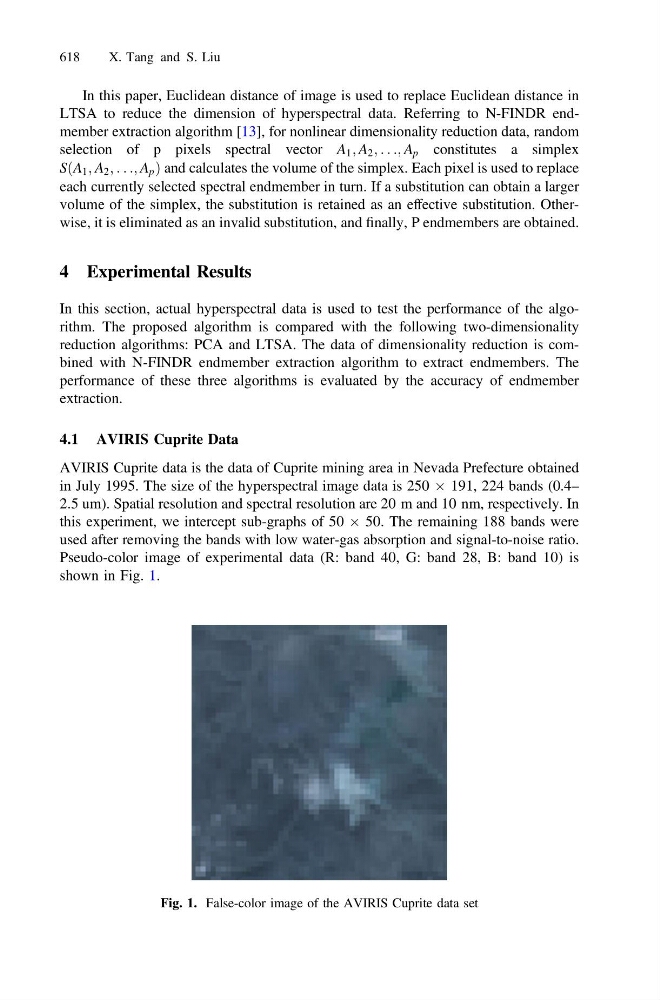
AVIRIS Cuprite data is the data of Cuprite mining area in Nevada Prefecture obtained
in July 1995. The size of the hyperspectral image data is 250 Â 191, 224 bands (0.4–
2.5 um). Spatial resolution and spectral resolution are 20 m and 10 nm, respectively. In
this experiment, we intercept sub-graphs of 50 Â 50. The remaining 188 bands were
used after removing the bands with low water-gas absorption and signal-to-noise ratio.
Pseudo-color image of experimental data (R: band 40, G: band 28, B: band 10) is
shown in Fig. 1.
Fig. 1. False-color image of the AVIRIS Cuprite data set
618
X. Tang and S. Liu