

used to align the local tangent space coordinates and the global low-dimensional
embedded coordinates by minimizing the local error shown in Formula (2).
E i ¼ min
L i 2R
dÂd
Y i I À
1
k
1 k 1
T
k
À L i H i
2
F
ð2Þ
3 Models and Methods
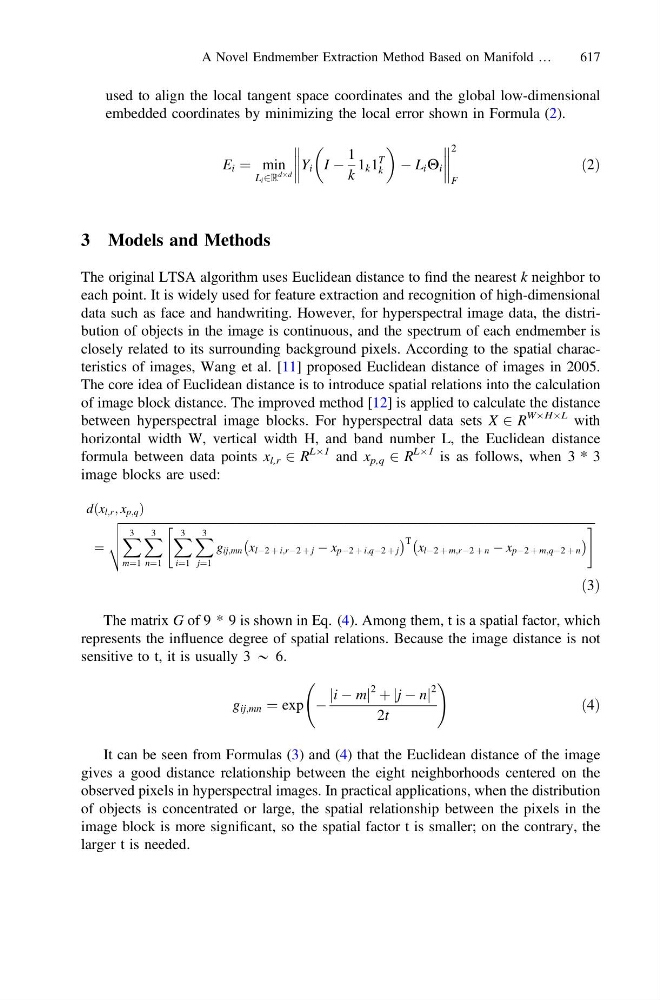
The original LTSA algorithm uses Euclidean distance to find the nearest k neighbor to
each point. It is widely used for feature extraction and recognition of high-dimensional
data such as face and handwriting. However, for hyperspectral image data, the distribution of objects in the image is continuous, and the spectrum of each endmember is
closely related to its surrounding background pixels. According to the spatial characteristics of images, Wang et al. [11] proposed Euclidean distance of images in 2005.
The core idea of Euclidean distance is to introduce spatial relations into the calculation
of image block distance. The improved method [12] is applied to calculate the distance
between hyperspectral image blocks. For hyperspectral data sets X 2 R
WÂHÂL with
horizontal width W, vertical width H, and band number L, the Euclidean distance
formula between data points x l,r 2 R
LÂ1 and x p,q 2 R
LÂ1 is as follows, when 3 * 3
image blocks are used:
dðx l;r ; x p;q Þ
¼
ffiffiffiffiffiffiffiffiffiffiffiffiffiffiffiffiffiffiffiffiffiffiffiffiffiffiffiffiffiffiffiffiffiffiffiffiffiffiffiffiffiffiffiffiffiffiffiffiffiffiffiffiffiffiffiffiffiffiffiffiffiffiffiffiffiffiffiffiffiffiffiffiffiffiffiffiffiffiffiffiffiffiffiffiffiffiffiffiffiffiffiffiffiffiffiffiffiffiffiffiffiffiffiffiffiffiffiffiffiffiffiffiffiffiffiffiffiffiffiffiffiffiffiffiffiffiffiffiffiffiffiffiffiffiffiffiffiffiffiffiffiffiffiffiffiffiffiffiffiffiffiffiffiffiffiffiffiffiffiffiffiffiffiffiffiffiffiffi ffi
X 3
m¼1
X 3
n¼1
X 3
i¼1
X 3
j¼1
g ij;mn x lÀ2 þ i;rÀ2 þ j À x pÀ2 þ i;qÀ2 þ j
À
Á T x lÀ2 þ m;rÀ2 þ n À x pÀ2 þ m;qÀ2 þ n
À
Á
"
#
v
u
u
t
ð3Þ
The matrix G of 9 * 9 is shown in Eq. (4). Among them, t is a spatial factor, which
represents the influence degree of spatial relations. Because the image distance is not
sensitive to t, it is usually 3 * 6.
g ij;mn ¼ exp À
i À m
j
j
2 þ j À n
j
j
2
2t
!
ð4Þ
It can be seen from Formulas (3) and (4) that the Euclidean distance of the image
gives a good distance relationship between the eight neighborhoods centered on the
observed pixels in hyperspectral images. In practical applications, when the distribution
of objects is concentrated or large, the spatial relationship between the pixels in the
image block is more significant, so the spatial factor t is smaller; on the contrary, the
larger t is needed.
A Novel Endmember Extraction Method Based on Manifold …
617