

(2) “Two sets of falling detection model”: A simple analysis of the data in “2. Model
Establishment Process” shows that the angular velocity is the physical quantity that
best describes the falling and the most accurate judgment of falling. Therefore, we
believe that angular velocity reaching the threshold is first when falling occurs.
During the actual test, it was found that the acceleration of the sliding fall was
greater than the acceleration of the forward fall. We theoretically analyze: Most of the
subjects subconsciously supported the ground in the forward fall, which alleviates the
impact. Thus, the acceleration was not big. Therefore, we put forward the idea of
“grouping judgment”: Under the premise of angular velocity characteristics, two sets of
acceleration judgments are made: One is when the pitch angle reaches the threshold,
and the acceleration reaches a relatively small threshold, it will be considered to have a
side fall or a back fall; the other is when the acceleration reaches a relatively large
threshold, it is considered to have a forward fall. And the “grouping judgment” optimizes the judgment model.
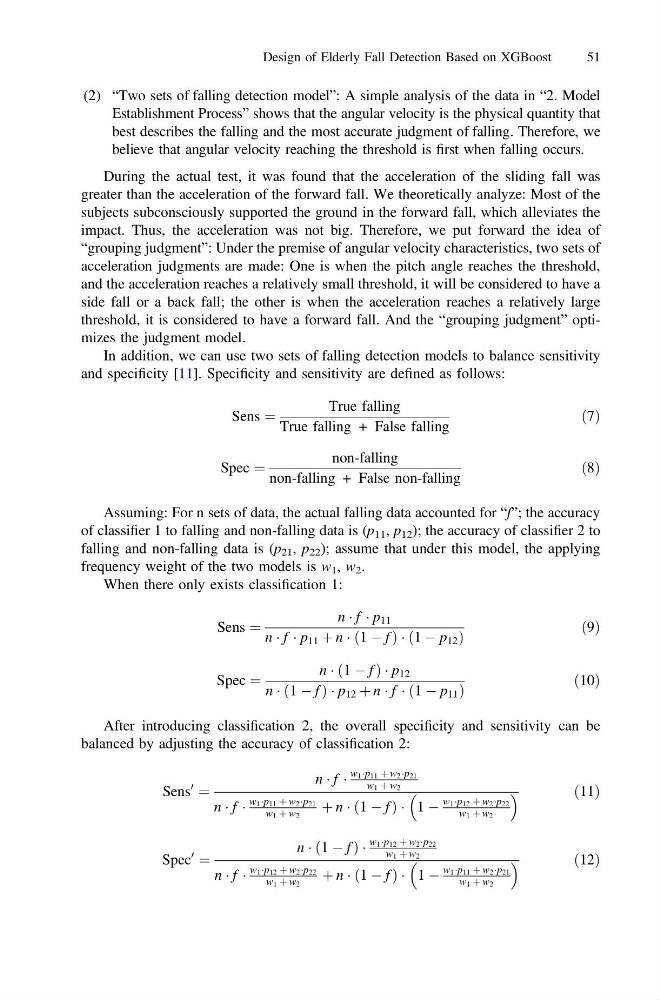
In addition, we can use two sets of falling detection models to balance sensitivity
and specificity [11]. Specificity and sensitivity are defined as follows:
Sens ¼
True falling
True falling + False falling
ð7Þ
Spec ¼
non-falling
non-falling + False non-falling
ð8Þ
Assuming: For n sets of data, the actual falling data accounted for “f”; the accuracy
of classifier 1 to falling and non-falling data is (p 11 , p 12 ); the accuracy of classifier 2 to
falling and non-falling data is (p 21 , p 22 ); assume that under this model, the applying
frequency weight of the two models is w 1 , w 2 .
When there only exists classification 1:
Sens ¼
n Á f Á p 11
n Á f Á p 11 þ n Á 1 À f
ð
ÞÁ 1 À p 12
ð
Þ
ð9Þ
Spec ¼
n Á 1 À f
ð
ÞÁp 12
n Á 1 À f
ð
ÞÁp 12 þ n Á f Á 1 À p 11
ð
Þ
ð10Þ
After introducing classification 2, the overall specificity and sensitivity can be
balanced by adjusting the accuracy of classification 2:
Sens
0
¼
n Á f Á
w 1 Áp 11 þ w 2 Áp 21
w 1 þ w 2
n Á f Á
w 1 Áp 11 þ w 2 Áp 21
w 1 þ w 2
þ n Á 1 À f
ð
ÞÁ 1 À
w 1 Áp 12 þ w 2 Áp 22
w 1 þ w 2
ð11Þ
Spec
0
¼
n Á 1 À f
ð
ÞÁ
w 1 Áp 12 þ w 2 Áp 22
w 1 þ w 2
n Á f Á
w 1 Áp 12 þ w 2 Áp 22
w 1 þ w 2
þ n Á 1 À f
ð
ÞÁ 1 À
w 1 Áp 11 þ w 2 Áp 21
w 1 þ w 2
ð12Þ
Design of Elderly Fall Detection Based on XGBoost
51
Establishment Process” shows that the angular velocity is the physical quantity that
best describes the falling and the most accurate judgment of falling. Therefore, we
believe that angular velocity reaching the threshold is first when falling occurs.
During the actual test, it was found that the acceleration of the sliding fall was
greater than the acceleration of the forward fall. We theoretically analyze: Most of the
subjects subconsciously supported the ground in the forward fall, which alleviates the
impact. Thus, the acceleration was not big. Therefore, we put forward the idea of
“grouping judgment”: Under the premise of angular velocity characteristics, two sets of
acceleration judgments are made: One is when the pitch angle reaches the threshold,
and the acceleration reaches a relatively small threshold, it will be considered to have a
side fall or a back fall; the other is when the acceleration reaches a relatively large
threshold, it is considered to have a forward fall. And the “grouping judgment” optimizes the judgment model.
In addition, we can use two sets of falling detection models to balance sensitivity
and specificity [11]. Specificity and sensitivity are defined as follows:
Sens ¼
True falling
True falling + False falling
ð7Þ
Spec ¼
non-falling
non-falling + False non-falling
ð8Þ
Assuming: For n sets of data, the actual falling data accounted for “f”; the accuracy
of classifier 1 to falling and non-falling data is (p 11 , p 12 ); the accuracy of classifier 2 to
falling and non-falling data is (p 21 , p 22 ); assume that under this model, the applying
frequency weight of the two models is w 1 , w 2 .
When there only exists classification 1:
Sens ¼
n Á f Á p 11
n Á f Á p 11 þ n Á 1 À f
ð
ÞÁ 1 À p 12
ð
Þ
ð9Þ
Spec ¼
n Á 1 À f
ð
ÞÁp 12
n Á 1 À f
ð
ÞÁp 12 þ n Á f Á 1 À p 11
ð
Þ
ð10Þ
After introducing classification 2, the overall specificity and sensitivity can be
balanced by adjusting the accuracy of classification 2:
Sens
0
¼
n Á f Á
w 1 Áp 11 þ w 2 Áp 21
w 1 þ w 2
n Á f Á
w 1 Áp 11 þ w 2 Áp 21
w 1 þ w 2
þ n Á 1 À f
ð
ÞÁ 1 À
w 1 Áp 12 þ w 2 Áp 22
w 1 þ w 2
ð11Þ
Spec
0
¼
n Á 1 À f
ð
ÞÁ
w 1 Áp 12 þ w 2 Áp 22
w 1 þ w 2
n Á f Á
w 1 Áp 12 þ w 2 Áp 22
w 1 þ w 2
þ n Á 1 À f
ð
ÞÁ 1 À
w 1 Áp 11 þ w 2 Áp 21
w 1 þ w 2
ð12Þ
Design of Elderly Fall Detection Based on XGBoost
51