

(3) Adjust the parameters related to the waypoint behavior (capture radius, slip
radius) and the relevant parameters of the guidance algorithm (lead distance, lead
damper) at a certain steering angle and a certain speed.
(4) Calculate the maximum drift distance of the waypoint for each experiment.
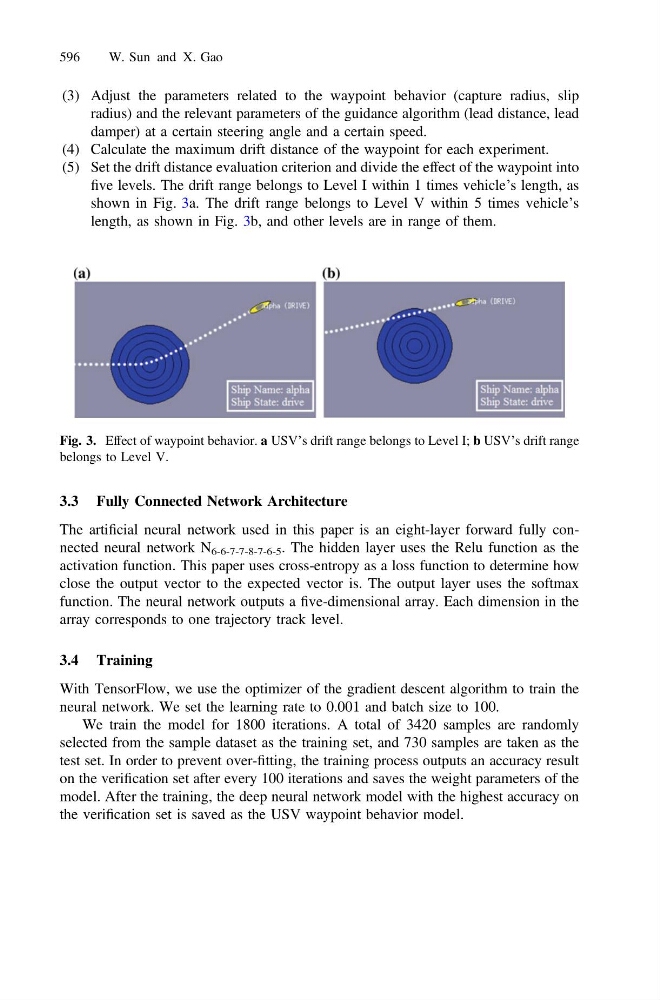
(5) Set the drift distance evaluation criterion and divide the effect of the waypoint into
five levels. The drift range belongs to Level I within 1 times vehicle’s length, as
shown in Fig. 3a. The drift range belongs to Level V within 5 times vehicle’s
length, as shown in Fig. 3b, and other levels are in range of them.
3.3 Fully Connected Network Architecture
The artificial neural network used in this paper is an eight-layer forward fully connected neural network N 6-6-7-7-8-7-6-5 . The hidden layer uses the Relu function as the
activation function. This paper uses cross-entropy as a loss function to determine how
close the output vector to the expected vector is. The output layer uses the softmax
function. The neural network outputs a five-dimensional array. Each dimension in the
array corresponds to one trajectory track level.
3.4 Training
With TensorFlow, we use the optimizer of the gradient descent algorithm to train the
neural network. We set the learning rate to 0.001 and batch size to 100.
We train the model for 1800 iterations. A total of 3420 samples are randomly
selected from the sample dataset as the training set, and 730 samples are taken as the
test set. In order to prevent over-fitting, the training process outputs an accuracy result
on the verification set after every 100 iterations and saves the weight parameters of the
model. After the training, the deep neural network model with the highest accuracy on
the verification set is saved as the USV waypoint behavior model.
Fig. 3. Effect of waypoint behavior. a USV’s drift range belongs to Level I; b USV’s drift range
belongs to Level V.
596
W. Sun and X. Gao