

3 Deep Learning for Waypoint Behavior of USV
The trajectory tracking control of USV is complex. There are two main reasons: Firstly,
different engines are installed in different vehicles, making it hard to use linear model
for converting speed and steering angle into throttle and rudder angle. And secondly,
the actual track of the vehicle is mighty affected by the wind and current, which is a
nonlinear effect. Traditional methods such as Lyapunov’s methods or passivity-based
theorems can only approximate rather than solve it fundamentally.
In addition, there are many factors in the implementation of waypoint behavior,
which belongs to the multi-dimensional vector space decision problem, and the
influence of various factors cannot be given through the linear or high-dimensional
space plane division. Therefore, by using the deep learning method to establish a deep
neural network model, the relationship between the trajectory tracking control and the
behavior parameters of the waypoint can be better mined. After training, the deep
neural network model has the ability to predict the trajectory tracking effect, that is, if
multi-dimensional feature is entered, the model can export the effect level for the
maneuvering decision of the USV and improve the track following performance.
3.1 Feature Selection
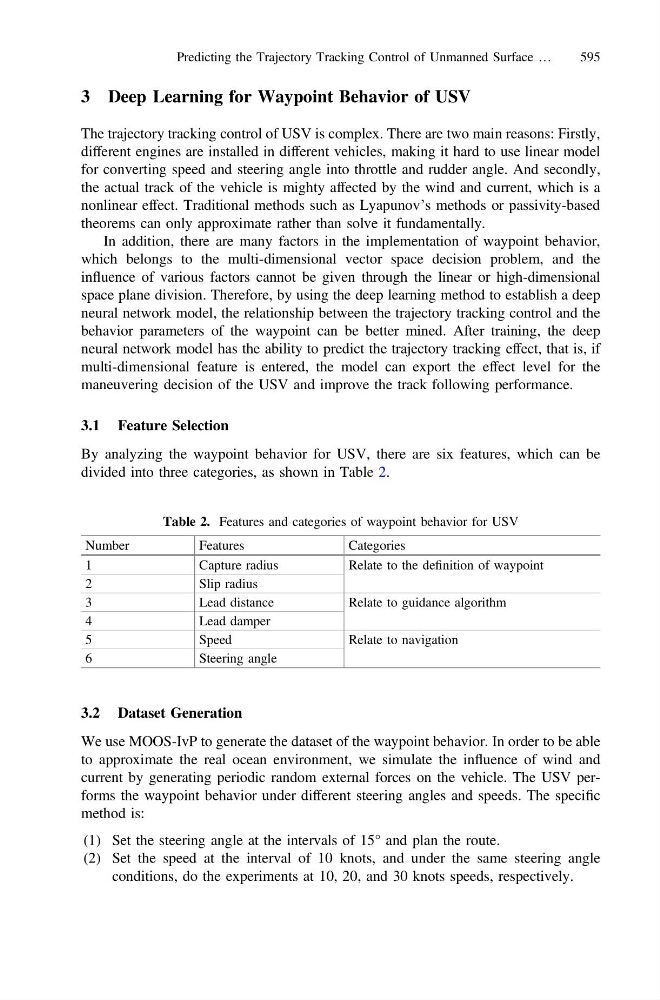
By analyzing the waypoint behavior for USV, there are six features, which can be
divided into three categories, as shown in Table 2.
3.2 Dataset Generation
We use MOOS-IvP to generate the dataset of the waypoint behavior. In order to be able
to approximate the real ocean environment, we simulate the influence of wind and
current by generating periodic random external forces on the vehicle. The USV performs the waypoint behavior under different steering angles and speeds. The specific
method is:
(1) Set the steering angle at the intervals of 15° and plan the route.
(2) Set the speed at the interval of 10 knots, and under the same steering angle
conditions, do the experiments at 10, 20, and 30 knots speeds, respectively.
Table 2. Features and categories of waypoint behavior for USV
Number
Features
Categories
1
Capture radius
Relate to the definition of waypoint
2
Slip radius
3
Lead distance
Relate to guidance algorithm
4
Lead damper
5
Speed
Relate to navigation
6
Steering angle
Predicting the Trajectory Tracking Control of Unmanned Surface …
595