

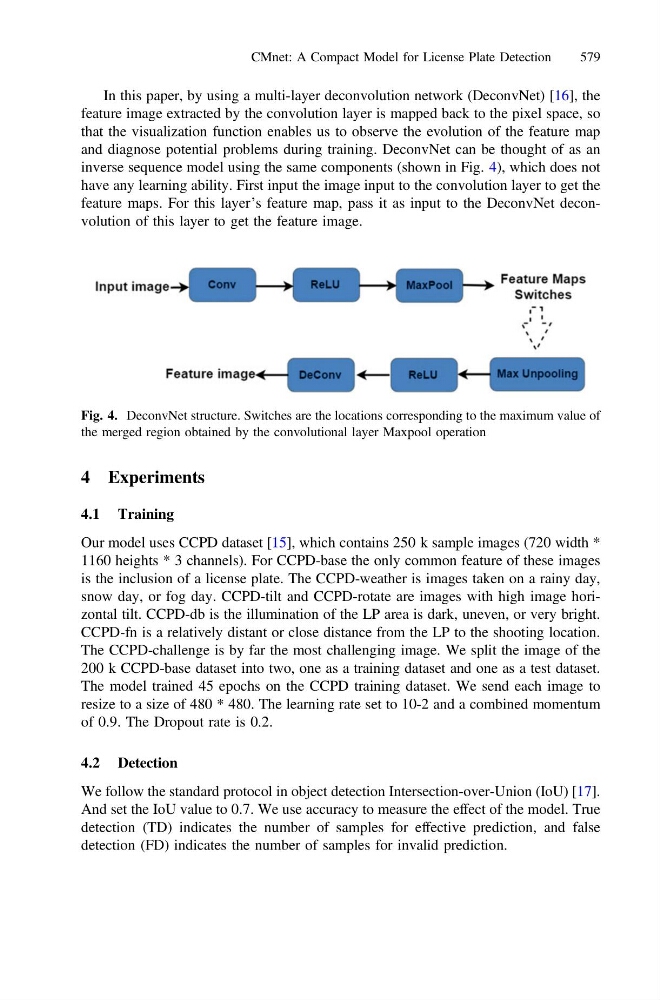
In this paper, by using a multi-layer deconvolution network (DeconvNet) [16], the
feature image extracted by the convolution layer is mapped back to the pixel space, so
that the visualization function enables us to observe the evolution of the feature map
and diagnose potential problems during training. DeconvNet can be thought of as an
inverse sequence model using the same components (shown in Fig. 4), which does not
have any learning ability. First input the image input to the convolution layer to get the
feature maps. For this layer’s feature map, pass it as input to the DeconvNet deconvolution of this layer to get the feature image.
4 Experiments
4.1 Training
Our model uses CCPD dataset [15], which contains 250 k sample images (720 width *
1160 heights * 3 channels). For CCPD-base the only common feature of these images
is the inclusion of a license plate. The CCPD-weather is images taken on a rainy day,
snow day, or fog day. CCPD-tilt and CCPD-rotate are images with high image horizontal tilt. CCPD-db is the illumination of the LP area is dark, uneven, or very bright.
CCPD-fn is a relatively distant or close distance from the LP to the shooting location.
The CCPD-challenge is by far the most challenging image. We split the image of the
200 k CCPD-base dataset into two, one as a training dataset and one as a test dataset.
The model trained 45 epochs on the CCPD training dataset. We send each image to
resize to a size of 480 * 480. The learning rate set to 10-2 and a combined momentum
of 0.9. The Dropout rate is 0.2.
4.2 Detection
We follow the standard protocol in object detection Intersection-over-Union (IoU) [17].
And set the IoU value to 0.7. We use accuracy to measure the effect of the model. True
detection (TD) indicates the number of samples for effective prediction, and false
detection (FD) indicates the number of samples for invalid prediction.
Fig. 4. DeconvNet structure. Switches are the locations corresponding to the maximum value of
the merged region obtained by the convolutional layer Maxpool operation
CMnet: A Compact Model for License Plate Detection
579