

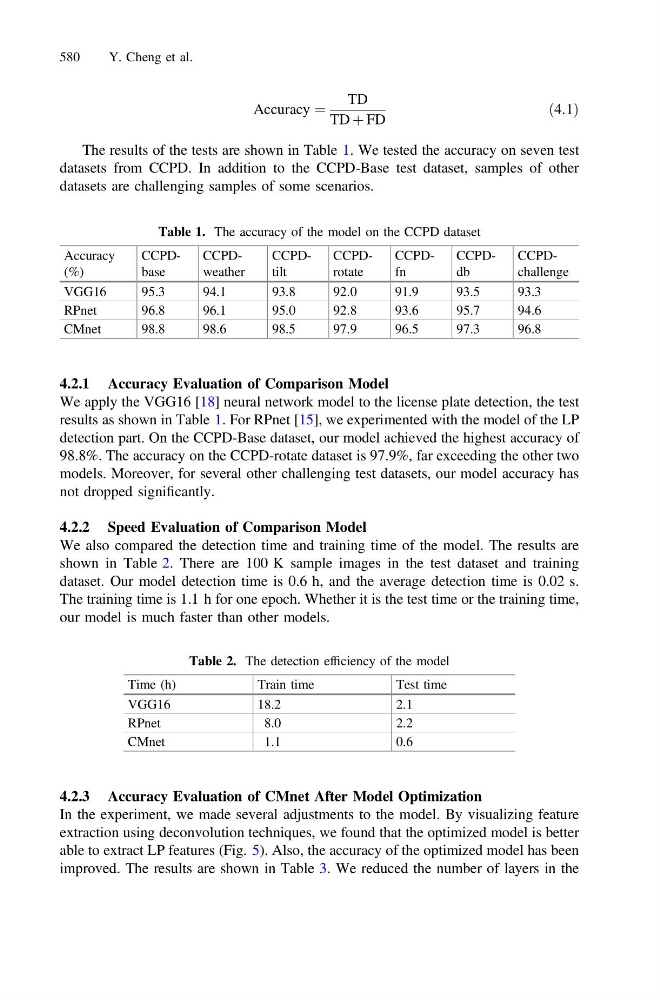
Accuracy ¼
TD
TD þ FD
ð4:1Þ
The results of the tests are shown in Table 1. We tested the accuracy on seven test
datasets from CCPD. In addition to the CCPD-Base test dataset, samples of other
datasets are challenging samples of some scenarios.
4.2.1 Accuracy Evaluation of Comparison Model
We apply the VGG16 [18] neural network model to the license plate detection, the test
results as shown in Table 1. For RPnet [15], we experimented with the model of the LP
detection part. On the CCPD-Base dataset, our model achieved the highest accuracy of
98.8%. The accuracy on the CCPD-rotate dataset is 97.9%, far exceeding the other two
models. Moreover, for several other challenging test datasets, our model accuracy has
not dropped significantly.
4.2.2 Speed Evaluation of Comparison Model
We also compared the detection time and training time of the model. The results are
shown in Table 2. There are 100 K sample images in the test dataset and training
dataset. Our model detection time is 0.6 h, and the average detection time is 0.02 s.
The training time is 1.1 h for one epoch. Whether it is the test time or the training time,
our model is much faster than other models.
4.2.3 Accuracy Evaluation of CMnet After Model Optimization
In the experiment, we made several adjustments to the model. By visualizing feature
extraction using deconvolution techniques, we found that the optimized model is better
able to extract LP features (Fig. 5). Also, the accuracy of the optimized model has been
improved. The results are shown in Table 3. We reduced the number of layers in the
Table 1. The accuracy of the model on the CCPD dataset
Accuracy
(%)
CCPDbase
CCPDweather
CCPDtilt
CCPDrotate
CCPDfn
CCPDdb
CCPDchallenge
VGG16
95.3
94.1
93.8
92.0
91.9
93.5
93.3
RPnet
96.8
96.1
95.0
92.8
93.6
95.7
94.6
CMnet
98.8
98.6
98.5
97.9
96.5
97.3
96.8
Table 2. The detection efficiency of the model
Time (h)
Train time
Test time
VGG16
18.2
2.1
RPnet
8.0
2.2
CMnet
1.1
0.6
580
Y. Cheng et al.