

Using the computed values, we define our score
v b ¼
P
i
w b es i
ð Þm i
2 W b þ H b
ð
Þ
j :
ð3Þ
where m i is the sum of the intensity of all edge pixels in es i . The W b and H b are the
box’s width and height. A value of j [ 1 is used to offset the bias of larger windows
having more edges on average.
The Edge Boxes can quickly estimate hundreds of object-like boxes b and similar
object score v b . Paper [6] shows that Edge Boxes can better detect various shapes of
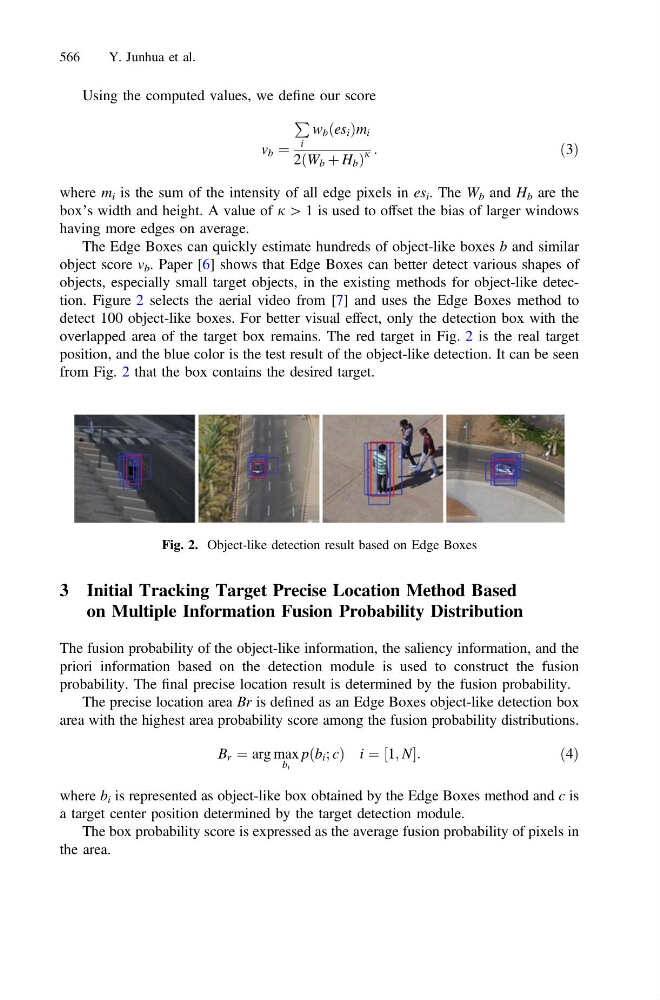
objects, especially small target objects, in the existing methods for object-like detection. Figure 2 selects the aerial video from [7] and uses the Edge Boxes method to
detect 100 object-like boxes. For better visual effect, only the detection box with the
overlapped area of the target box remains. The red target in Fig. 2 is the real target
position, and the blue color is the test result of the object-like detection. It can be seen
from Fig. 2 that the box contains the desired target.
3 Initial Tracking Target Precise Location Method Based
on Multiple Information Fusion Probability Distribution
The fusion probability of the object-like information, the saliency information, and the
priori information based on the detection module is used to construct the fusion
probability. The final precise location result is determined by the fusion probability.
The precise location area Br is defined as an Edge Boxes object-like detection box
area with the highest area probability score among the fusion probability distributions.
B r ¼ arg max
b i
p b i ; c
ð
Þ i ¼ 1; N
½
:
ð4Þ
where b i is represented as object-like box obtained by the Edge Boxes method and c is
a target center position determined by the target detection module.
The box probability score is expressed as the average fusion probability of pixels in
the area.
Fig. 2. Object-like detection result based on Edge Boxes
566
Y. Junhua et al.