

according to the target initial position determined by the target detection. Finally, these
three probabilities are adaptively fused to build multiple clues fused probability distribution. The precisely located initial tracking target area is Edge Boxes object-like
box with the highest average probability of fusion probability distribution.
2 Object-like Detection-Based Edge Feature
The Edge Boxes method is designed to get a collection of rectangular regions in the
image that are most likely to contain objects. The method first gets edge pixel set
E through structured edge detection [5]. Each edge pixel has its corresponding edge
intensity m e and direction h e . Eight fields growth is performed on the edge pixels, and
the termination condition is that the angle between the edge points beyond p=2. The set
of edge points of growth is called an edge group ES.
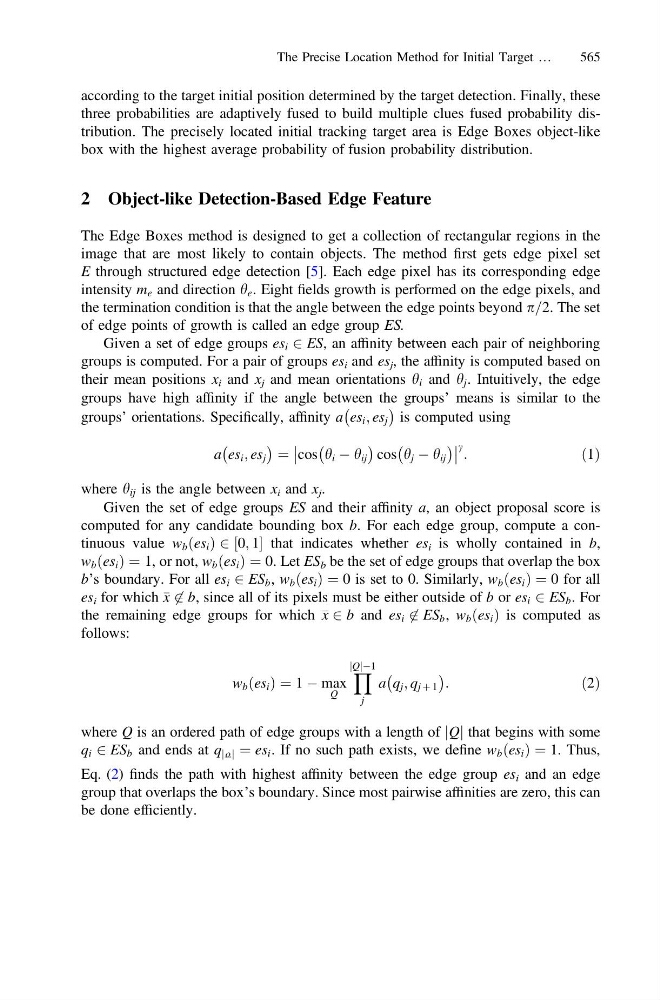
Given a set of edge groups es i 2 ES, an affinity between each pair of neighboring
groups is computed. For a pair of groups es i and es j , the affinity is computed based on
their mean positions x i and x j and mean orientations h i and h j . Intuitively, the edge
groups have high affinity if the angle between the groups’ means is similar to the
groups’ orientations. Specifically, affinity a es i ; es j
À
Á
is computed using
a es i ; es j
À
Á ¼ cos h i À h ij
À
Á
cos h j À h ij
À
Á
c :
ð1Þ
where h ij is the angle between x i and x j .
Given the set of edge groups ES and their affinity a, an object proposal score is
computed for any candidate bounding box b. For each edge group, compute a continuous value w b es i
ð Þ 2 ½0; 1 that indicates whether es i is wholly contained in b,
w b es i
ð Þ ¼ 1, or not, w b es i
ð Þ ¼ 0. Let ES b be the set of edge groups that overlap the box
b’s boundary. For all es i 2 ES b , w b es i
ð Þ ¼ 0 is set to 0. Similarly, w b es i
ð Þ ¼ 0 for all
es i for which x 6 2 b, since all of its pixels must be either outside of b or es i 2 ES b . For
the remaining edge groups for which x 2 b and es i 6 2 ES b , w b es i
ð Þ is computed as
follows:
w b es i
ð Þ ¼ 1 À max
Q
Y
jQjÀ1
j
a q j ; q j þ 1
À
Á :
ð2Þ
where Q is an ordered path of edge groups with a length of Q
j j that begins with some
q i 2 ES b and ends at q j o
* j ¼ es i . If no such path exists, we define w b es i
ð Þ ¼ 1. Thus,
Eq. (2) finds the path with highest affinity between the edge group es i and an edge
group that overlaps the box’s boundary. Since most pairwise affinities are zero, this can
be done efficiently.
The Precise Location Method for Initial Target …
565