

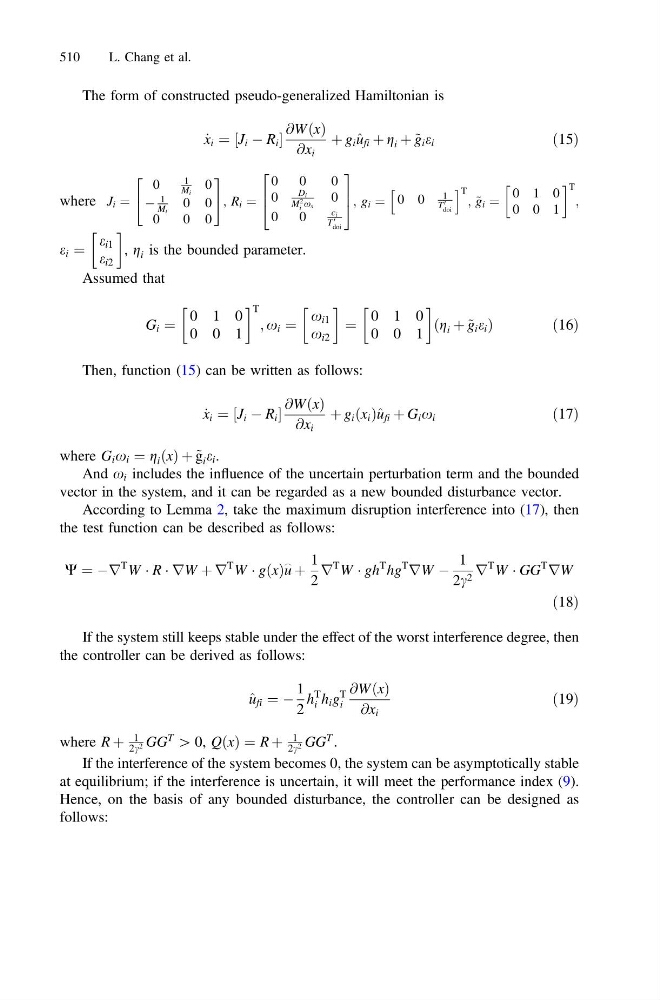
The form of constructed pseudo-generalized Hamiltonian is
_
x i ¼ ½J i À R i
@WðxÞ
@x i
þ g i ^ u fi þ g i þ ~ g i e i
ð15Þ
where J i ¼
0
1
Mi 0
À
1
Mi
0 0
0
0 0
2
4
3
5 ; R i ¼
0
0
0
0
Di
M 2
i xs
0
0
0
ci
T 0
doi
2
6
4
3
7
5; g i ¼ 0 0
1
T 0
doi
h
i T ; ~ g i ¼
0 1 0
0 0 1
T
;
e i ¼
e i1
e i2
, g i is the bounded parameter.
Assumed that
G i ¼
0 1 0
0 0 1
T
; x i ¼
x i1
x i2
¼
0 1 0
0 0 1
ðg i þ ~ g i e i Þ
ð 16Þ
Then, function (15) can be written as follows:
_
x i ¼ ½J i À R i
@WðxÞ
@x i
þ g i ðx i Þ^ u fi þ G i x i
ð17Þ
where G i x i ¼ g i ðxÞ þ ~ g i e i .
And x i includes the influence of the uncertain perturbation term and the bounded
vector in the system, and it can be regarded as a new bounded disturbance vector.
According to Lemma 2, take the maximum disruption interference into (17), then
the test function can be described as follows:
W ¼ Àr
T W Á R Á rW þ r
T W Á gðxÞu
_ þ
1
2
r
T W Á gh
T hg
T
rW À
1
2c 2 r
T W Á GG
T
rW
ð18Þ
If the system still keeps stable under the effect of the worst interference degree, then
the controller can be derived as follows:
^ u fi ¼ À
1
2
h
T
i h i g
T
i
@WðxÞ
@x i
ð19Þ
where R þ
1
2c 2 GG
T
[ 0, QðxÞ ¼ R þ
1
2c 2 GG
T .
If the interference of the system becomes 0, the system can be asymptotically stable
at equilibrium; if the interference is uncertain, it will meet the performance index (9).
Hence, on the basis of any bounded disturbance, the controller can be designed as
follows:
510
L. Chang et al.
_
x i ¼ ½J i À R i
@WðxÞ
@x i
þ g i ^ u fi þ g i þ ~ g i e i
ð15Þ
where J i ¼
0
1
Mi 0
À
1
Mi
0 0
0
0 0
2
4
3
5 ; R i ¼
0
0
0
0
Di
M 2
i xs
0
0
0
ci
T 0
doi
2
6
4
3
7
5; g i ¼ 0 0
1
T 0
doi
h
i T ; ~ g i ¼
0 1 0
0 0 1
T
;
e i ¼
e i1
e i2
, g i is the bounded parameter.
Assumed that
G i ¼
0 1 0
0 0 1
T
; x i ¼
x i1
x i2
¼
0 1 0
0 0 1
ðg i þ ~ g i e i Þ
ð 16Þ
Then, function (15) can be written as follows:
_
x i ¼ ½J i À R i
@WðxÞ
@x i
þ g i ðx i Þ^ u fi þ G i x i
ð17Þ
where G i x i ¼ g i ðxÞ þ ~ g i e i .
And x i includes the influence of the uncertain perturbation term and the bounded
vector in the system, and it can be regarded as a new bounded disturbance vector.
According to Lemma 2, take the maximum disruption interference into (17), then
the test function can be described as follows:
W ¼ Àr
T W Á R Á rW þ r
T W Á gðxÞu
_ þ
1
2
r
T W Á gh
T hg
T
rW À
1
2c 2 r
T W Á GG
T
rW
ð18Þ
If the system still keeps stable under the effect of the worst interference degree, then
the controller can be derived as follows:
^ u fi ¼ À
1
2
h
T
i h i g
T
i
@WðxÞ
@x i
ð19Þ
where R þ
1
2c 2 GG
T
[ 0, QðxÞ ¼ R þ
1
2c 2 GG
T .
If the interference of the system becomes 0, the system can be asymptotically stable
at equilibrium; if the interference is uncertain, it will meet the performance index (9).
Hence, on the basis of any bounded disturbance, the controller can be designed as
follows:
510
L. Chang et al.