

u fi ¼ À
1
2
T
0
doi h i ðxÞh
T
i ðxÞ
b i
c i
ðE
0
qi À
1
b i
E
0
fdsi Þ À
X n
i6 ¼j
E
0
qj
"
B ij cos d ij
þ c i
X
1 k i
E
0
qk G ik ðsin d ik À sin d isks Þ À E
00
fdsi
#
ð20Þ
Theorem 3 For any given c [ 0, there is an energy function WðxÞ and QðxÞ for system
(12),through the controller (20) effect with the worst interference condition, it meets the
dissipative inequality (8). The system will have the characteristic of interference suppression and asymptotically stable at the equilibrium point.
According to Minimax theory, the performance index is established for system
(12). We can calculate the maximum interference degree of the system and withstand
on the base of the test function. Then, we can solve the conservatism caused by
inequality reduction, further accurately design the interference suppression controller.
4 Simulation Results
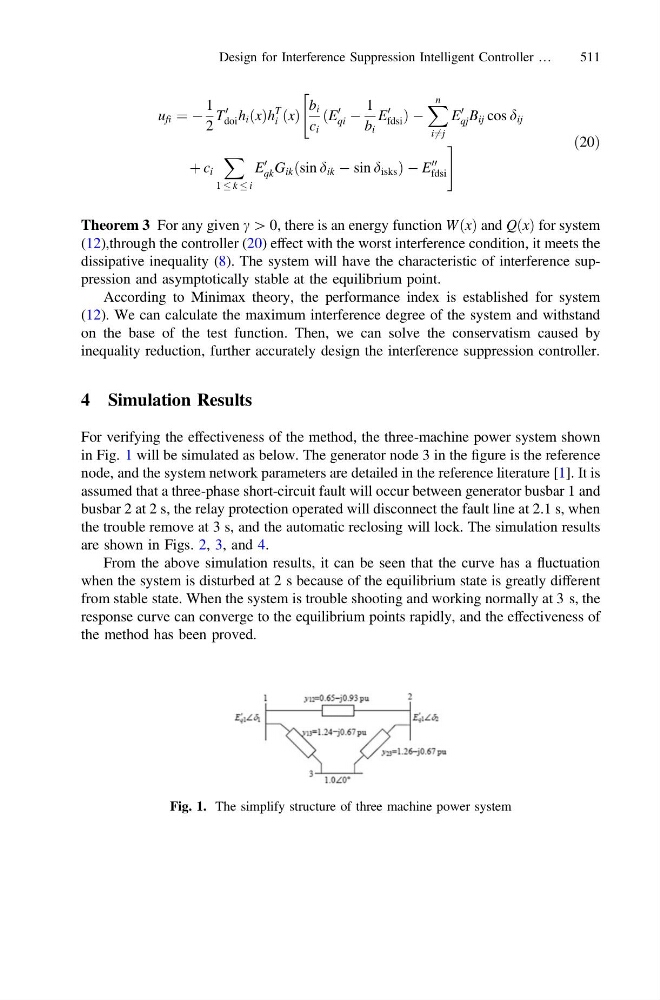
For verifying the effectiveness of the method, the three-machine power system shown
in Fig. 1 will be simulated as below. The generator node 3 in the figure is the reference
node, and the system network parameters are detailed in the reference literature [1]. It is
assumed that a three-phase short-circuit fault will occur between generator busbar 1 and
busbar 2 at 2 s, the relay protection operated will disconnect the fault line at 2.1 s, when
the trouble remove at 3 s, and the automatic reclosing will lock. The simulation results
are shown in Figs. 2, 3, and 4.
From the above simulation results, it can be seen that the curve has a fluctuation
when the system is disturbed at 2 s because of the equilibrium state is greatly different
from stable state. When the system is trouble shooting and working normally at 3 s, the
response curve can converge to the equilibrium points rapidly, and the effectiveness of
the method has been proved.
Fig. 1. The simplify structure of three machine power system
Design for Interference Suppression Intelligent Controller …
511
1
2
T
0
doi h i ðxÞh
T
i ðxÞ
b i
c i
ðE
0
qi À
1
b i
E
0
fdsi Þ À
X n
i6 ¼j
E
0
qj
"
B ij cos d ij
þ c i
X
1 k i
E
0
qk G ik ðsin d ik À sin d isks Þ À E
00
fdsi
#
ð20Þ
Theorem 3 For any given c [ 0, there is an energy function WðxÞ and QðxÞ for system
(12),through the controller (20) effect with the worst interference condition, it meets the
dissipative inequality (8). The system will have the characteristic of interference suppression and asymptotically stable at the equilibrium point.
According to Minimax theory, the performance index is established for system
(12). We can calculate the maximum interference degree of the system and withstand
on the base of the test function. Then, we can solve the conservatism caused by
inequality reduction, further accurately design the interference suppression controller.
4 Simulation Results
For verifying the effectiveness of the method, the three-machine power system shown
in Fig. 1 will be simulated as below. The generator node 3 in the figure is the reference
node, and the system network parameters are detailed in the reference literature [1]. It is
assumed that a three-phase short-circuit fault will occur between generator busbar 1 and
busbar 2 at 2 s, the relay protection operated will disconnect the fault line at 2.1 s, when
the trouble remove at 3 s, and the automatic reclosing will lock. The simulation results
are shown in Figs. 2, 3, and 4.
From the above simulation results, it can be seen that the curve has a fluctuation
when the system is disturbed at 2 s because of the equilibrium state is greatly different
from stable state. When the system is trouble shooting and working normally at 3 s, the
response curve can converge to the equilibrium points rapidly, and the effectiveness of
the method has been proved.
Fig. 1. The simplify structure of three machine power system
Design for Interference Suppression Intelligent Controller …
511