

@E k
@w hj
¼
@E k
@^ y
k
j
Á
@^ y
k
j
@b j
Á
@b j
@w hj
ð2Þ
The special property of activation function sigmoid, f
0
ðxÞ ¼ f ðxÞð1 Ã f ðxÞÞ, the
derivative of the output neuron is:
g j ¼
@E k
@^ y
k
j
Á
@^ y
k
j
@b j
¼ ^ y
k
j 1 À ^ y
k
j
y
k
j À ^ y
k
j
ð3Þ
So, we can get the derivative of the output neuron.
3 Results and Discussion
This chapter focuses on the experimental design of the auxiliary diagnosis function of
benign and malignant pulmonary nodules and verifies its performance through
experiments. First, this paper uses two deep learning methods for lung nodule CT data.
Seven methods were used to compare CNN-based pulmonary nodule-assisted diagnosis with improved lung nodule-assisted diagnosis of CNN. Then, the SVM and
ELM-based nodule-assisted diagnosis method were compared to classify the CT data of
lung nodules. Finally, the advantages of improved CNN algorithm with higher accuracy and lower algorithm difficulty are obtained.
3.1 Results
The experimental data used was the LIDC-IDRI database, which contained a CTG
image of the 124G lung. It contains 1018 cases; each case is stored in a separate folder,
and each folder has about 100–500 pictures, and the folder records the results of the
doctor’s diagnosis, the benign and malignant lung nodules, contour coordinates, and
other information. Based on the relevant file information, 1067 sets of data can be
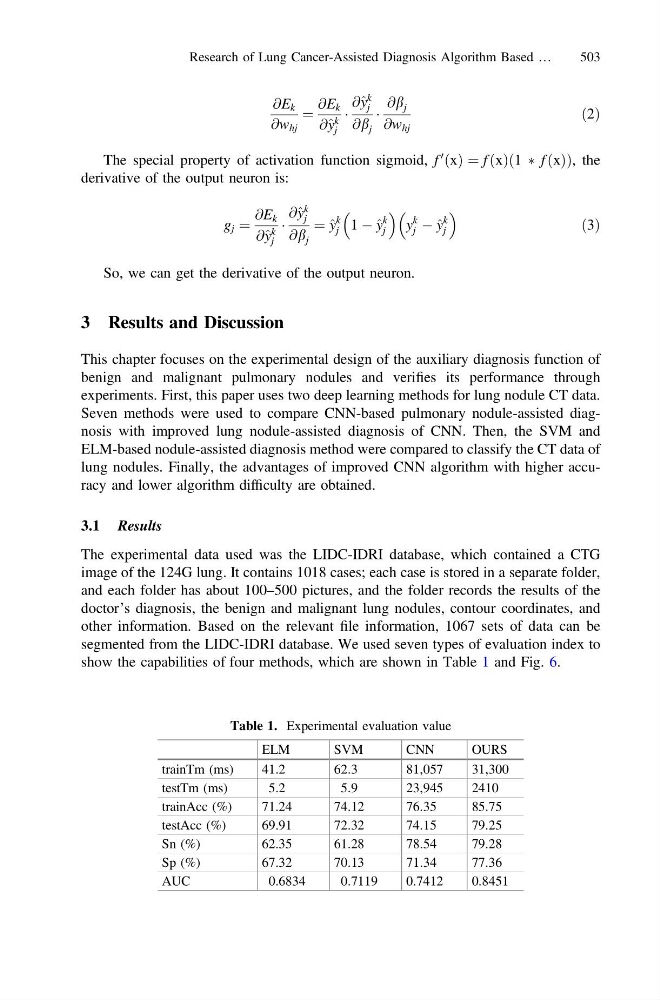
segmented from the LIDC-IDRI database. We used seven types of evaluation index to
show the capabilities of four methods, which are shown in Table 1 and Fig. 6.
Table 1. Experimental evaluation value
ELM
SVM
CNN
OURS
trainTm (ms)
41.2
62.3
81,057
31,300
testTm (ms)
5.2
5.9
23,945
2410
trainAcc (%)
71.24
74.12
76.35
85.75
testAcc (%)
69.91
72.32
74.15
79.25
Sn (%)
62.35
61.28
78.54
79.28
Sp (%)
67.32
70.13
71.34
77.36
AUC
0.6834
0.7119
0.7412
0.8451
Research of Lung Cancer-Assisted Diagnosis Algorithm Based …
503
@w hj
¼
@E k
@^ y
k
j
Á
@^ y
k
j
@b j
Á
@b j
@w hj
ð2Þ
The special property of activation function sigmoid, f
0
ðxÞ ¼ f ðxÞð1 Ã f ðxÞÞ, the
derivative of the output neuron is:
g j ¼
@E k
@^ y
k
j
Á
@^ y
k
j
@b j
¼ ^ y
k
j 1 À ^ y
k
j
y
k
j À ^ y
k
j
ð3Þ
So, we can get the derivative of the output neuron.
3 Results and Discussion
This chapter focuses on the experimental design of the auxiliary diagnosis function of
benign and malignant pulmonary nodules and verifies its performance through
experiments. First, this paper uses two deep learning methods for lung nodule CT data.
Seven methods were used to compare CNN-based pulmonary nodule-assisted diagnosis with improved lung nodule-assisted diagnosis of CNN. Then, the SVM and
ELM-based nodule-assisted diagnosis method were compared to classify the CT data of
lung nodules. Finally, the advantages of improved CNN algorithm with higher accuracy and lower algorithm difficulty are obtained.
3.1 Results
The experimental data used was the LIDC-IDRI database, which contained a CTG
image of the 124G lung. It contains 1018 cases; each case is stored in a separate folder,
and each folder has about 100–500 pictures, and the folder records the results of the
doctor’s diagnosis, the benign and malignant lung nodules, contour coordinates, and
other information. Based on the relevant file information, 1067 sets of data can be
segmented from the LIDC-IDRI database. We used seven types of evaluation index to
show the capabilities of four methods, which are shown in Table 1 and Fig. 6.
Table 1. Experimental evaluation value
ELM
SVM
CNN
OURS
trainTm (ms)
41.2
62.3
81,057
31,300
testTm (ms)
5.2
5.9
23,945
2410
trainAcc (%)
71.24
74.12
76.35
85.75
testAcc (%)
69.91
72.32
74.15
79.25
Sn (%)
62.35
61.28
78.54
79.28
Sp (%)
67.32
70.13
71.34
77.36
AUC
0.6834
0.7119
0.7412
0.8451
Research of Lung Cancer-Assisted Diagnosis Algorithm Based …
503