

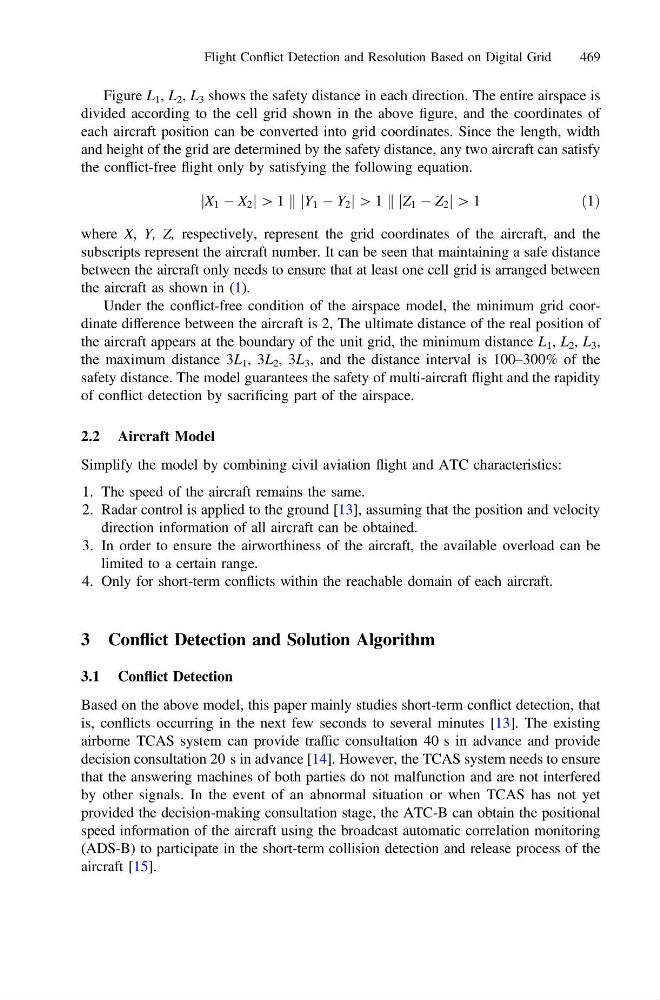
Figure L 1 , L 2 , L 3 shows the safety distance in each direction. The entire airspace is
divided according to the cell grid shown in the above figure, and the coordinates of
each aircraft position can be converted into grid coordinates. Since the length, width
and height of the grid are determined by the safety distance, any two aircraft can satisfy
the conflict-free flight only by satisfying the following equation.
X 1 À X 2
j
j[ 1 k Y 1 À Y 2
j
j[ 1 k Z 1 À Z 2
j
j[ 1
ð1Þ
where X, Y, Z, respectively, represent the grid coordinates of the aircraft, and the
subscripts represent the aircraft number. It can be seen that maintaining a safe distance
between the aircraft only needs to ensure that at least one cell grid is arranged between
the aircraft as shown in (1).
Under the conflict-free condition of the airspace model, the minimum grid coordinate difference between the aircraft is 2, The ultimate distance of the real position of
the aircraft appears at the boundary of the unit grid, the minimum distance L 1 , L 2 , L 3 ,
the maximum distance 3L 1 , 3L 2 , 3L 3 , and the distance interval is 100–300% of the
safety distance. The model guarantees the safety of multi-aircraft flight and the rapidity
of conflict detection by sacrificing part of the airspace.
2.2 Aircraft Model
Simplify the model by combining civil aviation flight and ATC characteristics:
1. The speed of the aircraft remains the same.
2. Radar control is applied to the ground [13], assuming that the position and velocity
direction information of all aircraft can be obtained.
3. In order to ensure the airworthiness of the aircraft, the available overload can be
limited to a certain range.
4. Only for short-term conflicts within the reachable domain of each aircraft.
3 Conflict Detection and Solution Algorithm
3.1 Conflict Detection
Based on the above model, this paper mainly studies short-term conflict detection, that
is, conflicts occurring in the next few seconds to several minutes [13]. The existing
airborne TCAS system can provide traffic consultation 40 s in advance and provide
decision consultation 20 s in advance [14]. However, the TCAS system needs to ensure
that the answering machines of both parties do not malfunction and are not interfered
by other signals. In the event of an abnormal situation or when TCAS has not yet
provided the decision-making consultation stage, the ATC-B can obtain the positional
speed information of the aircraft using the broadcast automatic correlation monitoring
(ADS-B) to participate in the short-term collision detection and release process of the
aircraft [15].
Flight Conflict Detection and Resolution Based on Digital Grid
469