

446
S. Chen et al.
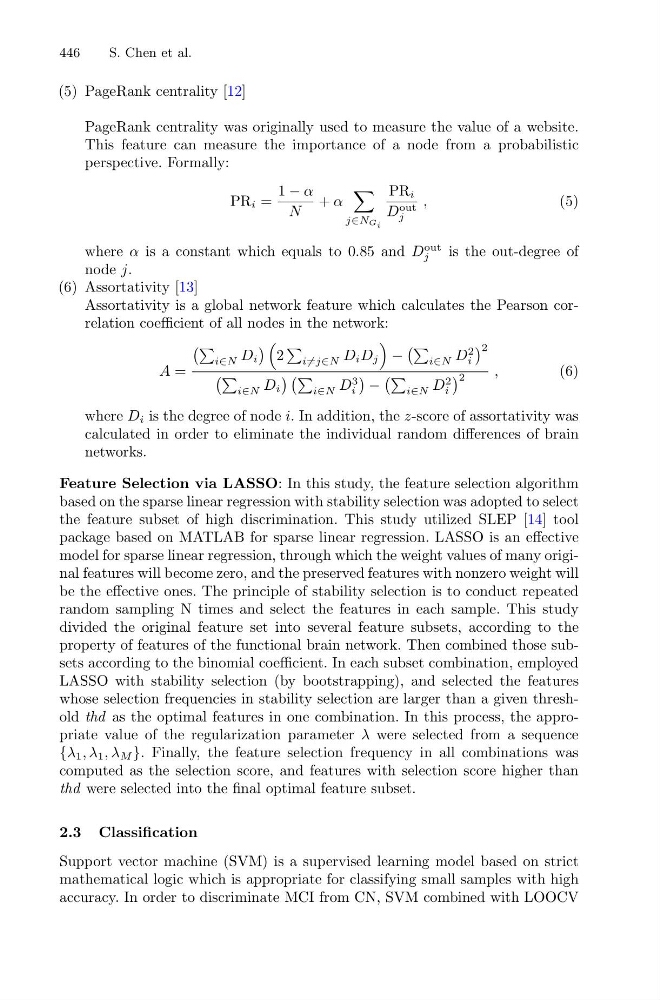
(5) PageRank centrality [12]
PageRank centrality was originally used to measure the value of a website.
This feature can measure the importance of a node from a probabilistic
perspective. Formally:
PR i =
1 − α
N
+ α
j∈NG i
PR i
D out
j
,
(5)
where α is a constant which equals to 0.85 and D
out
j
is the out-degree of
node j.
(6) Assortativity [13]
Assortativity is a global network feature which calculates the Pearson correlation coefficient of all nodes in the network:
A =
i∈N D i
2
i =j∈N D i D j
−
i∈N D
2
i
2
i∈N D i
i∈N D 3
i
−
i∈N D 2
i
2
,
(6)
where D i is the degree of node i. In addition, the z-score of assortativity was
calculated in order to eliminate the individual random differences of brain
networks.
Feature Selection via LASSO: In this study, the feature selection algorithm
based on the sparse linear regression with stability selection was adopted to select
the feature subset of high discrimination. This study utilized SLEP [14] tool
package based on MATLAB for sparse linear regression. LASSO is an effective
model for sparse linear regression, through which the weight values of many original features will become zero, and the preserved features with nonzero weight will
be the effective ones. The principle of stability selection is to conduct repeated
random sampling N times and select the features in each sample. This study
divided the original feature set into several feature subsets, according to the
property of features of the functional brain network. Then combined those subsets according to the binomial coefficient. In each subset combination, employed
LASSO with stability selection (by bootstrapping), and selected the features
whose selection frequencies in stability selection are larger than a given threshold thd as the optimal features in one combination. In this process, the appropriate value of the regularization parameter λ were selected from a sequence
{λ 1 , λ 1 , λ M }. Finally, the feature selection frequency in all combinations was
computed as the selection score, and features with selection score higher than
thd were selected into the final optimal feature subset.
2.3 Classification
Support vector machine (SVM) is a supervised learning model based on strict
mathematical logic which is appropriate for classifying small samples with high
accuracy. In order to discriminate MCI from CN, SVM combined with LOOCV