

Computer-Aided Diagnosis of Mild Cognitive Impairment Based on SVM
445
Feature extraction based on network measures: Adjacency matrices of
each subject constructed under various thresholds are different, resulting in the
difference of the network features. Therefore, it is necessary to find a comprehensive measurement of all thresholds. In this study, except for using features from
each threshold, AUC of each series feature was calculated to improve the generalization ability of features. Totally, nine network measures (including both local
and global measures) were used to generate features from adjacency matrix. For
all subjects, each local network measures had 90 features (represent the value
in 90 brain areas), and each global network measures had one feature. Network
measures employed are:
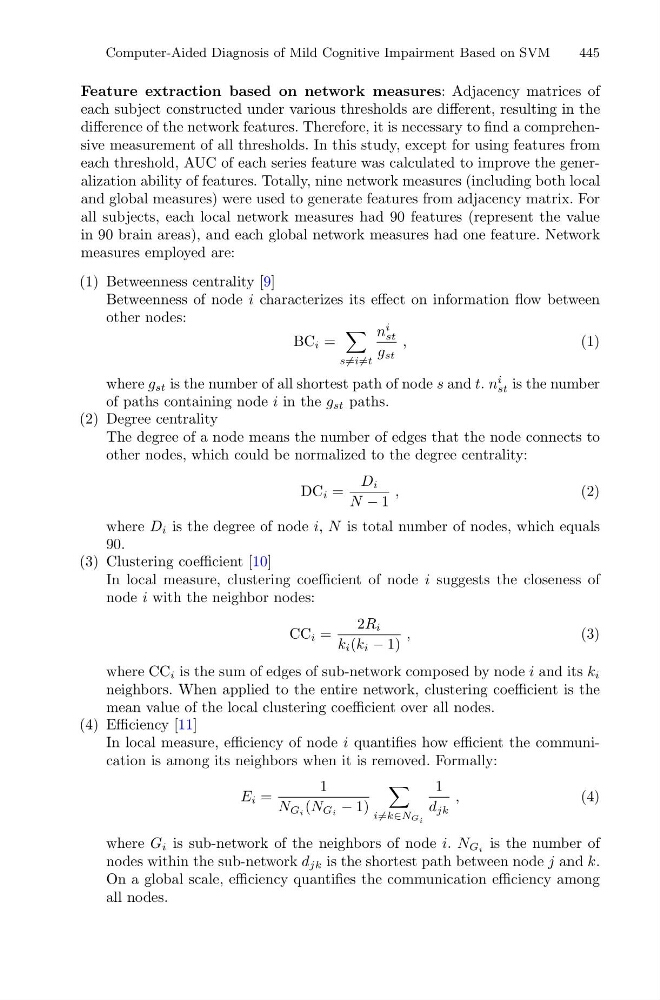
(1) Betweenness centrality [9]
Betweenness of node i characterizes its effect on information flow between
other nodes:
BC i =
s =i =t
n
i
st
g st
,
(1)
where g st is the number of all shortest path of node s and t. n
i
st is the number
of paths containing node i in the g st paths.
(2) Degree centrality
The degree of a node means the number of edges that the node connects to
other nodes, which could be normalized to the degree centrality:
DC i =
D i
N − 1
,
(2)
where D i is the degree of node i, N is total number of nodes, which equals
90.
(3) Clustering coefficient [10]
In local measure, clustering coefficient of node i suggests the closeness of
node i with the neighbor nodes:
CC i =
2R i
k i (k i − 1)
,
(3)
where CC i is the sum of edges of sub-network composed by node i and its k i
neighbors. When applied to the entire network, clustering coefficient is the
mean value of the local clustering coefficient over all nodes.
(4) Efficiency [11]
In local measure, efficiency of node i quantifies how efficient the communication is among its neighbors when it is removed. Formally:
E i =
1
N Gi (N Gi − 1)
i =k∈NG i
1
d jk
,
(4)
where G i is sub-network of the neighbors of node i. N Gi is the number of
nodes within the sub-network d jk is the shortest path between node j and k.
On a global scale, efficiency quantifies the communication efficiency among
all nodes.