

444
S. Chen et al.
2.1 Brain Network Construction
Data acquisition and preprocessing: Data of rs-fMRI using three tesla
(3T) scanners were selected from Alzheimer’s Disease Neuroimaging Initiative (ADNI, http://adni.loni.usc.edu/). The rs-fMRI data of each subject were
acquired with the following parameters: repetition time (TR) = 3000 ms; echo
time (TE) = 30 ms; flip angle = 80
◦ ; slice thickness = 3.312 mm; and 48 slices. By
utilizing the packages of the DPABI [6] and the SPM12 [7], the preprocessing
was carried out, including slice timing, realign, denoising, normalization and
smoothing.
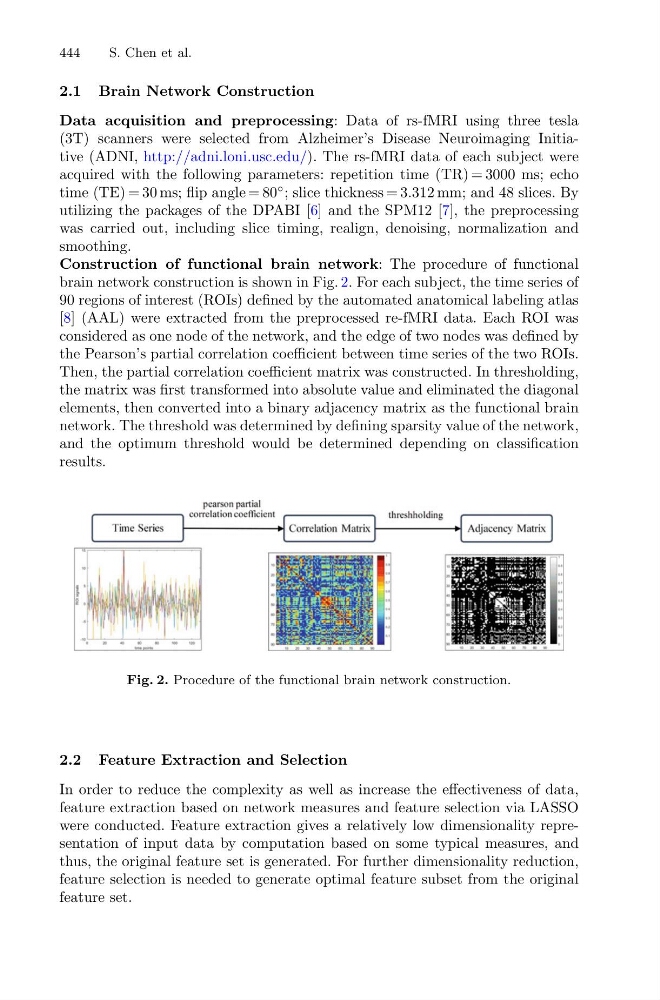
Construction of functional brain network: The procedure of functional
brain network construction is shown in Fig. 2. For each subject, the time series of
90 regions of interest (ROIs) defined by the automated anatomical labeling atlas
[8] (AAL) were extracted from the preprocessed re-fMRI data. Each ROI was
considered as one node of the network, and the edge of two nodes was defined by
the Pearson’s partial correlation coefficient between time series of the two ROIs.
Then, the partial correlation coefficient matrix was constructed. In thresholding,
the matrix was first transformed into absolute value and eliminated the diagonal
elements, then converted into a binary adjacency matrix as the functional brain
network. The threshold was determined by defining sparsity value of the network,
and the optimum threshold would be determined depending on classification
results.
Fig. 2. Procedure of the functional brain network construction.
2.2 Feature Extraction and Selection
In order to reduce the complexity as well as increase the effectiveness of data,
feature extraction based on network measures and feature selection via LASSO
were conducted. Feature extraction gives a relatively low dimensionality representation of input data by computation based on some typical measures, and
thus, the original feature set is generated. For further dimensionality reduction,
feature selection is needed to generate optimal feature subset from the original
feature set.