

Computer-Aided Diagnosis of Mild Cognitive Impairment Based on SVM
443
network analysis, which is important for analyzing the pathogenesis and prevention of brain diseases. Researchers have recognized the use of complex network
analysis and machine learning in the diagnosis of cognitive impairment. Khazaee
et al. [4] proved that abundant original features and effective feature selection
are both conducive to obtaining the optimal feature set in the classification of
MCI, AD and healthy subjects. In the research on the identification of whether
MCI is converted to AD or not by Ye et al. [5], the method of stability selection
with sparse logistic regression was introduced for feature selection.
This study aimed to develop a complex network-based machine learning
method of accurate-aided diagnosis for MCI in order to reduce the conversion
from MCI to AD. This study adapted the advantages of the previous study and
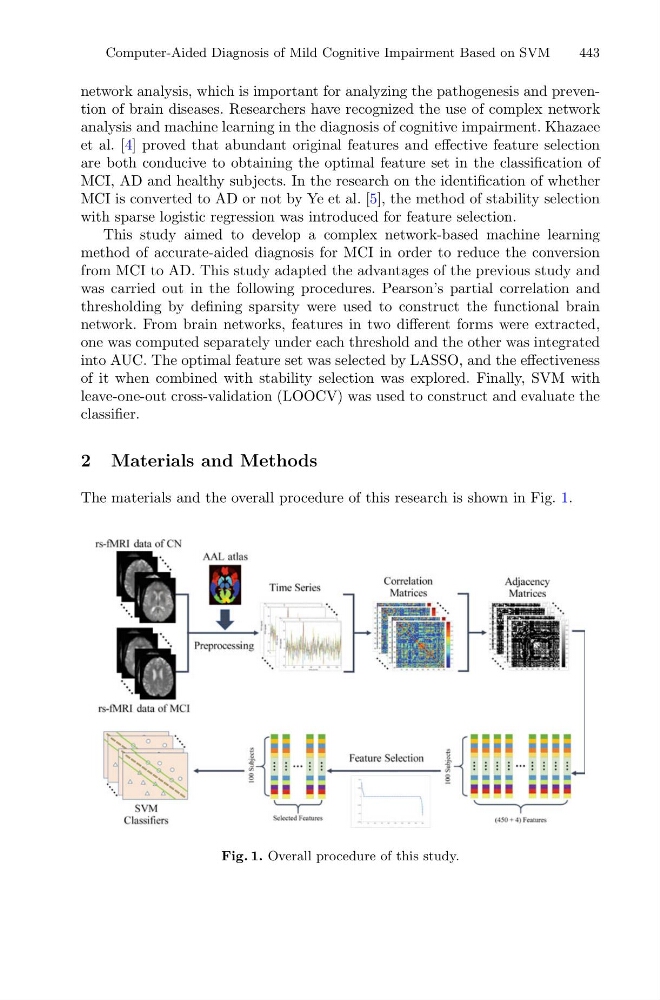
was carried out in the following procedures. Pearson’s partial correlation and
thresholding by defining sparsity were used to construct the functional brain
network. From brain networks, features in two different forms were extracted,
one was computed separately under each threshold and the other was integrated
into AUC. The optimal feature set was selected by LASSO, and the effectiveness
of it when combined with stability selection was explored. Finally, SVM with
leave-one-out cross-validation (LOOCV) was used to construct and evaluate the
classifier.
2 Materials and Methods
The materials and the overall procedure of this research is shown in Fig. 1.
Fig. 1. Overall procedure of this study.