

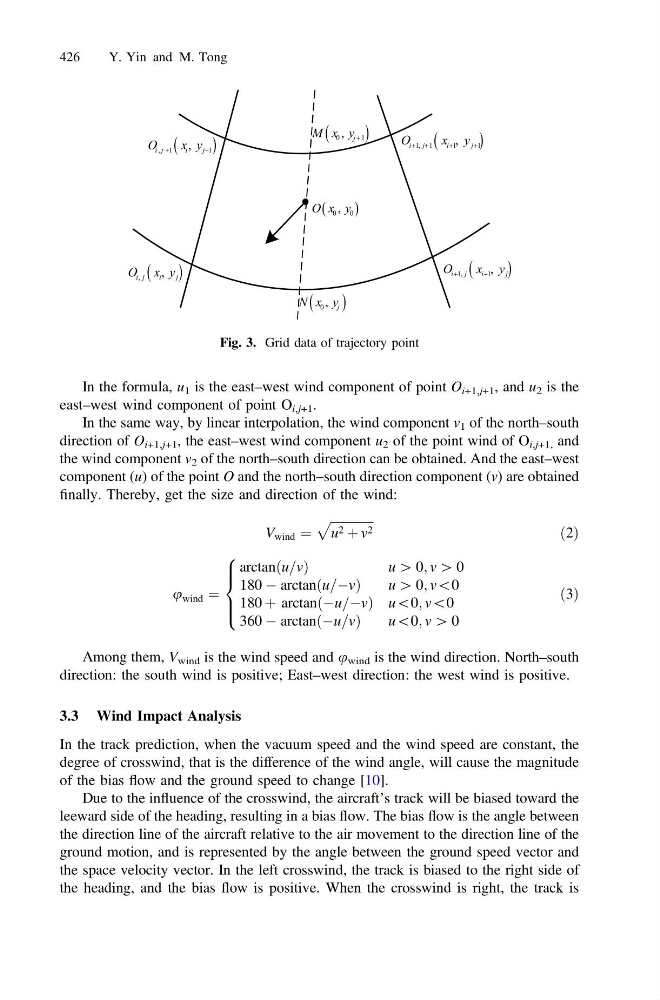
In the formula, u 1 is the east–west wind component of point O i+1,j+1 , and u 2 is the
east–west wind component of point O i,j+1 .
In the same way, by linear interpolation, the wind component v 1 of the north–south
direction of O i+1,j+1 , the east–west wind component u 2 of the point wind of O i,j+1, and
the wind component v 2 of the north–south direction can be obtained. And the east–west
component (u) of the point O and the north–south direction component (v) are obtained
finally. Thereby, get the size and direction of the wind:
V wind ¼
ffiffiffiffiffiffiffiffiffiffiffiffiffiffi
u 2 þ v 2
p
ð2Þ
u wind ¼
arctanðu=vÞ
u [ 0; v [ 0
180 À arctanðu=ÀvÞ
u [ 0; v\0
180 þ arctanðÀu=ÀvÞ u\0; v\0
360 À arctanðÀu=vÞ
u\0; v [ 0
8
> > <
> > :
ð3Þ
Among them, V wind is the wind speed and u wind is the wind direction. North–south
direction: the south wind is positive; East–west direction: the west wind is positive.
3.3 Wind Impact Analysis
In the track prediction, when the vacuum speed and the wind speed are constant, the
degree of crosswind, that is the difference of the wind angle, will cause the magnitude
of the bias flow and the ground speed to change [10].
Due to the influence of the crosswind, the aircraft’s track will be biased toward the
leeward side of the heading, resulting in a bias flow. The bias flow is the angle between
the direction line of the aircraft relative to the air movement to the direction line of the
ground motion, and is represented by the angle between the ground speed vector and
the space velocity vector. In the left crosswind, the track is biased to the right side of
the heading, and the bias flow is positive. When the crosswind is right, the track is
, 1
1
,
i j
i
j
O
x y
1, 1
1
1
,
i
j
i
j
O
x y
1,
1 ,
i
j
i
j
O
x y
,
,
i j
i
j
O x y
0 , j
N x y
0
1
, j
M x y
0
0
,
O x y
Fig. 3. Grid data of trajectory point
426
Y. Yin and M. Tong
east–west wind component of point O i,j+1 .
In the same way, by linear interpolation, the wind component v 1 of the north–south
direction of O i+1,j+1 , the east–west wind component u 2 of the point wind of O i,j+1, and
the wind component v 2 of the north–south direction can be obtained. And the east–west
component (u) of the point O and the north–south direction component (v) are obtained
finally. Thereby, get the size and direction of the wind:
V wind ¼
ffiffiffiffiffiffiffiffiffiffiffiffiffiffi
u 2 þ v 2
p
ð2Þ
u wind ¼
arctanðu=vÞ
u [ 0; v [ 0
180 À arctanðu=ÀvÞ
u [ 0; v\0
180 þ arctanðÀu=ÀvÞ u\0; v\0
360 À arctanðÀu=vÞ
u\0; v [ 0
8
> > <
> > :
ð3Þ
Among them, V wind is the wind speed and u wind is the wind direction. North–south
direction: the south wind is positive; East–west direction: the west wind is positive.
3.3 Wind Impact Analysis
In the track prediction, when the vacuum speed and the wind speed are constant, the
degree of crosswind, that is the difference of the wind angle, will cause the magnitude
of the bias flow and the ground speed to change [10].
Due to the influence of the crosswind, the aircraft’s track will be biased toward the
leeward side of the heading, resulting in a bias flow. The bias flow is the angle between
the direction line of the aircraft relative to the air movement to the direction line of the
ground motion, and is represented by the angle between the ground speed vector and
the space velocity vector. In the left crosswind, the track is biased to the right side of
the heading, and the bias flow is positive. When the crosswind is right, the track is
, 1
1
,
i j
i
j
O
x y
1, 1
1
1
,
i
j
i
j
O
x y
1,
1 ,
i
j
i
j
O
x y
,
,
i j
i
j
O x y
0 , j
N x y
0
1
, j
M x y
0
0
,
O x y
Fig. 3. Grid data of trajectory point
426
Y. Yin and M. Tong