

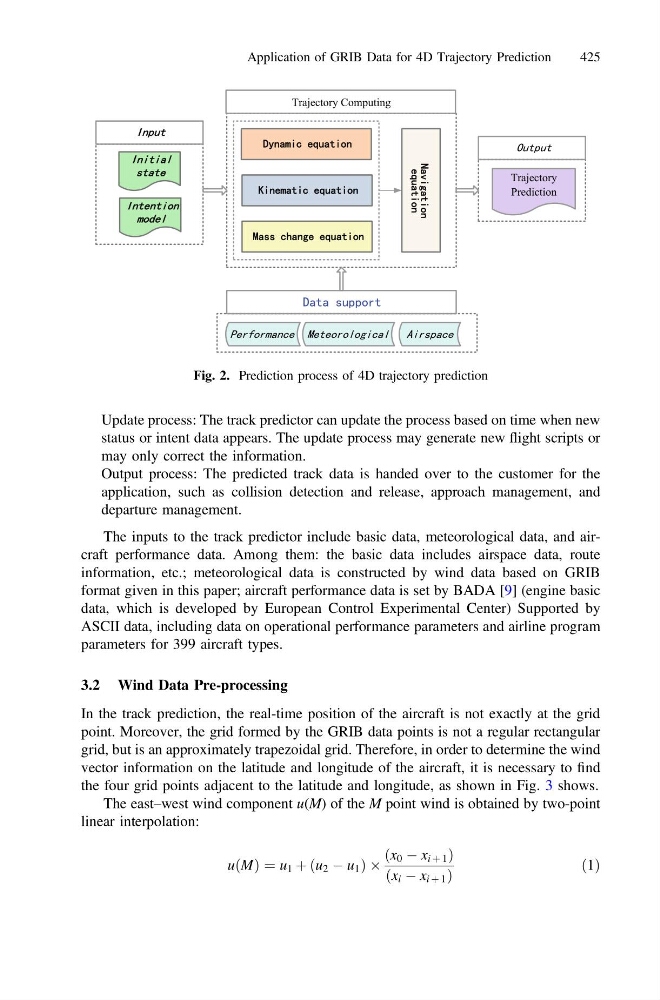
Update process: The track predictor can update the process based on time when new
status or intent data appears. The update process may generate new flight scripts or
may only correct the information.
Output process: The predicted track data is handed over to the customer for the
application, such as collision detection and release, approach management, and
departure management.
The inputs to the track predictor include basic data, meteorological data, and aircraft performance data. Among them: the basic data includes airspace data, route
information, etc.; meteorological data is constructed by wind data based on GRIB
format given in this paper; aircraft performance data is set by BADA [9] (engine basic
data, which is developed by European Control Experimental Center) Supported by
ASCII data, including data on operational performance parameters and airline program
parameters for 399 aircraft types.
3.2 Wind Data Pre-processing
In the track prediction, the real-time position of the aircraft is not exactly at the grid
point. Moreover, the grid formed by the GRIB data points is not a regular rectangular
grid, but is an approximately trapezoidal grid. Therefore, in order to determine the wind
vector information on the latitude and longitude of the aircraft, it is necessary to find
the four grid points adjacent to the latitude and longitude, as shown in Fig. 3 shows.
The east–west wind component u(M) of the M point wind is obtained by two-point
linear interpolation:
uðMÞ ¼ u 1 þ ðu 2 À u 1 Þ Â
ðx 0 À x i þ 1 Þ
ðx i À x i þ 1 Þ
ð1Þ
Trajectory Computing
Trajectory
Prediction
Fig. 2. Prediction process of 4D trajectory prediction
Application of GRIB Data for 4D Trajectory Prediction
425
status or intent data appears. The update process may generate new flight scripts or
may only correct the information.
Output process: The predicted track data is handed over to the customer for the
application, such as collision detection and release, approach management, and
departure management.
The inputs to the track predictor include basic data, meteorological data, and aircraft performance data. Among them: the basic data includes airspace data, route
information, etc.; meteorological data is constructed by wind data based on GRIB
format given in this paper; aircraft performance data is set by BADA [9] (engine basic
data, which is developed by European Control Experimental Center) Supported by
ASCII data, including data on operational performance parameters and airline program
parameters for 399 aircraft types.
3.2 Wind Data Pre-processing
In the track prediction, the real-time position of the aircraft is not exactly at the grid
point. Moreover, the grid formed by the GRIB data points is not a regular rectangular
grid, but is an approximately trapezoidal grid. Therefore, in order to determine the wind
vector information on the latitude and longitude of the aircraft, it is necessary to find
the four grid points adjacent to the latitude and longitude, as shown in Fig. 3 shows.
The east–west wind component u(M) of the M point wind is obtained by two-point
linear interpolation:
uðMÞ ¼ u 1 þ ðu 2 À u 1 Þ Â
ðx 0 À x i þ 1 Þ
ðx i À x i þ 1 Þ
ð1Þ
Trajectory Computing
Trajectory
Prediction
Fig. 2. Prediction process of 4D trajectory prediction
Application of GRIB Data for 4D Trajectory Prediction
425