

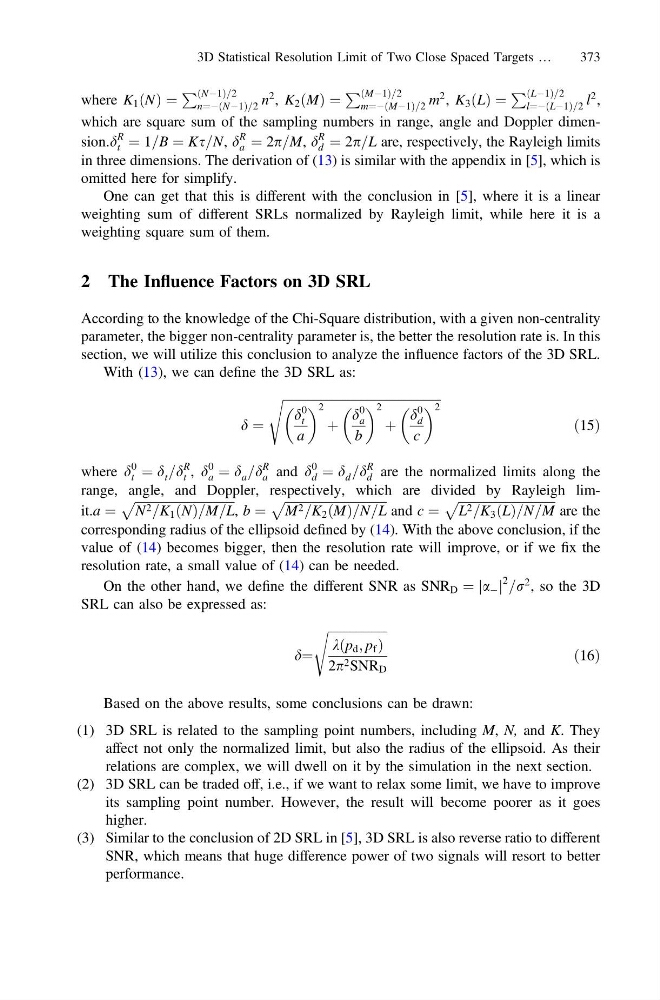
where K 1 ðNÞ ¼
P ðNÀ1Þ=2
n¼ÀðNÀ1Þ=2 n
2 , K 2 ðMÞ ¼
P ðMÀ1Þ=2
m¼ÀðMÀ1Þ=2 m
2 , K 3 ðLÞ ¼
P ðLÀ1Þ=2
l¼ÀðLÀ1Þ=2 l
2 ,
which are square sum of the sampling numbers in range, angle and Doppler dimension.d
R
t ¼ 1=B ¼ Ks=N, d
R
a ¼ 2p=M, d
R
d ¼ 2p=L are, respectively, the Rayleigh limits
in three dimensions. The derivation of (13) is similar with the appendix in [5], which is
omitted here for simplify.
One can get that this is different with the conclusion in [5], where it is a linear
weighting sum of different SRLs normalized by Rayleigh limit, while here it is a
weighting square sum of them.
2 The Influence Factors on 3D SRL
According to the knowledge of the Chi-Square distribution, with a given non-centrality
parameter, the bigger non-centrality parameter is, the better the resolution rate is. In this
section, we will utilize this conclusion to analyze the influence factors of the 3D SRL.
With (13), we can define the 3D SRL as:
d ¼
ffiffiffiffiffiffiffiffiffiffiffiffiffiffiffiffiffiffiffiffiffiffiffiffiffiffiffiffiffiffiffiffiffiffiffiffiffiffiffiffiffiffiffiffiffiffiffiffiffiffi ffi
d
0
t
a
2
þ
d
0
a
b
2
þ
d
0
d
c
2
s
ð15Þ
where d
0
t ¼ d t =d
R
t , d
0
a ¼ d a =d
R
a and d
0
d ¼ d d =d
R
d are the normalized limits along the
range, angle, and Doppler, respectively, which are divided by Rayleigh limit.a ¼
ffiffiffiffiffiffiffiffiffiffiffiffiffiffiffiffiffiffiffiffiffiffiffiffiffiffiffiffiffiffiffiffi
N 2 =K 1 ðNÞ=M=L
p
, b ¼
ffiffiffiffiffiffiffiffiffiffiffiffiffiffiffiffiffiffiffiffiffiffiffiffiffiffiffiffiffiffiffiffi ffi
M 2 =K 2 ðMÞ=N=L
p
and c ¼
ffiffiffiffiffiffiffiffiffiffiffiffiffiffiffiffiffiffiffiffiffiffiffiffiffiffiffiffiffiffiffi
L 2 =K 3 ðLÞ=N=M
p
are the
corresponding radius of the ellipsoid defined by (14). With the above conclusion, if the
value of (14) becomes bigger, then the resolution rate will improve, or if we fix the
resolution rate, a small value of (14) can be needed.
On the other hand, we define the different SNR as SNR D ¼ a À
j j
2 =r
2 , so the 3D
SRL can also be expressed as:
d¼
ffiffiffiffiffiffiffiffiffiffiffiffiffiffiffiffiffiffiffi
kðp d ; p f Þ
2p 2 SNR D
s
ð16Þ
Based on the above results, some conclusions can be drawn:
(1) 3D SRL is related to the sampling point numbers, including M, N, and K. They
affect not only the normalized limit, but also the radius of the ellipsoid. As their
relations are complex, we will dwell on it by the simulation in the next section.
(2) 3D SRL can be traded off, i.e., if we want to relax some limit, we have to improve
its sampling point number. However, the result will become poorer as it goes
higher.
(3) Similar to the conclusion of 2D SRL in [5], 3D SRL is also reverse ratio to different
SNR, which means that huge difference power of two signals will resort to better
performance.
3D Statistical Resolution Limit of Two Close Spaced Targets …
373
P ðNÀ1Þ=2
n¼ÀðNÀ1Þ=2 n
2 , K 2 ðMÞ ¼
P ðMÀ1Þ=2
m¼ÀðMÀ1Þ=2 m
2 , K 3 ðLÞ ¼
P ðLÀ1Þ=2
l¼ÀðLÀ1Þ=2 l
2 ,
which are square sum of the sampling numbers in range, angle and Doppler dimension.d
R
t ¼ 1=B ¼ Ks=N, d
R
a ¼ 2p=M, d
R
d ¼ 2p=L are, respectively, the Rayleigh limits
in three dimensions. The derivation of (13) is similar with the appendix in [5], which is
omitted here for simplify.
One can get that this is different with the conclusion in [5], where it is a linear
weighting sum of different SRLs normalized by Rayleigh limit, while here it is a
weighting square sum of them.
2 The Influence Factors on 3D SRL
According to the knowledge of the Chi-Square distribution, with a given non-centrality
parameter, the bigger non-centrality parameter is, the better the resolution rate is. In this
section, we will utilize this conclusion to analyze the influence factors of the 3D SRL.
With (13), we can define the 3D SRL as:
d ¼
ffiffiffiffiffiffiffiffiffiffiffiffiffiffiffiffiffiffiffiffiffiffiffiffiffiffiffiffiffiffiffiffiffiffiffiffiffiffiffiffiffiffiffiffiffiffiffiffiffiffi ffi
d
0
t
a
2
þ
d
0
a
b
2
þ
d
0
d
c
2
s
ð15Þ
where d
0
t ¼ d t =d
R
t , d
0
a ¼ d a =d
R
a and d
0
d ¼ d d =d
R
d are the normalized limits along the
range, angle, and Doppler, respectively, which are divided by Rayleigh limit.a ¼
ffiffiffiffiffiffiffiffiffiffiffiffiffiffiffiffiffiffiffiffiffiffiffiffiffiffiffiffiffiffiffiffi
N 2 =K 1 ðNÞ=M=L
p
, b ¼
ffiffiffiffiffiffiffiffiffiffiffiffiffiffiffiffiffiffiffiffiffiffiffiffiffiffiffiffiffiffiffiffi ffi
M 2 =K 2 ðMÞ=N=L
p
and c ¼
ffiffiffiffiffiffiffiffiffiffiffiffiffiffiffiffiffiffiffiffiffiffiffiffiffiffiffiffiffiffiffi
L 2 =K 3 ðLÞ=N=M
p
are the
corresponding radius of the ellipsoid defined by (14). With the above conclusion, if the
value of (14) becomes bigger, then the resolution rate will improve, or if we fix the
resolution rate, a small value of (14) can be needed.
On the other hand, we define the different SNR as SNR D ¼ a À
j j
2 =r
2 , so the 3D
SRL can also be expressed as:
d¼
ffiffiffiffiffiffiffiffiffiffiffiffiffiffiffiffiffiffiffi
kðp d ; p f Þ
2p 2 SNR D
s
ð16Þ
Based on the above results, some conclusions can be drawn:
(1) 3D SRL is related to the sampling point numbers, including M, N, and K. They
affect not only the normalized limit, but also the radius of the ellipsoid. As their
relations are complex, we will dwell on it by the simulation in the next section.
(2) 3D SRL can be traded off, i.e., if we want to relax some limit, we have to improve
its sampling point number. However, the result will become poorer as it goes
higher.
(3) Similar to the conclusion of 2D SRL in [5], 3D SRL is also reverse ratio to different
SNR, which means that huge difference power of two signals will resort to better
performance.
3D Statistical Resolution Limit of Two Close Spaced Targets …
373