

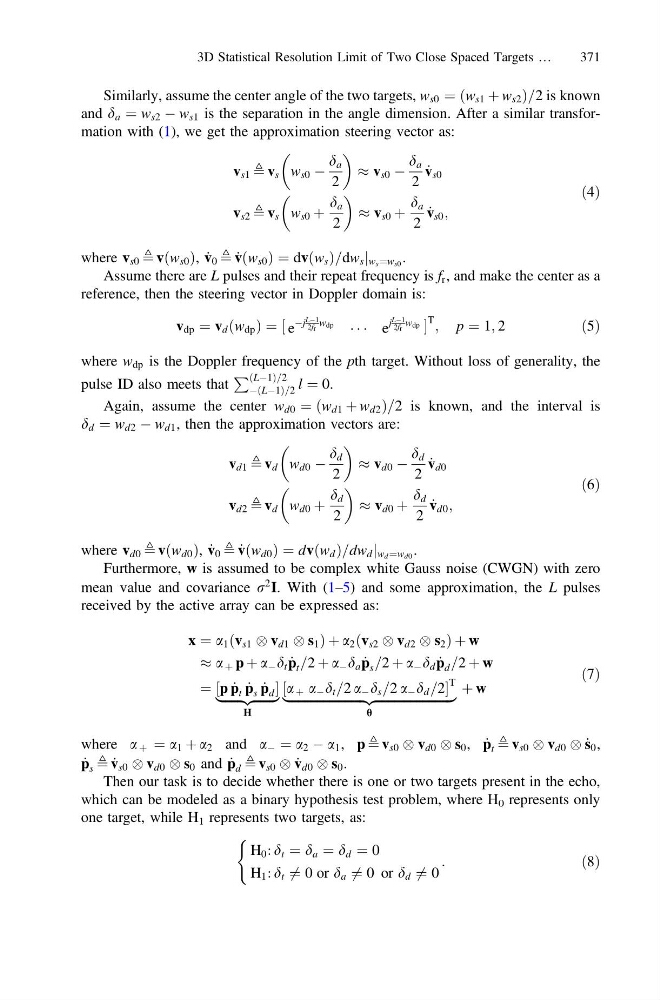
Similarly, assume the center angle of the two targets, w s0 ¼ w s1 þ w s2
ð
Þ =2 is known
and d a ¼ w s2 À w s1 is the separation in the angle dimension. After a similar transformation with (1), we get the approximation steering vector as:
v s1 , v s w s0 À
d a
2
% v s0 À
d a
2
_
v s0
v s2 , v s w s0 þ
d a
2
% v s0 þ
d a
2
_
v s0 ;
ð4Þ
where v s0 , vðw s0 Þ, _
v 0 , _
vðw s0 Þ ¼ dvðw s Þ=dw s w s ¼w s0
j
.
Assume there are L pulses and their repeat frequency is f r , and make the center as a
reference, then the steering vector in Doppler domain is:
v dp ¼ v d ðw dp Þ ¼ ½ e
Àj
LÀ1
2fr w dp
Á Á Á e
j
LÀ1
2fr w dp
T ; p ¼ 1; 2
ð5Þ
where w dp is the Doppler frequency of the pth target. Without loss of generality, the
pulse ID also meets that
P ðLÀ1Þ=2
ÀðLÀ1Þ=2 l ¼ 0.
Again, assume the center w d0 ¼ w d1 þ w d2
ð
Þ =2 is known, and the interval is
d d ¼ w d2 À w d1 , then the approximation vectors are:
v d1 , v d w d0 À
d d
2
% v d0 À
d d
2
_
v d0
v d2 , v d w d0 þ
d d
2
% v d0 þ
d d
2
_
v d0 ;
ð6Þ
where v d0 , vðw d0 Þ, _
v 0 , _
vðw d0 Þ ¼ dvðw d Þ=dw d w d ¼w d0
j
.
Furthermore, w is assumed to be complex white Gauss noise (CWGN) with zero
mean value and covariance r
2 I. With (1–5) and some approximation, the L pulses
received by the active array can be expressed as:
x ¼ a 1 ðv s1 v d1 s 1 Þ þ a 2 ðv s2 v d2 s 2 Þ þ w
% a þ p þ a À d t _
p t =2 þ a À d a _
p s =2 þ a À d d _
p d =2 þ w
¼ p _
p t _
p s _
p d
½
|fflfflfflfflfflffl{zfflfflfflfflfflffl}
H
a þ a À d t =2 a À d s =2 a À d d =2
½
T
|fflfflfflfflfflfflfflfflfflfflfflfflfflfflfflfflfflfflfflfflfflfflfflffl{zfflfflfflfflfflfflfflfflfflfflfflfflfflfflfflfflfflfflfflfflfflfflfflffl}
h
þ w
ð7Þ
where a þ ¼ a 1 þ a 2 and a À ¼ a 2 À a 1 , p , v s0 v d0 s 0 , _
p t , v s0 v d0 _
s 0 ,
_
p s , _
v s0 v d0 s 0 and _
p d , v s0 _
v d0 s 0 .
Then our task is to decide whether there is one or two targets present in the echo,
which can be modeled as a binary hypothesis test problem, where H 0 represents only
one target, while H 1 represents two targets, as:
H 0 : d t ¼ d a ¼ d d ¼ 0
H 1 : d t 6 ¼ 0 or d a 6 ¼ 0 or d d 6 ¼ 0
(
:
ð8Þ
3D Statistical Resolution Limit of Two Close Spaced Targets …
371
ð
Þ =2 is known
and d a ¼ w s2 À w s1 is the separation in the angle dimension. After a similar transformation with (1), we get the approximation steering vector as:
v s1 , v s w s0 À
d a
2
% v s0 À
d a
2
_
v s0
v s2 , v s w s0 þ
d a
2
% v s0 þ
d a
2
_
v s0 ;
ð4Þ
where v s0 , vðw s0 Þ, _
v 0 , _
vðw s0 Þ ¼ dvðw s Þ=dw s w s ¼w s0
j
.
Assume there are L pulses and their repeat frequency is f r , and make the center as a
reference, then the steering vector in Doppler domain is:
v dp ¼ v d ðw dp Þ ¼ ½ e
Àj
LÀ1
2fr w dp
Á Á Á e
j
LÀ1
2fr w dp
T ; p ¼ 1; 2
ð5Þ
where w dp is the Doppler frequency of the pth target. Without loss of generality, the
pulse ID also meets that
P ðLÀ1Þ=2
ÀðLÀ1Þ=2 l ¼ 0.
Again, assume the center w d0 ¼ w d1 þ w d2
ð
Þ =2 is known, and the interval is
d d ¼ w d2 À w d1 , then the approximation vectors are:
v d1 , v d w d0 À
d d
2
% v d0 À
d d
2
_
v d0
v d2 , v d w d0 þ
d d
2
% v d0 þ
d d
2
_
v d0 ;
ð6Þ
where v d0 , vðw d0 Þ, _
v 0 , _
vðw d0 Þ ¼ dvðw d Þ=dw d w d ¼w d0
j
.
Furthermore, w is assumed to be complex white Gauss noise (CWGN) with zero
mean value and covariance r
2 I. With (1–5) and some approximation, the L pulses
received by the active array can be expressed as:
x ¼ a 1 ðv s1 v d1 s 1 Þ þ a 2 ðv s2 v d2 s 2 Þ þ w
% a þ p þ a À d t _
p t =2 þ a À d a _
p s =2 þ a À d d _
p d =2 þ w
¼ p _
p t _
p s _
p d
½
|fflfflfflfflfflffl{zfflfflfflfflfflffl}
H
a þ a À d t =2 a À d s =2 a À d d =2
½
T
|fflfflfflfflfflfflfflfflfflfflfflfflfflfflfflfflfflfflfflfflfflfflfflffl{zfflfflfflfflfflfflfflfflfflfflfflfflfflfflfflfflfflfflfflfflfflfflfflffl}
h
þ w
ð7Þ
where a þ ¼ a 1 þ a 2 and a À ¼ a 2 À a 1 , p , v s0 v d0 s 0 , _
p t , v s0 v d0 _
s 0 ,
_
p s , _
v s0 v d0 s 0 and _
p d , v s0 _
v d0 s 0 .
Then our task is to decide whether there is one or two targets present in the echo,
which can be modeled as a binary hypothesis test problem, where H 0 represents only
one target, while H 1 represents two targets, as:
H 0 : d t ¼ d a ¼ d d ¼ 0
H 1 : d t 6 ¼ 0 or d a 6 ¼ 0 or d d 6 ¼ 0
(
:
ð8Þ
3D Statistical Resolution Limit of Two Close Spaced Targets …
371