

Doppler SRL. Therefore, the range-angle-Doppler SRL should also be a function of the
three respective SRLs and the expression of it is our concerned problem. Besides, the
range-Doppler SRL in [5] is for the inner pulse, which is very poor as the pulse length
is usually very short, so we will investigate Doppler SRL among multiple pulses.
Similar to the existing researches, we will first establish the binary hypothesis test
model, then get a linear model of the GLRT with the Taylor expansion and approximation, further we will explore the factors which will make effects on the united SRL
and make some simulations.
1.1 3D SRL Model
In this section, we will extend the results in [5] to the angle domain for the active array,
by bringing in array steering vector, and also extent inner pulse-Doppler to inter-pulse
Doppler.
This work was supported by the National Natural Science Foundation of China
under Grant 61501486.
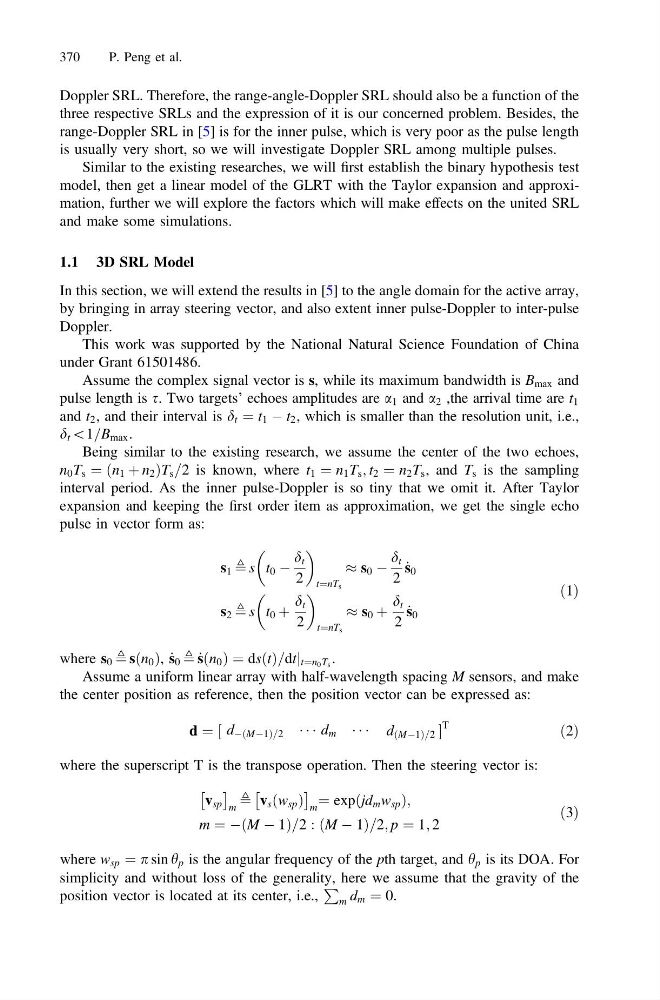
Assume the complex signal vector is s, while its maximum bandwidth is B max and
pulse length is s. Two targets’ echoes amplitudes are a 1 and a 2 ,the arrival time are t 1
and t 2 , and their interval is d t ¼ t 1 À t 2 , which is smaller than the resolution unit, i.e.,
d t \1=B max .
Being similar to the existing research, we assume the center of the two echoes,
n 0 T s ¼ ðn 1 þ n 2 ÞT s =2 is known, where t 1 ¼ n 1 T s ; t 2 ¼ n 2 T s , and T s is the sampling
interval period. As the inner pulse-Doppler is so tiny that we omit it. After Taylor
expansion and keeping the first order item as approximation, we get the single echo
pulse in vector form as:
s 1 , s t 0 À
d t
2
t¼nT s
% s 0 À
d t
2
_
s 0
s 2 , s t 0 þ
d t
2
t¼nT s
% s 0 þ
d t
2
_
s 0
ð1Þ
where s 0 , sðn 0 Þ, _
s 0 , _
sðn 0 Þ ¼ dsðtÞ=dt t¼n 0 T s
j
.
Assume a uniform linear array with half-wavelength spacing M sensors, and make
the center position as reference, then the position vector can be expressed as:
d ¼ ½ d ÀðMÀ1Þ=2 Á Á Á d m Á Á Á d ðMÀ1Þ=2
T
ð2Þ
where the superscript T is the transpose operation. Then the steering vector is:
v sp
 Ã
m
, v s ðw sp Þ
Â
Ã
m
¼ expðjd m w sp Þ;
m ¼ ÀðM À 1Þ=2 : ðM À 1Þ=2; p ¼ 1; 2
ð3Þ
where w sp ¼ p sin h p is the angular frequency of the pth target, and h p is its DOA. For
simplicity and without loss of the generality, here we assume that the gravity of the
position vector is located at its center, i.e.,
P
m d m ¼ 0.
370
P. Peng et al.
three respective SRLs and the expression of it is our concerned problem. Besides, the
range-Doppler SRL in [5] is for the inner pulse, which is very poor as the pulse length
is usually very short, so we will investigate Doppler SRL among multiple pulses.
Similar to the existing researches, we will first establish the binary hypothesis test
model, then get a linear model of the GLRT with the Taylor expansion and approximation, further we will explore the factors which will make effects on the united SRL
and make some simulations.
1.1 3D SRL Model
In this section, we will extend the results in [5] to the angle domain for the active array,
by bringing in array steering vector, and also extent inner pulse-Doppler to inter-pulse
Doppler.
This work was supported by the National Natural Science Foundation of China
under Grant 61501486.
Assume the complex signal vector is s, while its maximum bandwidth is B max and
pulse length is s. Two targets’ echoes amplitudes are a 1 and a 2 ,the arrival time are t 1
and t 2 , and their interval is d t ¼ t 1 À t 2 , which is smaller than the resolution unit, i.e.,
d t \1=B max .
Being similar to the existing research, we assume the center of the two echoes,
n 0 T s ¼ ðn 1 þ n 2 ÞT s =2 is known, where t 1 ¼ n 1 T s ; t 2 ¼ n 2 T s , and T s is the sampling
interval period. As the inner pulse-Doppler is so tiny that we omit it. After Taylor
expansion and keeping the first order item as approximation, we get the single echo
pulse in vector form as:
s 1 , s t 0 À
d t
2
t¼nT s
% s 0 À
d t
2
_
s 0
s 2 , s t 0 þ
d t
2
t¼nT s
% s 0 þ
d t
2
_
s 0
ð1Þ
where s 0 , sðn 0 Þ, _
s 0 , _
sðn 0 Þ ¼ dsðtÞ=dt t¼n 0 T s
j
.
Assume a uniform linear array with half-wavelength spacing M sensors, and make
the center position as reference, then the position vector can be expressed as:
d ¼ ½ d ÀðMÀ1Þ=2 Á Á Á d m Á Á Á d ðMÀ1Þ=2
T
ð2Þ
where the superscript T is the transpose operation. Then the steering vector is:
v sp
 Ã
m
, v s ðw sp Þ
Â
Ã
m
¼ expðjd m w sp Þ;
m ¼ ÀðM À 1Þ=2 : ðM À 1Þ=2; p ¼ 1; 2
ð3Þ
where w sp ¼ p sin h p is the angular frequency of the pth target, and h p is its DOA. For
simplicity and without loss of the generality, here we assume that the gravity of the
position vector is located at its center, i.e.,
P
m d m ¼ 0.
370
P. Peng et al.