

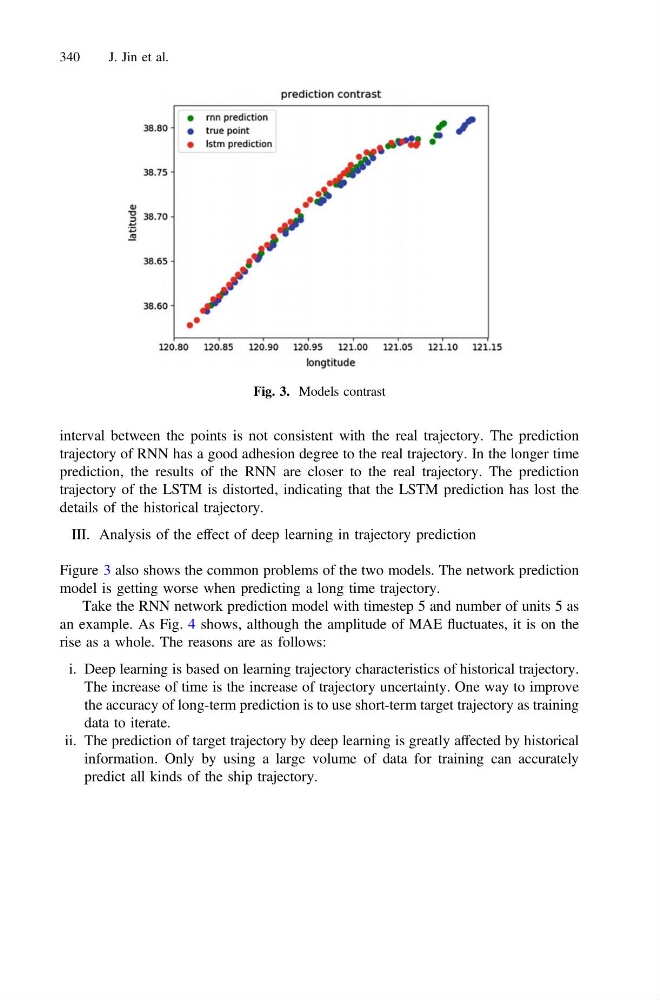
interval between the points is not consistent with the real trajectory. The prediction
trajectory of RNN has a good adhesion degree to the real trajectory. In the longer time
prediction, the results of the RNN are closer to the real trajectory. The prediction
trajectory of the LSTM is distorted, indicating that the LSTM prediction has lost the
details of the historical trajectory.
III. Analysis of the effect of deep learning in trajectory prediction
Figure 3 also shows the common problems of the two models. The network prediction
model is getting worse when predicting a long time trajectory.
Take the RNN network prediction model with timestep 5 and number of units 5 as
an example. As Fig. 4 shows, although the amplitude of MAE fluctuates, it is on the
rise as a whole. The reasons are as follows:
i. Deep learning is based on learning trajectory characteristics of historical trajectory.
The increase of time is the increase of trajectory uncertainty. One way to improve
the accuracy of long-term prediction is to use short-term target trajectory as training
data to iterate.
ii. The prediction of target trajectory by deep learning is greatly affected by historical
information. Only by using a large volume of data for training can accurately
predict all kinds of the ship trajectory.
Fig. 3. Models contrast
340
J. Jin et al.
trajectory of RNN has a good adhesion degree to the real trajectory. In the longer time
prediction, the results of the RNN are closer to the real trajectory. The prediction
trajectory of the LSTM is distorted, indicating that the LSTM prediction has lost the
details of the historical trajectory.
III. Analysis of the effect of deep learning in trajectory prediction
Figure 3 also shows the common problems of the two models. The network prediction
model is getting worse when predicting a long time trajectory.
Take the RNN network prediction model with timestep 5 and number of units 5 as
an example. As Fig. 4 shows, although the amplitude of MAE fluctuates, it is on the
rise as a whole. The reasons are as follows:
i. Deep learning is based on learning trajectory characteristics of historical trajectory.
The increase of time is the increase of trajectory uncertainty. One way to improve
the accuracy of long-term prediction is to use short-term target trajectory as training
data to iterate.
ii. The prediction of target trajectory by deep learning is greatly affected by historical
information. Only by using a large volume of data for training can accurately
predict all kinds of the ship trajectory.
Fig. 3. Models contrast
340
J. Jin et al.