

5 Conclusion
Based on the characteristics of AIS information and network training requirements, this
paper adopts the longitude, latitude and time interval of target as input to establish a
simplified RNN target trajectory prediction model. In this paper, the loss function of the
network is optimized through the experimental simulation, and Absolute loss is finally
selected as loss function. In order to select appropriate parameters to optimize network,
this paper carried out control variable experiments with timestep and the number of
units in hidden layer as variables. Finally, RNN network was optimal when the
timestep is equal to 5 and the number of units is equal to 7. Under the premise that all
network models are optimal, this paper compares the effect of RNN model and LSTM
model. Experimental results show that RNN network model proposed in this paper has
better prediction effect. Finally, according to the prediction results of RNN and LSTM,
the characteristics of deep learning in the field of ship trajectory prediction are
analyzed.
References
1. Gambs S, Killijian M, Cortez DP, Mguel N (2012) Next place prediction using mobility
markov chains. In: Proceedings of the 1st workshop on measurement, privacy, and mobility,
vol 3. ACM, New York, pp 1–6
2. Song C, Qu Z, Blumm N, Barabsi A-L (2010) Limits of predictability in human mobility.
Science 327(5968):1018–1021
3. Qiao S, Nan H, Xinwen Z et al (2018) A dynamic trajectory prediction algorithm based on
Kalman filter. Acta Electronica Sinica 46(2):418–423
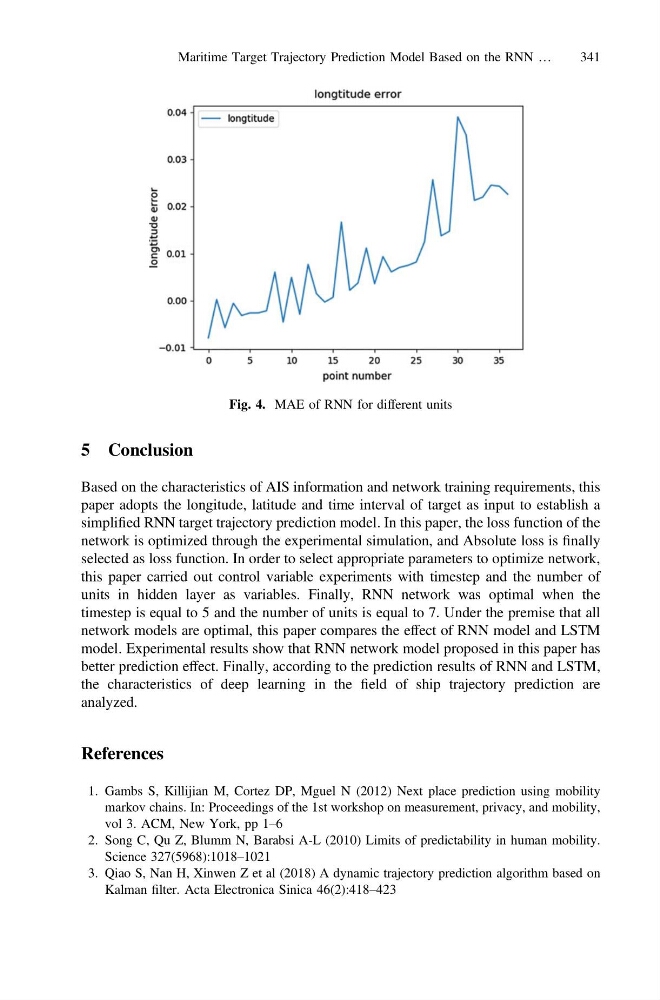
Fig. 4. MAE of RNN for different units
Maritime Target Trajectory Prediction Model Based on the RNN …
341
Based on the characteristics of AIS information and network training requirements, this
paper adopts the longitude, latitude and time interval of target as input to establish a
simplified RNN target trajectory prediction model. In this paper, the loss function of the
network is optimized through the experimental simulation, and Absolute loss is finally
selected as loss function. In order to select appropriate parameters to optimize network,
this paper carried out control variable experiments with timestep and the number of
units in hidden layer as variables. Finally, RNN network was optimal when the
timestep is equal to 5 and the number of units is equal to 7. Under the premise that all
network models are optimal, this paper compares the effect of RNN model and LSTM
model. Experimental results show that RNN network model proposed in this paper has
better prediction effect. Finally, according to the prediction results of RNN and LSTM,
the characteristics of deep learning in the field of ship trajectory prediction are
analyzed.
References
1. Gambs S, Killijian M, Cortez DP, Mguel N (2012) Next place prediction using mobility
markov chains. In: Proceedings of the 1st workshop on measurement, privacy, and mobility,
vol 3. ACM, New York, pp 1–6
2. Song C, Qu Z, Blumm N, Barabsi A-L (2010) Limits of predictability in human mobility.
Science 327(5968):1018–1021
3. Qiao S, Nan H, Xinwen Z et al (2018) A dynamic trajectory prediction algorithm based on
Kalman filter. Acta Electronica Sinica 46(2):418–423
Fig. 4. MAE of RNN for different units
Maritime Target Trajectory Prediction Model Based on the RNN …
341