

ratio of training set is 0%, 10%, …, 99%. We can’t take 100% here, because 100%
means that there is no training data so the classification model can’t be trained. The
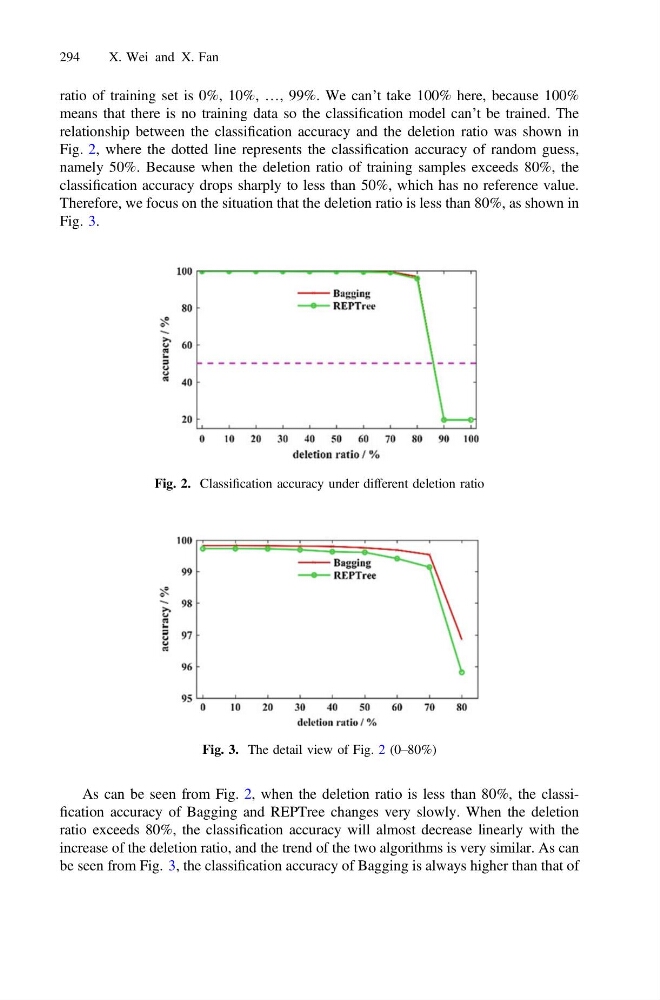
relationship between the classification accuracy and the deletion ratio was shown in
Fig. 2, where the dotted line represents the classification accuracy of random guess,
namely 50%. Because when the deletion ratio of training samples exceeds 80%, the
classification accuracy drops sharply to less than 50%, which has no reference value.
Therefore, we focus on the situation that the deletion ratio is less than 80%, as shown in
Fig. 3.
As can be seen from Fig. 2, when the deletion ratio is less than 80%, the classification accuracy of Bagging and REPTree changes very slowly. When the deletion
ratio exceeds 80%, the classification accuracy will almost decrease linearly with the
increase of the deletion ratio, and the trend of the two algorithms is very similar. As can
be seen from Fig. 3, the classification accuracy of Bagging is always higher than that of
Fig. 2. Classification accuracy under different deletion ratio
Fig. 3. The detail view of Fig. 2 (0–80%)
294
X. Wei and X. Fan
means that there is no training data so the classification model can’t be trained. The
relationship between the classification accuracy and the deletion ratio was shown in
Fig. 2, where the dotted line represents the classification accuracy of random guess,
namely 50%. Because when the deletion ratio of training samples exceeds 80%, the
classification accuracy drops sharply to less than 50%, which has no reference value.
Therefore, we focus on the situation that the deletion ratio is less than 80%, as shown in
Fig. 3.
As can be seen from Fig. 2, when the deletion ratio is less than 80%, the classification accuracy of Bagging and REPTree changes very slowly. When the deletion
ratio exceeds 80%, the classification accuracy will almost decrease linearly with the
increase of the deletion ratio, and the trend of the two algorithms is very similar. As can
be seen from Fig. 3, the classification accuracy of Bagging is always higher than that of
Fig. 2. Classification accuracy under different deletion ratio
Fig. 3. The detail view of Fig. 2 (0–80%)
294
X. Wei and X. Fan