

It can be seen that both of the two algorithms can predict the effect of decoy
jamming considerably accurately. The average accuracy of Bagging and REPTree were
99.66% and 99.58%, respectively. Thus, the classification performance of Bagging is
slightly better than that of REPTree under ideal conditions.
4.2 Comparison Experiment Under the Influence of Noise
In this section, the noise is injected into the training data, namely, a certain proportion
of the class labels in the data are flipped to other randomly selected values to study the
influence of class noise on the performance of the two classification algorithms. It
should be noted that only the training data are added with noise, while the test data are
not affected. Considering 11 different cases of noise ratio, i.e., 0%, 10%, …, 100%. For
each case, five times of two-fold cross-validation experiments were performed to study
the influence of label noise. The relationship between the classification accuracy and
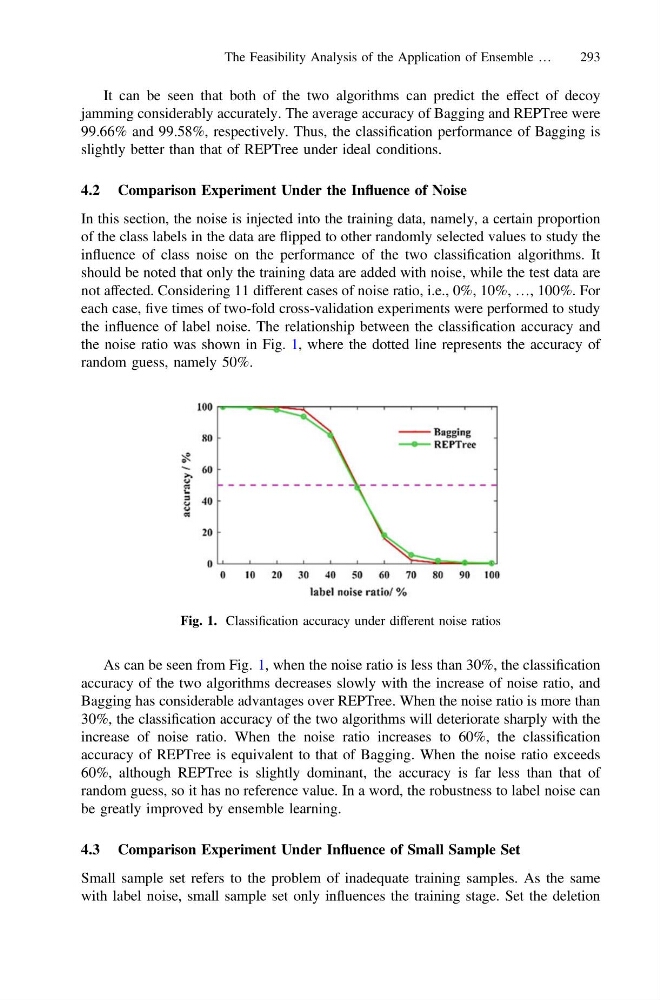
the noise ratio was shown in Fig. 1, where the dotted line represents the accuracy of
random guess, namely 50%.
As can be seen from Fig. 1, when the noise ratio is less than 30%, the classification
accuracy of the two algorithms decreases slowly with the increase of noise ratio, and
Bagging has considerable advantages over REPTree. When the noise ratio is more than
30%, the classification accuracy of the two algorithms will deteriorate sharply with the
increase of noise ratio. When the noise ratio increases to 60%, the classification
accuracy of REPTree is equivalent to that of Bagging. When the noise ratio exceeds
60%, although REPTree is slightly dominant, the accuracy is far less than that of
random guess, so it has no reference value. In a word, the robustness to label noise can
be greatly improved by ensemble learning.
4.3 Comparison Experiment Under Influence of Small Sample Set
Small sample set refers to the problem of inadequate training samples. As the same
with label noise, small sample set only influences the training stage. Set the deletion
Fig. 1. Classification accuracy under different noise ratios
The Feasibility Analysis of the Application of Ensemble …
293
jamming considerably accurately. The average accuracy of Bagging and REPTree were
99.66% and 99.58%, respectively. Thus, the classification performance of Bagging is
slightly better than that of REPTree under ideal conditions.
4.2 Comparison Experiment Under the Influence of Noise
In this section, the noise is injected into the training data, namely, a certain proportion
of the class labels in the data are flipped to other randomly selected values to study the
influence of class noise on the performance of the two classification algorithms. It
should be noted that only the training data are added with noise, while the test data are
not affected. Considering 11 different cases of noise ratio, i.e., 0%, 10%, …, 100%. For
each case, five times of two-fold cross-validation experiments were performed to study
the influence of label noise. The relationship between the classification accuracy and
the noise ratio was shown in Fig. 1, where the dotted line represents the accuracy of
random guess, namely 50%.
As can be seen from Fig. 1, when the noise ratio is less than 30%, the classification
accuracy of the two algorithms decreases slowly with the increase of noise ratio, and
Bagging has considerable advantages over REPTree. When the noise ratio is more than
30%, the classification accuracy of the two algorithms will deteriorate sharply with the
increase of noise ratio. When the noise ratio increases to 60%, the classification
accuracy of REPTree is equivalent to that of Bagging. When the noise ratio exceeds
60%, although REPTree is slightly dominant, the accuracy is far less than that of
random guess, so it has no reference value. In a word, the robustness to label noise can
be greatly improved by ensemble learning.
4.3 Comparison Experiment Under Influence of Small Sample Set
Small sample set refers to the problem of inadequate training samples. As the same
with label noise, small sample set only influences the training stage. Set the deletion
Fig. 1. Classification accuracy under different noise ratios
The Feasibility Analysis of the Application of Ensemble …
293