

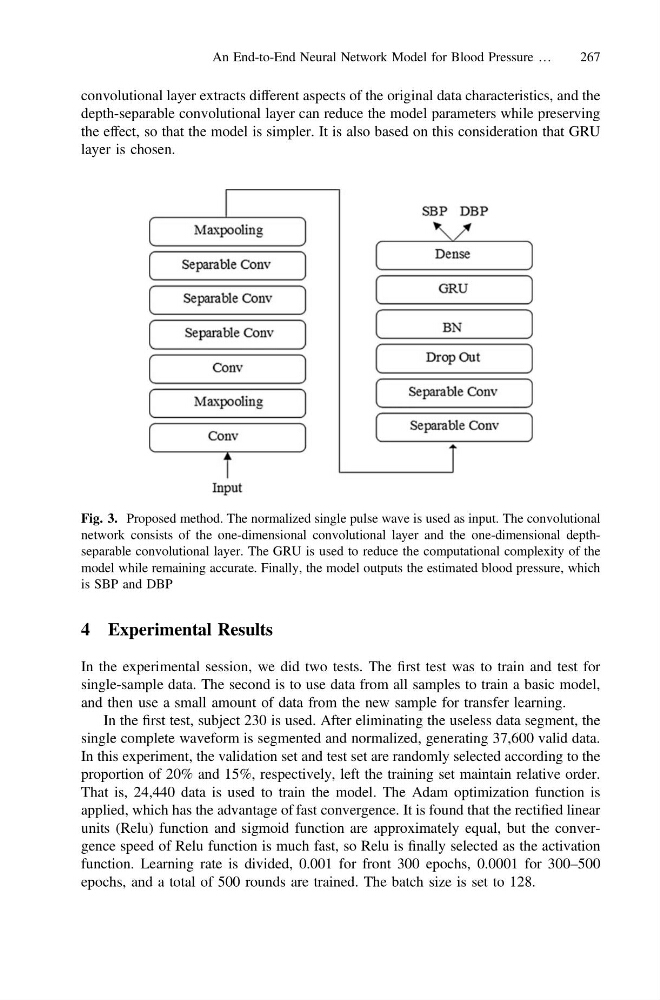
convolutional layer extracts different aspects of the original data characteristics, and the
depth-separable convolutional layer can reduce the model parameters while preserving
the effect, so that the model is simpler. It is also based on this consideration that GRU
layer is chosen.
4 Experimental Results
In the experimental session, we did two tests. The first test was to train and test for
single-sample data. The second is to use data from all samples to train a basic model,
and then use a small amount of data from the new sample for transfer learning.
In the first test, subject 230 is used. After eliminating the useless data segment, the
single complete waveform is segmented and normalized, generating 37,600 valid data.
In this experiment, the validation set and test set are randomly selected according to the
proportion of 20% and 15%, respectively, left the training set maintain relative order.
That is, 24,440 data is used to train the model. The Adam optimization function is
applied, which has the advantage of fast convergence. It is found that the rectified linear
units (Relu) function and sigmoid function are approximately equal, but the convergence speed of Relu function is much fast, so Relu is finally selected as the activation
function. Learning rate is divided, 0.001 for front 300 epochs, 0.0001 for 300–500
epochs, and a total of 500 rounds are trained. The batch size is set to 128.
Fig. 3. Proposed method. The normalized single pulse wave is used as input. The convolutional
network consists of the one-dimensional convolutional layer and the one-dimensional depthseparable convolutional layer. The GRU is used to reduce the computational complexity of the
model while remaining accurate. Finally, the model outputs the estimated blood pressure, which
is SBP and DBP
An End-to-End Neural Network Model for Blood Pressure …
267
depth-separable convolutional layer can reduce the model parameters while preserving
the effect, so that the model is simpler. It is also based on this consideration that GRU
layer is chosen.
4 Experimental Results
In the experimental session, we did two tests. The first test was to train and test for
single-sample data. The second is to use data from all samples to train a basic model,
and then use a small amount of data from the new sample for transfer learning.
In the first test, subject 230 is used. After eliminating the useless data segment, the
single complete waveform is segmented and normalized, generating 37,600 valid data.
In this experiment, the validation set and test set are randomly selected according to the
proportion of 20% and 15%, respectively, left the training set maintain relative order.
That is, 24,440 data is used to train the model. The Adam optimization function is
applied, which has the advantage of fast convergence. It is found that the rectified linear
units (Relu) function and sigmoid function are approximately equal, but the convergence speed of Relu function is much fast, so Relu is finally selected as the activation
function. Learning rate is divided, 0.001 for front 300 epochs, 0.0001 for 300–500
epochs, and a total of 500 rounds are trained. The batch size is set to 128.
Fig. 3. Proposed method. The normalized single pulse wave is used as input. The convolutional
network consists of the one-dimensional convolutional layer and the one-dimensional depthseparable convolutional layer. The GRU is used to reduce the computational complexity of the
model while remaining accurate. Finally, the model outputs the estimated blood pressure, which
is SBP and DBP
An End-to-End Neural Network Model for Blood Pressure …
267