

The echo signal of the scattering point is
s r ðtÞ ¼ a cos 2pf c t À
2rðtÞ
c
!
&
'
ð3:2Þ
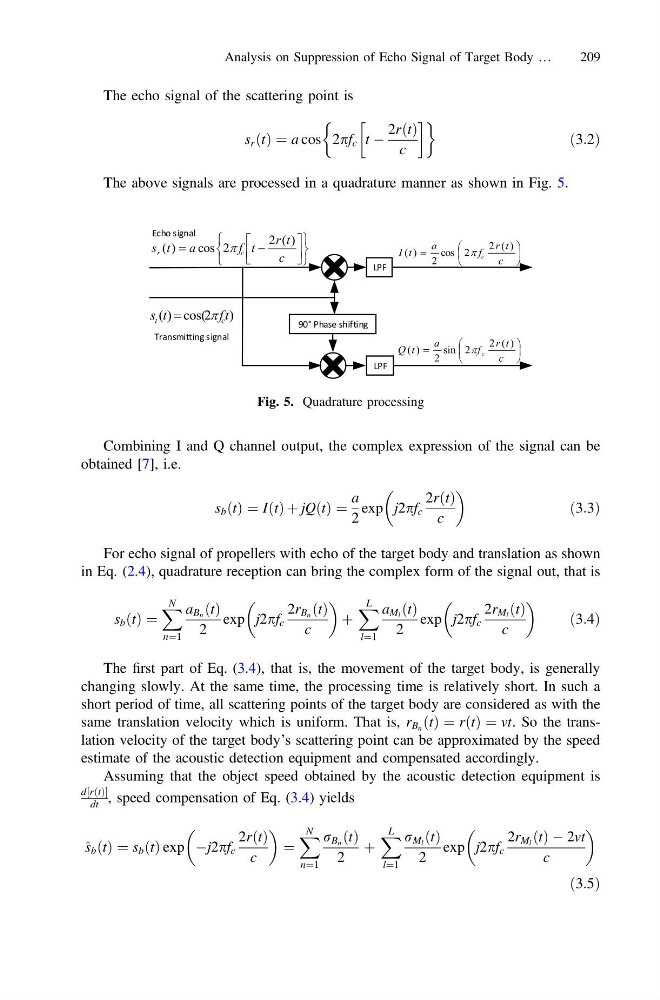
The above signals are processed in a quadrature manner as shown in Fig. 5.
Combining I and Q channel output, the complex expression of the signal can be
obtained [7], i.e.
s b ðtÞ ¼ IðtÞ þ jQðtÞ ¼
a
2
exp j2pf c
2rðtÞ
c
ð3:3Þ
For echo signal of propellers with echo of the target body and translation as shown
in Eq. (2.4), quadrature reception can bring the complex form of the signal out, that is
s b ðtÞ ¼
X N
n¼1
a B n ðtÞ
2
exp j2pf c
2r B n ðtÞ
c
þ
X L
l¼1
a M l ðtÞ
2
exp j2pf c
2r M l ðtÞ
c
ð3:4Þ
The first part of Eq. (3.4), that is, the movement of the target body, is generally
changing slowly. At the same time, the processing time is relatively short. In such a
short period of time, all scattering points of the target body are considered as with the
same translation velocity which is uniform. That is, r B n ðtÞ ¼ rðtÞ ¼ vt. So the translation velocity of the target body’s scattering point can be approximated by the speed
estimate of the acoustic detection equipment and compensated accordingly.
Assuming that the object speed obtained by the acoustic detection equipment is
d rðtÞ
½
dt , speed compensation of Eq. (3.4) yields
^ s b ðtÞ ¼ s b ðtÞ exp Àj2pf c
2rðtÞ
c
¼
X N
n¼1
r B n ðtÞ
2
þ
X L
l¼1
r M l ðtÞ
2
exp j2pf c
2r M l ðtÞ À 2vt
c
ð3:5Þ
Fig. 5. Quadrature processing
Analysis on Suppression of Echo Signal of Target Body …
209
s r ðtÞ ¼ a cos 2pf c t À
2rðtÞ
c
!
&
'
ð3:2Þ
The above signals are processed in a quadrature manner as shown in Fig. 5.
Combining I and Q channel output, the complex expression of the signal can be
obtained [7], i.e.
s b ðtÞ ¼ IðtÞ þ jQðtÞ ¼
a
2
exp j2pf c
2rðtÞ
c
ð3:3Þ
For echo signal of propellers with echo of the target body and translation as shown
in Eq. (2.4), quadrature reception can bring the complex form of the signal out, that is
s b ðtÞ ¼
X N
n¼1
a B n ðtÞ
2
exp j2pf c
2r B n ðtÞ
c
þ
X L
l¼1
a M l ðtÞ
2
exp j2pf c
2r M l ðtÞ
c
ð3:4Þ
The first part of Eq. (3.4), that is, the movement of the target body, is generally
changing slowly. At the same time, the processing time is relatively short. In such a
short period of time, all scattering points of the target body are considered as with the
same translation velocity which is uniform. That is, r B n ðtÞ ¼ rðtÞ ¼ vt. So the translation velocity of the target body’s scattering point can be approximated by the speed
estimate of the acoustic detection equipment and compensated accordingly.
Assuming that the object speed obtained by the acoustic detection equipment is
d rðtÞ
½
dt , speed compensation of Eq. (3.4) yields
^ s b ðtÞ ¼ s b ðtÞ exp Àj2pf c
2rðtÞ
c
¼
X N
n¼1
r B n ðtÞ
2
þ
X L
l¼1
r M l ðtÞ
2
exp j2pf c
2r M l ðtÞ À 2vt
c
ð3:5Þ
Fig. 5. Quadrature processing
Analysis on Suppression of Echo Signal of Target Body …
209