

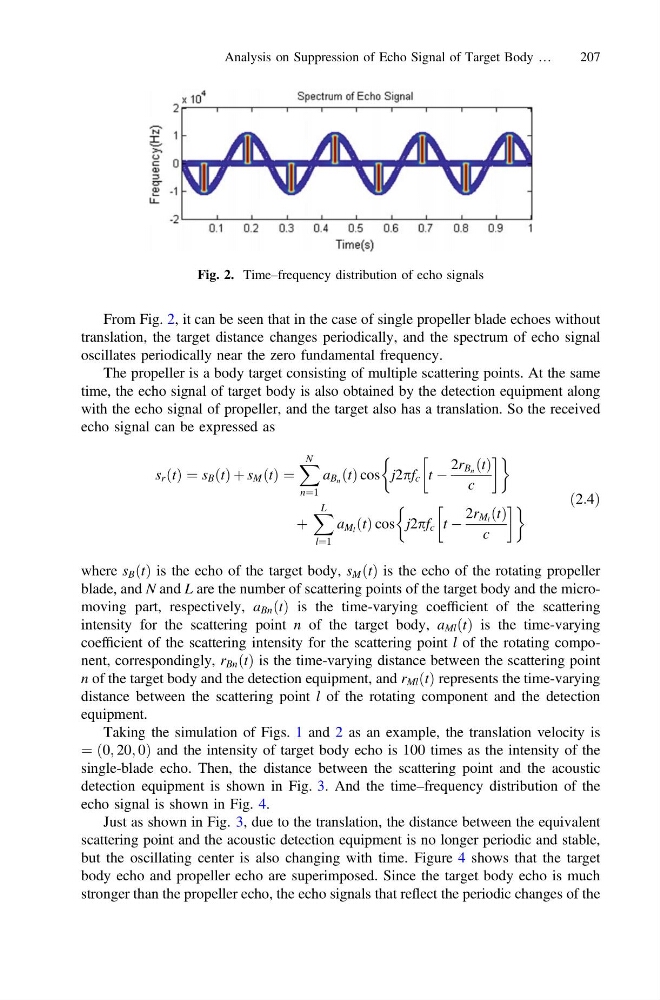
From Fig. 2, it can be seen that in the case of single propeller blade echoes without
translation, the target distance changes periodically, and the spectrum of echo signal
oscillates periodically near the zero fundamental frequency.
The propeller is a body target consisting of multiple scattering points. At the same
time, the echo signal of target body is also obtained by the detection equipment along
with the echo signal of propeller, and the target also has a translation. So the received
echo signal can be expressed as
s r ðtÞ ¼ s B ðtÞ þ s M ðtÞ ¼
X N
n¼1
a B n ðtÞ cos j2pf c t À
2r B n ðtÞ
c
!
&
'
þ
X L
l¼1
a M l ðtÞ cos j2pf c t À
2r M l ðtÞ
c
!
&
'
ð2:4Þ
where s B ðtÞ is the echo of the target body, s M ðtÞ is the echo of the rotating propeller
blade, and N and L are the number of scattering points of the target body and the micromoving part, respectively, a Bn ðtÞ is the time-varying coefficient of the scattering
intensity for the scattering point n of the target body, a Ml ðtÞ is the time-varying
coefficient of the scattering intensity for the scattering point l of the rotating component, correspondingly, r Bn ðtÞ is the time-varying distance between the scattering point
n of the target body and the detection equipment, and r Ml ðtÞ represents the time-varying
distance between the scattering point l of the rotating component and the detection
equipment.
Taking the simulation of Figs. 1 and 2 as an example, the translation velocity is
¼ ð0; 20; 0Þ and the intensity of target body echo is 100 times as the intensity of the
single-blade echo. Then, the distance between the scattering point and the acoustic
detection equipment is shown in Fig. 3. And the time–frequency distribution of the
echo signal is shown in Fig. 4.
Just as shown in Fig. 3, due to the translation, the distance between the equivalent
scattering point and the acoustic detection equipment is no longer periodic and stable,
but the oscillating center is also changing with time. Figure 4 shows that the target
body echo and propeller echo are superimposed. Since the target body echo is much
stronger than the propeller echo, the echo signals that reflect the periodic changes of the
Fig. 2. Time–frequency distribution of echo signals
Analysis on Suppression of Echo Signal of Target Body …
207
translation, the target distance changes periodically, and the spectrum of echo signal
oscillates periodically near the zero fundamental frequency.
The propeller is a body target consisting of multiple scattering points. At the same
time, the echo signal of target body is also obtained by the detection equipment along
with the echo signal of propeller, and the target also has a translation. So the received
echo signal can be expressed as
s r ðtÞ ¼ s B ðtÞ þ s M ðtÞ ¼
X N
n¼1
a B n ðtÞ cos j2pf c t À
2r B n ðtÞ
c
!
&
'
þ
X L
l¼1
a M l ðtÞ cos j2pf c t À
2r M l ðtÞ
c
!
&
'
ð2:4Þ
where s B ðtÞ is the echo of the target body, s M ðtÞ is the echo of the rotating propeller
blade, and N and L are the number of scattering points of the target body and the micromoving part, respectively, a Bn ðtÞ is the time-varying coefficient of the scattering
intensity for the scattering point n of the target body, a Ml ðtÞ is the time-varying
coefficient of the scattering intensity for the scattering point l of the rotating component, correspondingly, r Bn ðtÞ is the time-varying distance between the scattering point
n of the target body and the detection equipment, and r Ml ðtÞ represents the time-varying
distance between the scattering point l of the rotating component and the detection
equipment.
Taking the simulation of Figs. 1 and 2 as an example, the translation velocity is
¼ ð0; 20; 0Þ and the intensity of target body echo is 100 times as the intensity of the
single-blade echo. Then, the distance between the scattering point and the acoustic
detection equipment is shown in Fig. 3. And the time–frequency distribution of the
echo signal is shown in Fig. 4.
Just as shown in Fig. 3, due to the translation, the distance between the equivalent
scattering point and the acoustic detection equipment is no longer periodic and stable,
but the oscillating center is also changing with time. Figure 4 shows that the target
body echo and propeller echo are superimposed. Since the target body echo is much
stronger than the propeller echo, the echo signals that reflect the periodic changes of the
Fig. 2. Time–frequency distribution of echo signals
Analysis on Suppression of Echo Signal of Target Body …
207