

4.3 High-Impact Factors Screening by Lasso
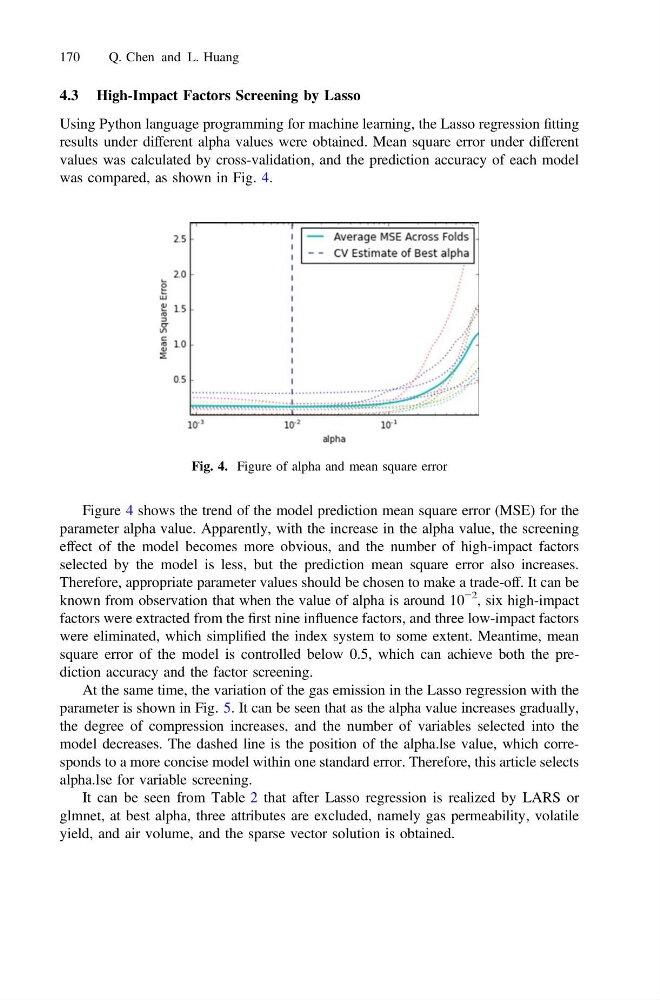
Using Python language programming for machine learning, the Lasso regression fitting
results under different alpha values were obtained. Mean square error under different
values was calculated by cross-validation, and the prediction accuracy of each model
was compared, as shown in Fig. 4.
Figure 4 shows the trend of the model prediction mean square error (MSE) for the
parameter alpha value. Apparently, with the increase in the alpha value, the screening
effect of the model becomes more obvious, and the number of high-impact factors
selected by the model is less, but the prediction mean square error also increases.
Therefore, appropriate parameter values should be chosen to make a trade-off. It can be
known from observation that when the value of alpha is around 10
−2 , six high-impact
factors were extracted from the first nine influence factors, and three low-impact factors
were eliminated, which simplified the index system to some extent. Meantime, mean
square error of the model is controlled below 0.5, which can achieve both the prediction accuracy and the factor screening.
At the same time, the variation of the gas emission in the Lasso regression with the
parameter is shown in Fig. 5. It can be seen that as the alpha value increases gradually,
the degree of compression increases, and the number of variables selected into the
model decreases. The dashed line is the position of the alpha.lse value, which corresponds to a more concise model within one standard error. Therefore, this article selects
alpha.lse for variable screening.
It can be seen from Table 2 that after Lasso regression is realized by LARS or
glmnet, at best alpha, three attributes are excluded, namely gas permeability, volatile
yield, and air volume, and the sparse vector solution is obtained.
Fig. 4. Figure of alpha and mean square error
170
Q. Chen and L. Huang
Using Python language programming for machine learning, the Lasso regression fitting
results under different alpha values were obtained. Mean square error under different
values was calculated by cross-validation, and the prediction accuracy of each model
was compared, as shown in Fig. 4.
Figure 4 shows the trend of the model prediction mean square error (MSE) for the
parameter alpha value. Apparently, with the increase in the alpha value, the screening
effect of the model becomes more obvious, and the number of high-impact factors
selected by the model is less, but the prediction mean square error also increases.
Therefore, appropriate parameter values should be chosen to make a trade-off. It can be
known from observation that when the value of alpha is around 10
−2 , six high-impact
factors were extracted from the first nine influence factors, and three low-impact factors
were eliminated, which simplified the index system to some extent. Meantime, mean
square error of the model is controlled below 0.5, which can achieve both the prediction accuracy and the factor screening.
At the same time, the variation of the gas emission in the Lasso regression with the
parameter is shown in Fig. 5. It can be seen that as the alpha value increases gradually,
the degree of compression increases, and the number of variables selected into the
model decreases. The dashed line is the position of the alpha.lse value, which corresponds to a more concise model within one standard error. Therefore, this article selects
alpha.lse for variable screening.
It can be seen from Table 2 that after Lasso regression is realized by LARS or
glmnet, at best alpha, three attributes are excluded, namely gas permeability, volatile
yield, and air volume, and the sparse vector solution is obtained.
Fig. 4. Figure of alpha and mean square error
170
Q. Chen and L. Huang