

relevance, such as attack power and health value grouped together for separate modeling operations.
In summary, we can use another formula to improve the formula in 3.1, using O A ,
O B to represent the offensive eigenvalues of Army A and Army B (attack point), and
D A , D B represent the defensive eigenvalues of Army A and Army B (defend point).
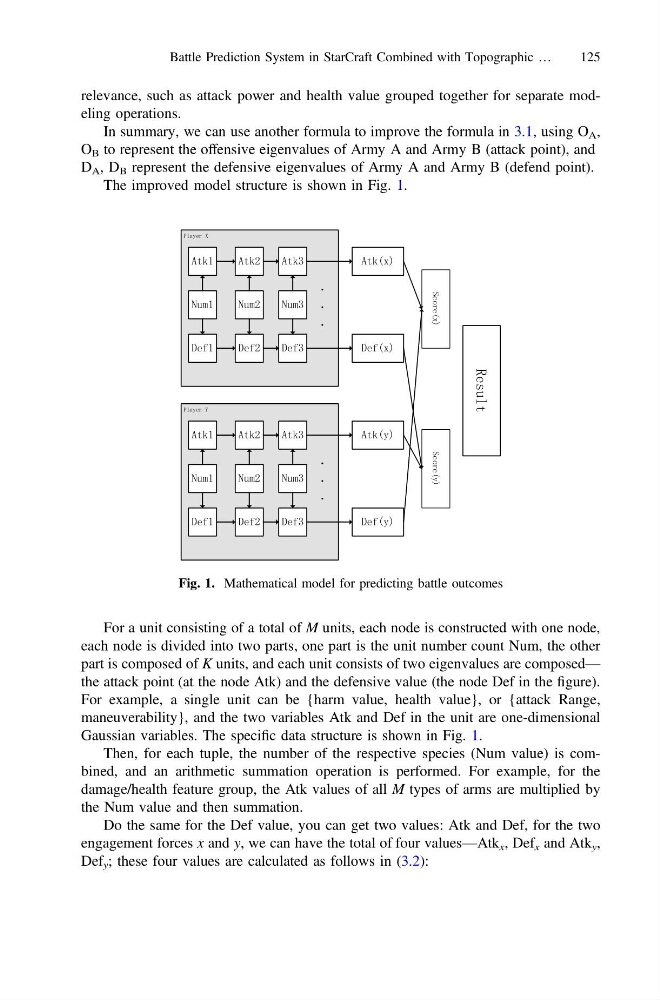
The improved model structure is shown in Fig. 1.
For a unit consisting of a total of M units, each node is constructed with one node,
each node is divided into two parts, one part is the unit number count Num, the other
part is composed of K units, and each unit consists of two eigenvalues are composed—
the attack point (at the node Atk) and the defensive value (the node Def in the figure).
For example, a single unit can be {harm value, health value}, or {attack Range,
maneuverability}, and the two variables Atk and Def in the unit are one-dimensional
Gaussian variables. The specific data structure is shown in Fig. 1.
Then, for each tuple, the number of the respective species (Num value) is combined, and an arithmetic summation operation is performed. For example, for the
damage/health feature group, the Atk values of all M types of arms are multiplied by
the Num value and then summation.
Do the same for the Def value, you can get two values: Atk and Def, for the two
engagement forces x and y, we can have the total of four values—Atk x , Def x and Atk y ,
Def y ; these four values are calculated as follows in (3.2):
Fig. 1. Mathematical model for predicting battle outcomes
Battle Prediction System in StarCraft Combined with Topographic …
125
In summary, we can use another formula to improve the formula in 3.1, using O A ,
O B to represent the offensive eigenvalues of Army A and Army B (attack point), and
D A , D B represent the defensive eigenvalues of Army A and Army B (defend point).
The improved model structure is shown in Fig. 1.
For a unit consisting of a total of M units, each node is constructed with one node,
each node is divided into two parts, one part is the unit number count Num, the other
part is composed of K units, and each unit consists of two eigenvalues are composed—
the attack point (at the node Atk) and the defensive value (the node Def in the figure).
For example, a single unit can be {harm value, health value}, or {attack Range,
maneuverability}, and the two variables Atk and Def in the unit are one-dimensional
Gaussian variables. The specific data structure is shown in Fig. 1.
Then, for each tuple, the number of the respective species (Num value) is combined, and an arithmetic summation operation is performed. For example, for the
damage/health feature group, the Atk values of all M types of arms are multiplied by
the Num value and then summation.
Do the same for the Def value, you can get two values: Atk and Def, for the two
engagement forces x and y, we can have the total of four values—Atk x , Def x and Atk y ,
Def y ; these four values are calculated as follows in (3.2):
Fig. 1. Mathematical model for predicting battle outcomes
Battle Prediction System in StarCraft Combined with Topographic …
125