

army. Another advantage of such a model is that it can be judged that the attribute has
the greatest impact on the outcome of the victory, that is, the main factors that can
clarify the victory of a battle in a vaguer way [4].
In addition, there is an important terrain in StarCraft. The difference between high
and low terrain, the one standing in the high ground often has greater advantages,
including better visibility, wider attack range, better hash formation, etc. Therefore, it is
one-sided to judge the outcome of a battle by considering only the attributes of the unit
itself. Therefore, based on the above ideas, we should further model. That is, based on
the above model, a terrain parameter of the highland and lowland is added as a
correction factor.
For ease of calculation, the above mathematical modeling analysis should not be
performed simultaneously. The situation should be analyzed first when both sides are
on the ground, and after the results are obtained, the situation will be modeled when
one of the parties is at a high level and the other is at a low level.
3.1 Core Ideas [6]
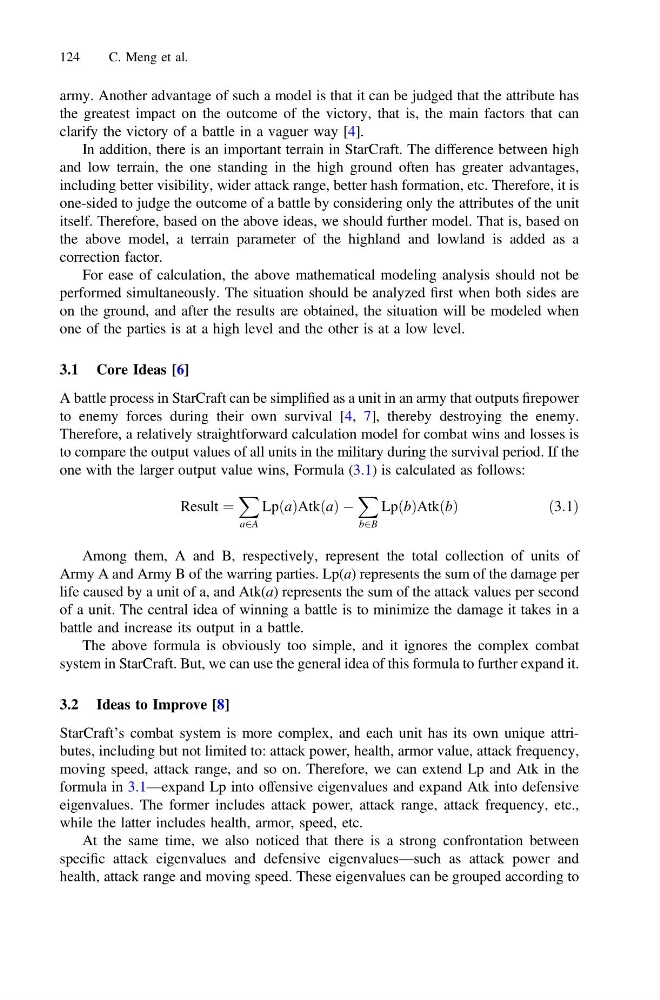
A battle process in StarCraft can be simplified as a unit in an army that outputs firepower
to enemy forces during their own survival [4, 7], thereby destroying the enemy.
Therefore, a relatively straightforward calculation model for combat wins and losses is
to compare the output values of all units in the military during the survival period. If the
one with the larger output value wins, Formula (3.1) is calculated as follows:
Result ¼
X
a2A
LpðaÞAtkðaÞ À
X
b2B
LpðbÞAtkðbÞ
ð 3:1Þ
Among them, A and B, respectively, represent the total collection of units of
Army A and Army B of the warring parties. Lp(a) represents the sum of the damage per
life caused by a unit of a, and Atk(a) represents the sum of the attack values per second
of a unit. The central idea of winning a battle is to minimize the damage it takes in a
battle and increase its output in a battle.
The above formula is obviously too simple, and it ignores the complex combat
system in StarCraft. But, we can use the general idea of this formula to further expand it.
3.2 Ideas to Improve [8]
StarCraft’s combat system is more complex, and each unit has its own unique attributes, including but not limited to: attack power, health, armor value, attack frequency,
moving speed, attack range, and so on. Therefore, we can extend Lp and Atk in the
formula in 3.1—expand Lp into offensive eigenvalues and expand Atk into defensive
eigenvalues. The former includes attack power, attack range, attack frequency, etc.,
while the latter includes health, armor, speed, etc.
At the same time, we also noticed that there is a strong confrontation between
specific attack eigenvalues and defensive eigenvalues—such as attack power and
health, attack range and moving speed. These eigenvalues can be grouped according to
124
C. Meng et al.
the greatest impact on the outcome of the victory, that is, the main factors that can
clarify the victory of a battle in a vaguer way [4].
In addition, there is an important terrain in StarCraft. The difference between high
and low terrain, the one standing in the high ground often has greater advantages,
including better visibility, wider attack range, better hash formation, etc. Therefore, it is
one-sided to judge the outcome of a battle by considering only the attributes of the unit
itself. Therefore, based on the above ideas, we should further model. That is, based on
the above model, a terrain parameter of the highland and lowland is added as a
correction factor.
For ease of calculation, the above mathematical modeling analysis should not be
performed simultaneously. The situation should be analyzed first when both sides are
on the ground, and after the results are obtained, the situation will be modeled when
one of the parties is at a high level and the other is at a low level.
3.1 Core Ideas [6]
A battle process in StarCraft can be simplified as a unit in an army that outputs firepower
to enemy forces during their own survival [4, 7], thereby destroying the enemy.
Therefore, a relatively straightforward calculation model for combat wins and losses is
to compare the output values of all units in the military during the survival period. If the
one with the larger output value wins, Formula (3.1) is calculated as follows:
Result ¼
X
a2A
LpðaÞAtkðaÞ À
X
b2B
LpðbÞAtkðbÞ
ð 3:1Þ
Among them, A and B, respectively, represent the total collection of units of
Army A and Army B of the warring parties. Lp(a) represents the sum of the damage per
life caused by a unit of a, and Atk(a) represents the sum of the attack values per second
of a unit. The central idea of winning a battle is to minimize the damage it takes in a
battle and increase its output in a battle.
The above formula is obviously too simple, and it ignores the complex combat
system in StarCraft. But, we can use the general idea of this formula to further expand it.
3.2 Ideas to Improve [8]
StarCraft’s combat system is more complex, and each unit has its own unique attributes, including but not limited to: attack power, health, armor value, attack frequency,
moving speed, attack range, and so on. Therefore, we can extend Lp and Atk in the
formula in 3.1—expand Lp into offensive eigenvalues and expand Atk into defensive
eigenvalues. The former includes attack power, attack range, attack frequency, etc.,
while the latter includes health, armor, speed, etc.
At the same time, we also noticed that there is a strong confrontation between
specific attack eigenvalues and defensive eigenvalues—such as attack power and
health, attack range and moving speed. These eigenvalues can be grouped according to
124
C. Meng et al.