

18.2 Computational Aspects and Programs
219
thus, e.g.,
T
[a,b]
n
(x) = T n (s(x)).
(18.8)
18.1.3 Miscellaneous
For completeness a few additional equations:
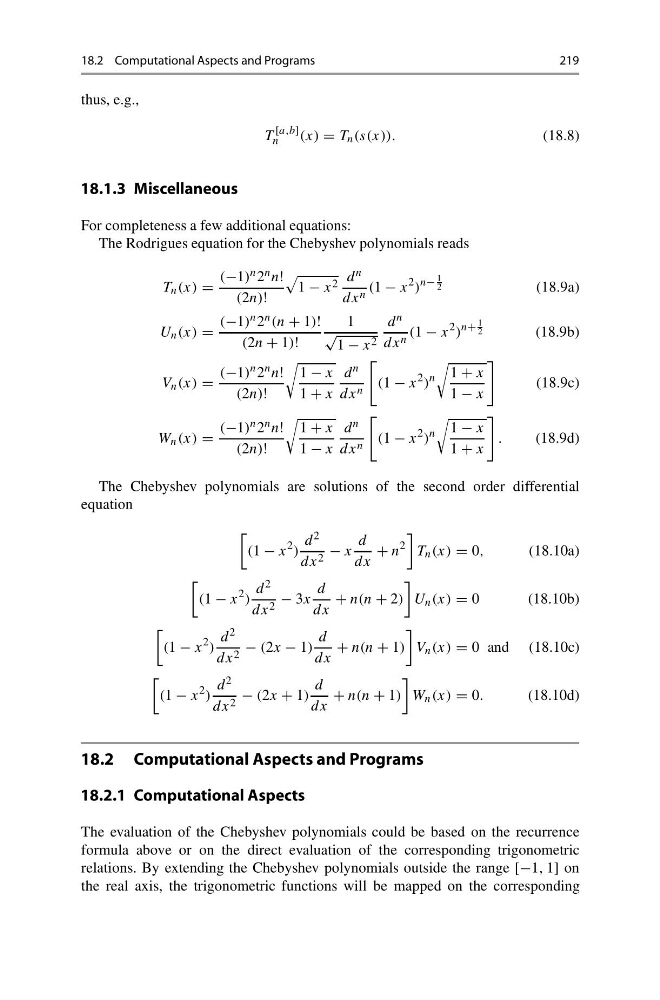
The Rodrigues equation for the Chebyshev polynomials reads
T n (x) =
(−1) n 2 n n!
(2n)!
1 − x 2 d n
dx n (1 − x
2 )
n−
1
2
(18.9a)
U n (x) =
(−1) n 2 n (n + 1)!
(2n + 1)!
1
√
1 − x 2
d n
dx n (1 − x
2 )
n+
1
2
(18.9b)
V n (x) =
(−1) n 2 n n!
(2n)!
1 − x
1 + x
d n
dx n
(1 − x
2 )
n
1 + x
1 − x
(18.9c)
W n (x) =
(−1) n 2 n n!
(2n)!
1 + x
1 − x
d n
dx n
(1 − x
2 )
n
1 − x
1 + x
.
(18.9d)
The Chebyshev polynomials are solutions of the second order differential
equation
(1 − x
2 )
d 2
dx 2 − x
d
dx
+ n
2
T n (x) = 0,
(18.10a)
(1 − x
2 )
d 2
dx 2 − 3x
d
dx
+ n(n + 2)
U n (x) = 0
(18.10b)
(1 − x
2 )
d 2
dx 2 − (2x − 1)
d
dx
+ n(n + 1)
V n (x) = 0 and (18.10c)
(1 − x
2 )
d 2
dx 2 − (2x + 1)
d
dx
+ n(n + 1)
W n (x) = 0.
(18.10d)
18.2 Computational Aspects and Programs
18.2.1 Computational Aspects
The evaluation of the Chebyshev polynomials could be based on the recurrence
formula above or on the direct evaluation of the corresponding trigonometric
relations. By extending the Chebyshev polynomials outside the range [−1, 1] on
the real axis, the trigonometric functions will be mapped on the corresponding
219
thus, e.g.,
T
[a,b]
n
(x) = T n (s(x)).
(18.8)
18.1.3 Miscellaneous
For completeness a few additional equations:
The Rodrigues equation for the Chebyshev polynomials reads
T n (x) =
(−1) n 2 n n!
(2n)!
1 − x 2 d n
dx n (1 − x
2 )
n−
1
2
(18.9a)
U n (x) =
(−1) n 2 n (n + 1)!
(2n + 1)!
1
√
1 − x 2
d n
dx n (1 − x
2 )
n+
1
2
(18.9b)
V n (x) =
(−1) n 2 n n!
(2n)!
1 − x
1 + x
d n
dx n
(1 − x
2 )
n
1 + x
1 − x
(18.9c)
W n (x) =
(−1) n 2 n n!
(2n)!
1 + x
1 − x
d n
dx n
(1 − x
2 )
n
1 − x
1 + x
.
(18.9d)
The Chebyshev polynomials are solutions of the second order differential
equation
(1 − x
2 )
d 2
dx 2 − x
d
dx
+ n
2
T n (x) = 0,
(18.10a)
(1 − x
2 )
d 2
dx 2 − 3x
d
dx
+ n(n + 2)
U n (x) = 0
(18.10b)
(1 − x
2 )
d 2
dx 2 − (2x − 1)
d
dx
+ n(n + 1)
V n (x) = 0 and (18.10c)
(1 − x
2 )
d 2
dx 2 − (2x + 1)
d
dx
+ n(n + 1)
W n (x) = 0.
(18.10d)
18.2 Computational Aspects and Programs
18.2.1 Computational Aspects
The evaluation of the Chebyshev polynomials could be based on the recurrence
formula above or on the direct evaluation of the corresponding trigonometric
relations. By extending the Chebyshev polynomials outside the range [−1, 1] on
the real axis, the trigonometric functions will be mapped on the corresponding