

218
18 Chebyshev Polynomials
18.1.2 The Shifted Chebyshev Polynomials
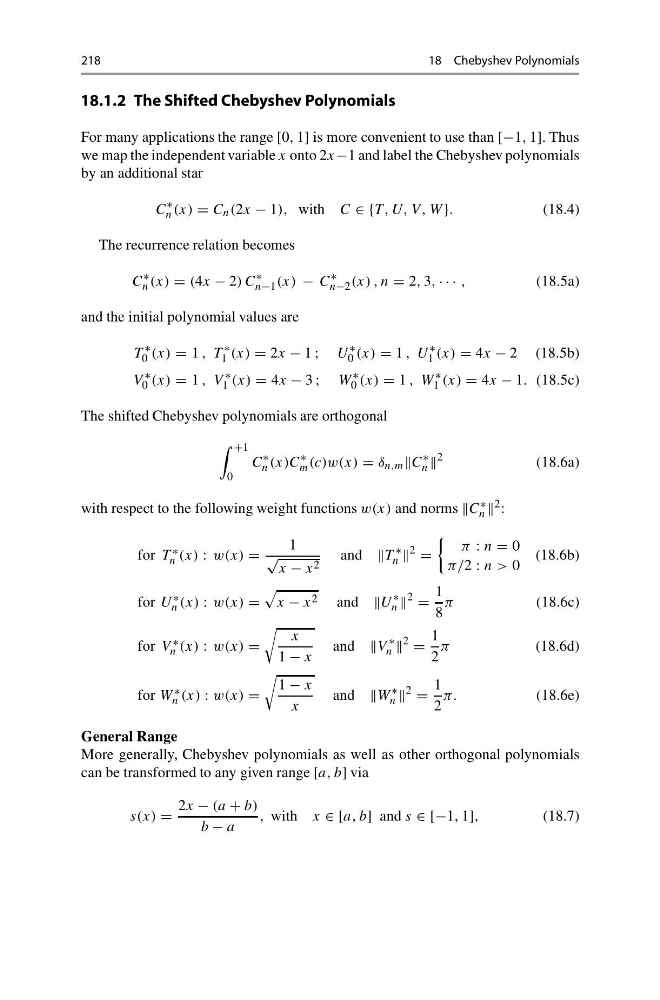
For many applications the range [0, 1] is more convenient to use than [−1, 1]. Thus
we map the independent variable x onto 2x −1 and label the Chebyshev polynomials
by an additional star
C
∗
n (x) = C n (2x − 1), with C ∈ {T , U, V , W }.
(18.4)
The recurrence relation becomes
C
∗
n (x) = (4x − 2) C
∗
n−1 (x) − C
∗
n−2 (x) , n = 2, 3, · · · ,
(18.5a)
and the initial polynomial values are
T
∗
0 (x) = 1 , T
∗
1 (x) = 2x − 1 ; U
∗
0 (x) = 1 , U
∗
1 (x) = 4x − 2 (18.5b)
V
∗
0 (x) = 1 , V
∗
1 (x) = 4x − 3 ; W
∗
0 (x) = 1 , W
∗
1 (x) = 4x − 1. (18.5c)
The shifted Chebyshev polynomials are orthogonal
+1
0
C
∗
n (x)C
∗
m (c)w(x) = δ n,m
∗
n
2
(18.6a)
with respect to the following weight functions w(x) and norms ∗
n 2 :
for T ∗
n (x) : w(x) =
1
√
x − x 2
and
∗
n
2
=
π : n = 0
π/2 : n > 0
(18.6b)
for U ∗
n (x) : w(x) =
x − x 2 and
∗
n
2
=
1
8
π
(18.6c)
for V ∗
n (x) : w(x) =
x
1 − x
and
∗
n
2
=
1
2
π
(18.6d)
for W ∗
n (x) : w(x) =
1 − x
x
and
∗
n
2
=
1
2
π.
(18.6e)
General Range
More generally, Chebyshev polynomials as well as other orthogonal polynomials
can be transformed to any given range [a, b] via
s(x) =
2x − (a + b)
b − a
, with x ∈ [a, b] and s ∈ [−1, 1],
(18.7)
18 Chebyshev Polynomials
18.1.2 The Shifted Chebyshev Polynomials
For many applications the range [0, 1] is more convenient to use than [−1, 1]. Thus
we map the independent variable x onto 2x −1 and label the Chebyshev polynomials
by an additional star
C
∗
n (x) = C n (2x − 1), with C ∈ {T , U, V , W }.
(18.4)
The recurrence relation becomes
C
∗
n (x) = (4x − 2) C
∗
n−1 (x) − C
∗
n−2 (x) , n = 2, 3, · · · ,
(18.5a)
and the initial polynomial values are
T
∗
0 (x) = 1 , T
∗
1 (x) = 2x − 1 ; U
∗
0 (x) = 1 , U
∗
1 (x) = 4x − 2 (18.5b)
V
∗
0 (x) = 1 , V
∗
1 (x) = 4x − 3 ; W
∗
0 (x) = 1 , W
∗
1 (x) = 4x − 1. (18.5c)
The shifted Chebyshev polynomials are orthogonal
+1
0
C
∗
n (x)C
∗
m (c)w(x) = δ n,m
∗
n
2
(18.6a)
with respect to the following weight functions w(x) and norms ∗
n 2 :
for T ∗
n (x) : w(x) =
1
√
x − x 2
and
∗
n
2
=
π : n = 0
π/2 : n > 0
(18.6b)
for U ∗
n (x) : w(x) =
x − x 2 and
∗
n
2
=
1
8
π
(18.6c)
for V ∗
n (x) : w(x) =
x
1 − x
and
∗
n
2
=
1
2
π
(18.6d)
for W ∗
n (x) : w(x) =
1 − x
x
and
∗
n
2
=
1
2
π.
(18.6e)
General Range
More generally, Chebyshev polynomials as well as other orthogonal polynomials
can be transformed to any given range [a, b] via
s(x) =
2x − (a + b)
b − a
, with x ∈ [a, b] and s ∈ [−1, 1],
(18.7)