

15.4 Gegenbauer Polynomials
189
15.4 Gegenbauer Polynomials
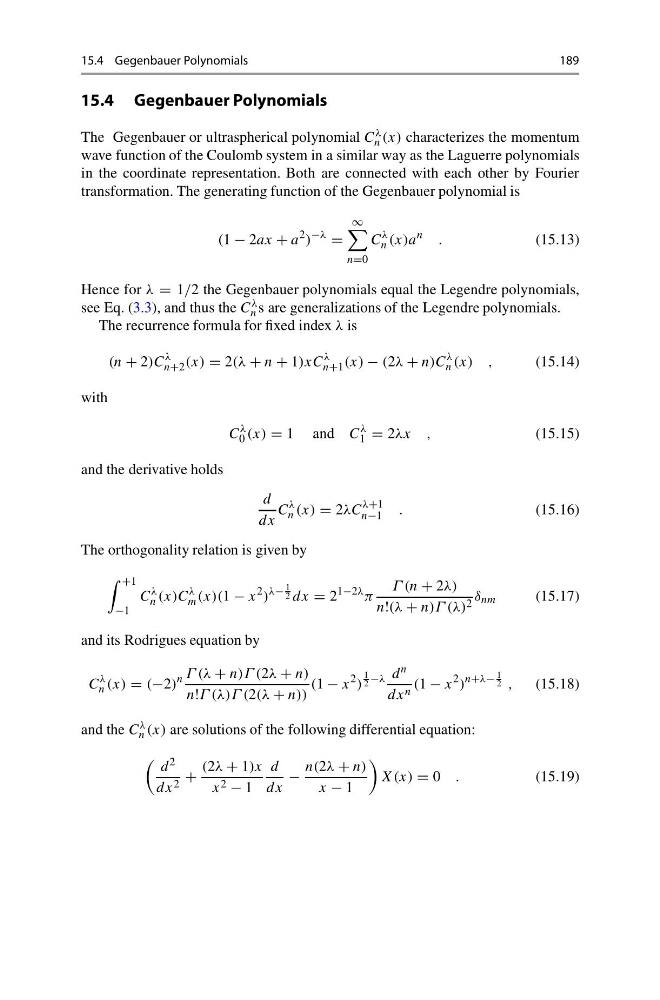
The Gegenbauer or ultraspherical polynomial C λ
n (x) characterizes the momentum
wave function of the Coulomb system in a similar way as the Laguerre polynomials
in the coordinate representation. Both are connected with each other by Fourier
transformation. The generating function of the Gegenbauer polynomial is
(1 − 2ax + a
2 )
−λ
=
∞
n=0
C
λ
n (x)a
n .
(15.13)
Hence for λ = 1/2 the Gegenbauer polynomials equal the Legendre polynomials,
see Eq. (3.3), and thus the C λ
n s are generalizations of the Legendre polynomials.
The recurrence formula for fixed index λ is
(n + 2)C
λ
n+2 (x) = 2(λ + n + 1)xC
λ
n+1 (x) − (2λ + n)C
λ
n (x) ,
(15.14)
with
C
λ
0 (x) = 1 and C
λ
1 = 2λx ,
(15.15)
and the derivative holds
d
dx
C
λ
n (x) = 2λC
λ+1
n−1 .
(15.16)
The orthogonality relation is given by
+1
−1
C
λ
n (x)C
λ
m (x)(1 − x
2 )
λ−
1
2 dx = 2
1−2λ π
Γ (n + 2λ)
n!(λ + n)Γ (λ) 2 δ nm
(15.17)
and its Rodrigues equation by
C
λ
n (x) = (−2)
n Γ (λ + n)Γ (2λ + n)
n!Γ (λ)Γ (2(λ + n))
(1 − x
2 )
1
2 −λ d n
dx n (1 − x
2 )
n+λ−
1
2 ,
(15.18)
and the C λ
n (x) are solutions of the following differential equation:
d 2
dx 2 +
(2λ + 1)x
x 2 − 1
d
dx
−
n(2λ + n)
x − 1
X(x) = 0 .
(15.19)
189
15.4 Gegenbauer Polynomials
The Gegenbauer or ultraspherical polynomial C λ
n (x) characterizes the momentum
wave function of the Coulomb system in a similar way as the Laguerre polynomials
in the coordinate representation. Both are connected with each other by Fourier
transformation. The generating function of the Gegenbauer polynomial is
(1 − 2ax + a
2 )
−λ
=
∞
n=0
C
λ
n (x)a
n .
(15.13)
Hence for λ = 1/2 the Gegenbauer polynomials equal the Legendre polynomials,
see Eq. (3.3), and thus the C λ
n s are generalizations of the Legendre polynomials.
The recurrence formula for fixed index λ is
(n + 2)C
λ
n+2 (x) = 2(λ + n + 1)xC
λ
n+1 (x) − (2λ + n)C
λ
n (x) ,
(15.14)
with
C
λ
0 (x) = 1 and C
λ
1 = 2λx ,
(15.15)
and the derivative holds
d
dx
C
λ
n (x) = 2λC
λ+1
n−1 .
(15.16)
The orthogonality relation is given by
+1
−1
C
λ
n (x)C
λ
m (x)(1 − x
2 )
λ−
1
2 dx = 2
1−2λ π
Γ (n + 2λ)
n!(λ + n)Γ (λ) 2 δ nm
(15.17)
and its Rodrigues equation by
C
λ
n (x) = (−2)
n Γ (λ + n)Γ (2λ + n)
n!Γ (λ)Γ (2(λ + n))
(1 − x
2 )
1
2 −λ d n
dx n (1 − x
2 )
n+λ−
1
2 ,
(15.18)
and the C λ
n (x) are solutions of the following differential equation:
d 2
dx 2 +
(2λ + 1)x
x 2 − 1
d
dx
−
n(2λ + n)
x − 1
X(x) = 0 .
(15.19)