

5.3 The Anger Function and the Weber Function
87
Because σ 1 (ν, z) is an even function and σ 2 (ν, z) an odd function
J ν (−z) = J −ν (z) and
(5.15a)
E ν (−z) = −E −ν (z).
(5.15b)
For z = 0 the Anger function J ν (z) and the Weber function E ν (z) becomes
J ν (0) =
sin(πν)
πν
and
(5.16a)
E ν (−z) =
1 − cos(πν)
πν
.
(5.16b)
5.3.1 Anger Function
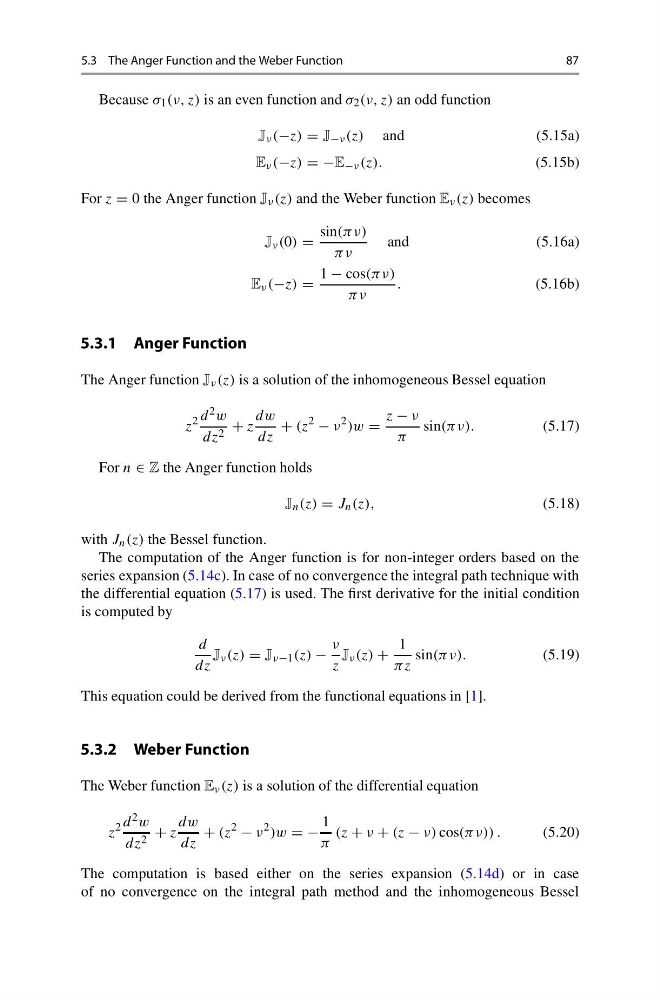
The Anger function J ν (z) is a solution of the inhomogeneous Bessel equation
z
2 d 2 w
dz 2 + z
dw
dz
+ (z
2
− ν
2 )w =
z − ν
π
sin(πν).
(5.17)
For n ∈ Z the Anger function holds
J n (z) = J n (z),
(5.18)
with J n (z) the Bessel function.
The computation of the Anger function is for non-integer orders based on the
series expansion (5.14c). In case of no convergence the integral path technique with
the differential equation (5.17) is used. The first derivative for the initial condition
is computed by
d
dz
J ν (z) = J ν−1 (z) −
ν
z
J ν (z) +
1
πz
sin(πν).
(5.19)
This equation could be derived from the functional equations in [1].
5.3.2 Weber Function
The Weber function E ν (z) is a solution of the differential equation
z
2 d 2 w
dz 2 + z
dw
dz
+ (z
2
− ν
2 )w = −
1
π
(z + ν + (z − ν) cos(πν)) .
(5.20)
The computation is based either on the series expansion (5.14d) or in case
of no convergence on the integral path method and the inhomogeneous Bessel
87
Because σ 1 (ν, z) is an even function and σ 2 (ν, z) an odd function
J ν (−z) = J −ν (z) and
(5.15a)
E ν (−z) = −E −ν (z).
(5.15b)
For z = 0 the Anger function J ν (z) and the Weber function E ν (z) becomes
J ν (0) =
sin(πν)
πν
and
(5.16a)
E ν (−z) =
1 − cos(πν)
πν
.
(5.16b)
5.3.1 Anger Function
The Anger function J ν (z) is a solution of the inhomogeneous Bessel equation
z
2 d 2 w
dz 2 + z
dw
dz
+ (z
2
− ν
2 )w =
z − ν
π
sin(πν).
(5.17)
For n ∈ Z the Anger function holds
J n (z) = J n (z),
(5.18)
with J n (z) the Bessel function.
The computation of the Anger function is for non-integer orders based on the
series expansion (5.14c). In case of no convergence the integral path technique with
the differential equation (5.17) is used. The first derivative for the initial condition
is computed by
d
dz
J ν (z) = J ν−1 (z) −
ν
z
J ν (z) +
1
πz
sin(πν).
(5.19)
This equation could be derived from the functional equations in [1].
5.3.2 Weber Function
The Weber function E ν (z) is a solution of the differential equation
z
2 d 2 w
dz 2 + z
dw
dz
+ (z
2
− ν
2 )w = −
1
π
(z + ν + (z − ν) cos(πν)) .
(5.20)
The computation is based either on the series expansion (5.14d) or in case
of no convergence on the integral path method and the inhomogeneous Bessel