

82
5 Ionization Counters
5.11 Current–Voltage Characteristics of the G.M. Counter
Like the proportional counter for the Geiger–Müller counter also we need to determine the best operating potential. The current–voltage characteristic for Geiger–
Müller counter falls in the region (E) of the current–voltage characteristic of an
ionization counter (Fig. 5.2), but it appears from this graph that there is no plateau
in this region as observed with proportional counter (Fig. 5.9) which is not true. The
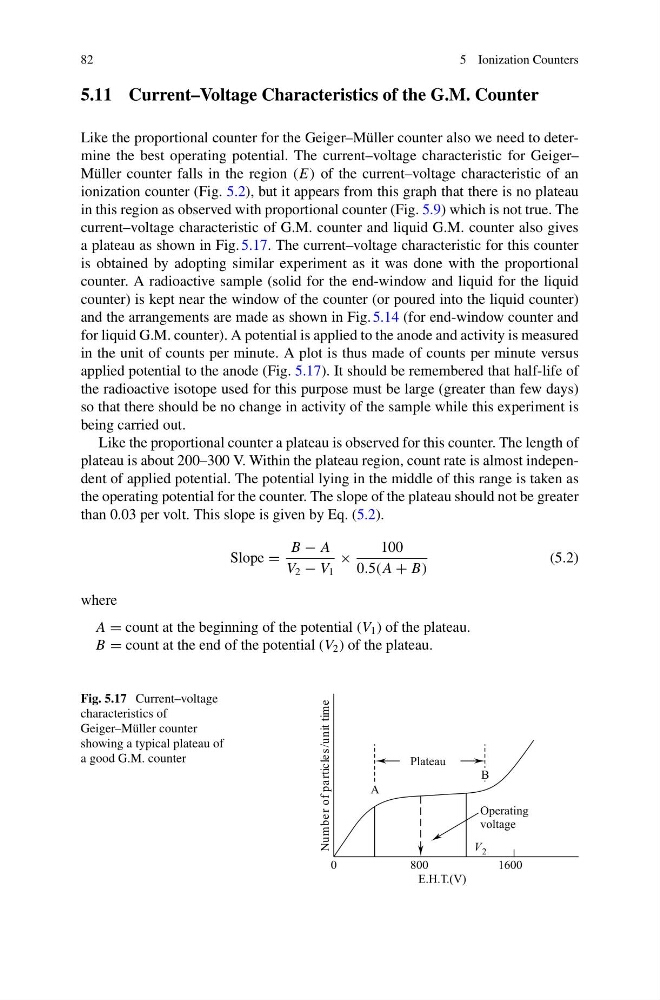
current–voltage characteristic of G.M. counter and liquid G.M. counter also gives
a plateau as shown in Fig. 5.17. The current–voltage characteristic for this counter
is obtained by adopting similar experiment as it was done with the proportional
counter. A radioactive sample (solid for the end-window and liquid for the liquid
counter) is kept near the window of the counter (or poured into the liquid counter)
and the arrangements are made as shown in Fig. 5.14 (for end-window counter and
for liquid G.M. counter). A potential is applied to the anode and activity is measured
in the unit of counts per minute. A plot is thus made of counts per minute versus
applied potential to the anode (Fig. 5.17). It should be remembered that half-life of
the radioactive isotope used for this purpose must be large (greater than few days)
so that there should be no change in activity of the sample while this experiment is
being carried out.
Like the proportional counter a plateau is observed for this counter. The length of
plateau is about 200–300 V. Within the plateau region, count rate is almost independent of applied potential. The potential lying in the middle of this range is taken as
the operating potential for the counter. The slope of the plateau should not be greater
than 0.03 per volt. This slope is given by Eq. (5.2).
Slope =
B − A
V 2 − V 1
×
100
0.5(A + B)
(5.2)
where
A = count at the beginning of the potential (V 1 ) of the plateau.
B = count at the end of the potential (V 2 ) of the plateau.
Fig. 5.17 Current–voltage
characteristics of
Geiger–Müller counter
showing a typical plateau of
a good G.M. counter
5 Ionization Counters
5.11 Current–Voltage Characteristics of the G.M. Counter
Like the proportional counter for the Geiger–Müller counter also we need to determine the best operating potential. The current–voltage characteristic for Geiger–
Müller counter falls in the region (E) of the current–voltage characteristic of an
ionization counter (Fig. 5.2), but it appears from this graph that there is no plateau
in this region as observed with proportional counter (Fig. 5.9) which is not true. The
current–voltage characteristic of G.M. counter and liquid G.M. counter also gives
a plateau as shown in Fig. 5.17. The current–voltage characteristic for this counter
is obtained by adopting similar experiment as it was done with the proportional
counter. A radioactive sample (solid for the end-window and liquid for the liquid
counter) is kept near the window of the counter (or poured into the liquid counter)
and the arrangements are made as shown in Fig. 5.14 (for end-window counter and
for liquid G.M. counter). A potential is applied to the anode and activity is measured
in the unit of counts per minute. A plot is thus made of counts per minute versus
applied potential to the anode (Fig. 5.17). It should be remembered that half-life of
the radioactive isotope used for this purpose must be large (greater than few days)
so that there should be no change in activity of the sample while this experiment is
being carried out.
Like the proportional counter a plateau is observed for this counter. The length of
plateau is about 200–300 V. Within the plateau region, count rate is almost independent of applied potential. The potential lying in the middle of this range is taken as
the operating potential for the counter. The slope of the plateau should not be greater
than 0.03 per volt. This slope is given by Eq. (5.2).
Slope =
B − A
V 2 − V 1
×
100
0.5(A + B)
(5.2)
where
A = count at the beginning of the potential (V 1 ) of the plateau.
B = count at the end of the potential (V 2 ) of the plateau.
Fig. 5.17 Current–voltage
characteristics of
Geiger–Müller counter
showing a typical plateau of
a good G.M. counter