

5.10 Liquid Geiger–Müller Counter
81
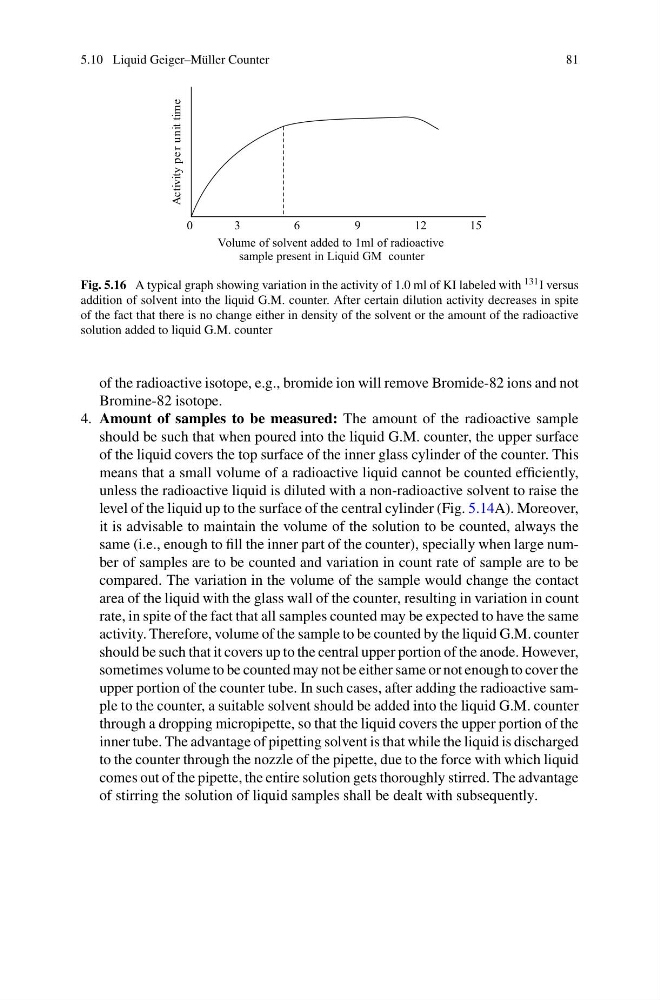
Fig. 5.16 A typical graph showing variation in the activity of 1.0 ml of KI labeled with 131 I versus
addition of solvent into the liquid G.M. counter. After certain dilution activity decreases in spite
of the fact that there is no change either in density of the solvent or the amount of the radioactive
solution added to liquid G.M. counter
of the radioactive isotope, e.g., bromide ion will remove Bromide-82 ions and not
Bromine-82 isotope.
4. Amount of samples to be measured: The amount of the radioactive sample
should be such that when poured into the liquid G.M. counter, the upper surface
of the liquid covers the top surface of the inner glass cylinder of the counter. This
means that a small volume of a radioactive liquid cannot be counted efficiently,
unless the radioactive liquid is diluted with a non-radioactive solvent to raise the
level of the liquid up to the surface of the central cylinder (Fig. 5.14A). Moreover,
it is advisable to maintain the volume of the solution to be counted, always the
same (i.e., enough to fill the inner part of the counter), specially when large number of samples are to be counted and variation in count rate of sample are to be
compared. The variation in the volume of the sample would change the contact
area of the liquid with the glass wall of the counter, resulting in variation in count
rate, in spite of the fact that all samples counted may be expected to have the same
activity. Therefore, volume of the sample to be counted by the liquid G.M. counter
should be such that it covers up to the central upper portion of the anode. However,
sometimes volume to be counted may not be either same or not enough to cover the
upper portion of the counter tube. In such cases, after adding the radioactive sample to the counter, a suitable solvent should be added into the liquid G.M. counter
through a dropping micropipette, so that the liquid covers the upper portion of the
inner tube. The advantage of pipetting solvent is that while the liquid is discharged
to the counter through the nozzle of the pipette, due to the force with which liquid
comes out of the pipette, the entire solution gets thoroughly stirred. The advantage
of stirring the solution of liquid samples shall be dealt with subsequently.
81
Fig. 5.16 A typical graph showing variation in the activity of 1.0 ml of KI labeled with 131 I versus
addition of solvent into the liquid G.M. counter. After certain dilution activity decreases in spite
of the fact that there is no change either in density of the solvent or the amount of the radioactive
solution added to liquid G.M. counter
of the radioactive isotope, e.g., bromide ion will remove Bromide-82 ions and not
Bromine-82 isotope.
4. Amount of samples to be measured: The amount of the radioactive sample
should be such that when poured into the liquid G.M. counter, the upper surface
of the liquid covers the top surface of the inner glass cylinder of the counter. This
means that a small volume of a radioactive liquid cannot be counted efficiently,
unless the radioactive liquid is diluted with a non-radioactive solvent to raise the
level of the liquid up to the surface of the central cylinder (Fig. 5.14A). Moreover,
it is advisable to maintain the volume of the solution to be counted, always the
same (i.e., enough to fill the inner part of the counter), specially when large number of samples are to be counted and variation in count rate of sample are to be
compared. The variation in the volume of the sample would change the contact
area of the liquid with the glass wall of the counter, resulting in variation in count
rate, in spite of the fact that all samples counted may be expected to have the same
activity. Therefore, volume of the sample to be counted by the liquid G.M. counter
should be such that it covers up to the central upper portion of the anode. However,
sometimes volume to be counted may not be either same or not enough to cover the
upper portion of the counter tube. In such cases, after adding the radioactive sample to the counter, a suitable solvent should be added into the liquid G.M. counter
through a dropping micropipette, so that the liquid covers the upper portion of the
inner tube. The advantage of pipetting solvent is that while the liquid is discharged
to the counter through the nozzle of the pipette, due to the force with which liquid
comes out of the pipette, the entire solution gets thoroughly stirred. The advantage
of stirring the solution of liquid samples shall be dealt with subsequently.