

5.8 Proportional Counter
69
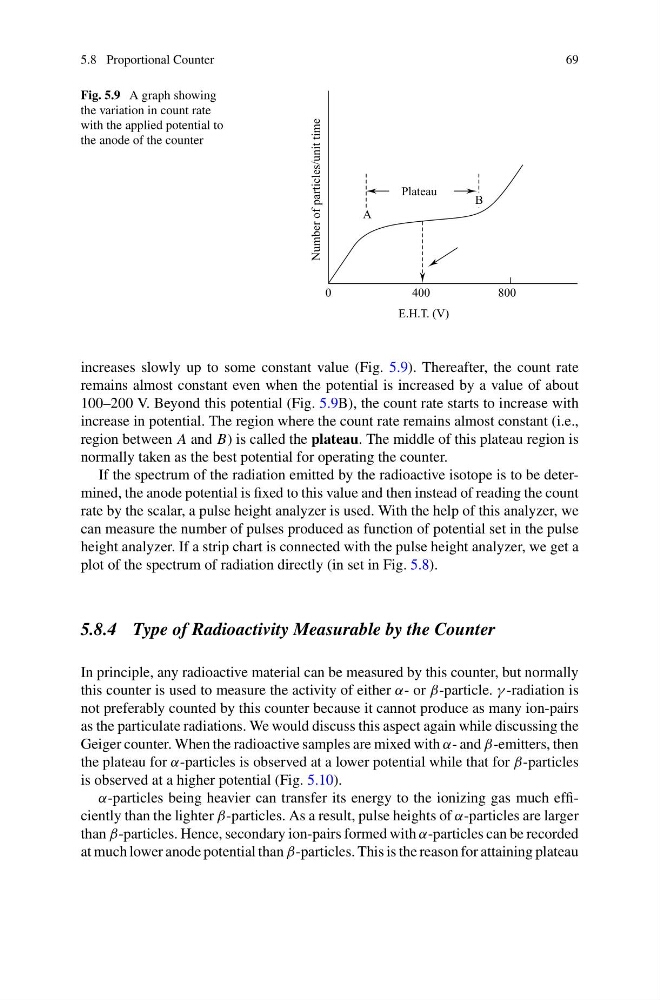
Fig. 5.9 A graph showing
the variation in count rate
with the applied potential to
the anode of the counter
0
400
800
E.H.T. (V)
A
Plateau
Number of particles/unit time
B
increases slowly up to some constant value (Fig. 5.9). Thereafter, the count rate
remains almost constant even when the potential is increased by a value of about
100–200 V. Beyond this potential (Fig. 5.9B), the count rate starts to increase with
increase in potential. The region where the count rate remains almost constant (i.e.,
region between A and B) is called the plateau. The middle of this plateau region is
normally taken as the best potential for operating the counter.
If the spectrum of the radiation emitted by the radioactive isotope is to be determined, the anode potential is fixed to this value and then instead of reading the count
rate by the scalar, a pulse height analyzer is used. With the help of this analyzer, we
can measure the number of pulses produced as function of potential set in the pulse
height analyzer. If a strip chart is connected with the pulse height analyzer, we get a
plot of the spectrum of radiation directly (in set in Fig. 5.8).
5.8.4 Type of Radioactivity Measurable by the Counter
In principle, any radioactive material can be measured by this counter, but normally
this counter is used to measure the activity of either α- or β-particle. γ -radiation is
not preferably counted by this counter because it cannot produce as many ion-pairs
as the particulate radiations. We would discuss this aspect again while discussing the
Geiger counter. When the radioactive samples are mixed with α- and β-emitters, then
the plateau for α-particles is observed at a lower potential while that for β-particles
is observed at a higher potential (Fig. 5.10).
α-particles being heavier can transfer its energy to the ionizing gas much efficiently than the lighter β-particles. As a result, pulse heights of α-particles are larger
than β-particles. Hence, secondary ion-pairs formed with α-particles can be recorded
at much lower anode potential than β-particles. This is the reason for attaining plateau
69
Fig. 5.9 A graph showing
the variation in count rate
with the applied potential to
the anode of the counter
0
400
800
E.H.T. (V)
A
Plateau
Number of particles/unit time
B
increases slowly up to some constant value (Fig. 5.9). Thereafter, the count rate
remains almost constant even when the potential is increased by a value of about
100–200 V. Beyond this potential (Fig. 5.9B), the count rate starts to increase with
increase in potential. The region where the count rate remains almost constant (i.e.,
region between A and B) is called the plateau. The middle of this plateau region is
normally taken as the best potential for operating the counter.
If the spectrum of the radiation emitted by the radioactive isotope is to be determined, the anode potential is fixed to this value and then instead of reading the count
rate by the scalar, a pulse height analyzer is used. With the help of this analyzer, we
can measure the number of pulses produced as function of potential set in the pulse
height analyzer. If a strip chart is connected with the pulse height analyzer, we get a
plot of the spectrum of radiation directly (in set in Fig. 5.8).
5.8.4 Type of Radioactivity Measurable by the Counter
In principle, any radioactive material can be measured by this counter, but normally
this counter is used to measure the activity of either α- or β-particle. γ -radiation is
not preferably counted by this counter because it cannot produce as many ion-pairs
as the particulate radiations. We would discuss this aspect again while discussing the
Geiger counter. When the radioactive samples are mixed with α- and β-emitters, then
the plateau for α-particles is observed at a lower potential while that for β-particles
is observed at a higher potential (Fig. 5.10).
α-particles being heavier can transfer its energy to the ionizing gas much efficiently than the lighter β-particles. As a result, pulse heights of α-particles are larger
than β-particles. Hence, secondary ion-pairs formed with α-particles can be recorded
at much lower anode potential than β-particles. This is the reason for attaining plateau