

70
5 Ionization Counters
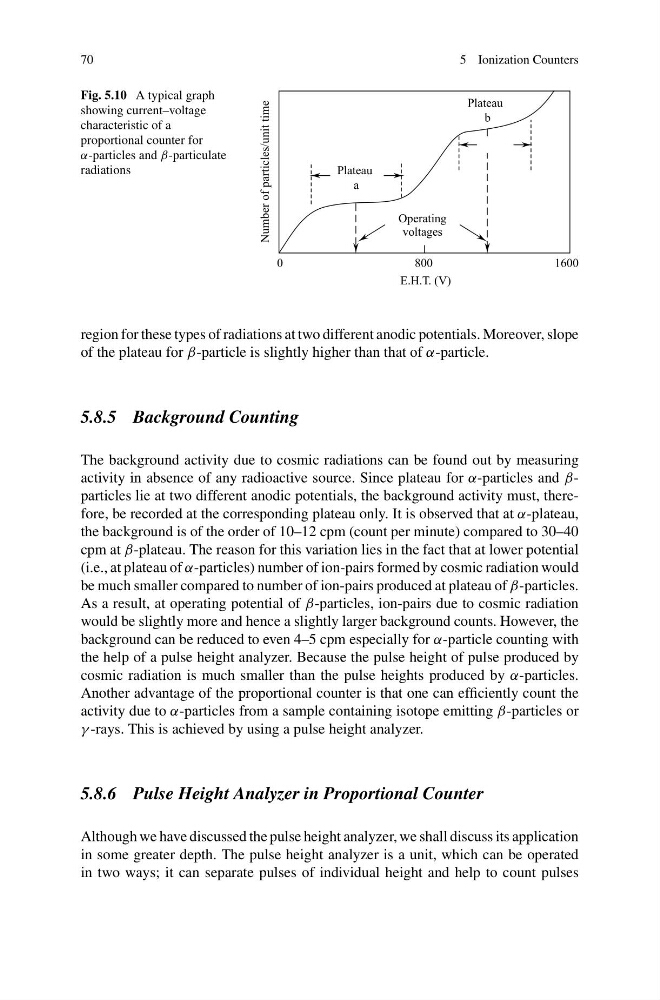
Fig. 5.10 A typical graph
showing current–voltage
characteristic of a
proportional counter for
α-particles and β-particulate
radiations
Plateau
Number of particles/unit time
a
Operating
voltages
800
E.H.T. (V)
1600
0
Plateau
b
region for these types of radiations at two different anodic potentials. Moreover, slope
of the plateau for β-particle is slightly higher than that of α-particle.
5.8.5 Background Counting
The background activity due to cosmic radiations can be found out by measuring
activity in absence of any radioactive source. Since plateau for α-particles and βparticles lie at two different anodic potentials, the background activity must, therefore, be recorded at the corresponding plateau only. It is observed that at α-plateau,
the background is of the order of 10–12 cpm (count per minute) compared to 30–40
cpm at β-plateau. The reason for this variation lies in the fact that at lower potential
(i.e., at plateau of α-particles) number of ion-pairs formed by cosmic radiation would
be much smaller compared to number of ion-pairs produced at plateau of β-particles.
As a result, at operating potential of β-particles, ion-pairs due to cosmic radiation
would be slightly more and hence a slightly larger background counts. However, the
background can be reduced to even 4–5 cpm especially for α-particle counting with
the help of a pulse height analyzer. Because the pulse height of pulse produced by
cosmic radiation is much smaller than the pulse heights produced by α-particles.
Another advantage of the proportional counter is that one can efficiently count the
activity due to α-particles from a sample containing isotope emitting β-particles or
γ -rays. This is achieved by using a pulse height analyzer.
5.8.6 Pulse Height Analyzer in Proportional Counter
Although we have discussed the pulse height analyzer, we shall discuss its application
in some greater depth. The pulse height analyzer is a unit, which can be operated
in two ways; it can separate pulses of individual height and help to count pulses
5 Ionization Counters
Fig. 5.10 A typical graph
showing current–voltage
characteristic of a
proportional counter for
α-particles and β-particulate
radiations
Plateau
Number of particles/unit time
a
Operating
voltages
800
E.H.T. (V)
1600
0
Plateau
b
region for these types of radiations at two different anodic potentials. Moreover, slope
of the plateau for β-particle is slightly higher than that of α-particle.
5.8.5 Background Counting
The background activity due to cosmic radiations can be found out by measuring
activity in absence of any radioactive source. Since plateau for α-particles and βparticles lie at two different anodic potentials, the background activity must, therefore, be recorded at the corresponding plateau only. It is observed that at α-plateau,
the background is of the order of 10–12 cpm (count per minute) compared to 30–40
cpm at β-plateau. The reason for this variation lies in the fact that at lower potential
(i.e., at plateau of α-particles) number of ion-pairs formed by cosmic radiation would
be much smaller compared to number of ion-pairs produced at plateau of β-particles.
As a result, at operating potential of β-particles, ion-pairs due to cosmic radiation
would be slightly more and hence a slightly larger background counts. However, the
background can be reduced to even 4–5 cpm especially for α-particle counting with
the help of a pulse height analyzer. Because the pulse height of pulse produced by
cosmic radiation is much smaller than the pulse heights produced by α-particles.
Another advantage of the proportional counter is that one can efficiently count the
activity due to α-particles from a sample containing isotope emitting β-particles or
γ -rays. This is achieved by using a pulse height analyzer.
5.8.6 Pulse Height Analyzer in Proportional Counter
Although we have discussed the pulse height analyzer, we shall discuss its application
in some greater depth. The pulse height analyzer is a unit, which can be operated
in two ways; it can separate pulses of individual height and help to count pulses