

5.6 Nature of Pulses Produced in Ionization Chamber
61
B
C
A
D
A
D
B
C
D
A
B
A D
I
II
III
IV
Time
– ve
+ ve
Zero
level 0
B
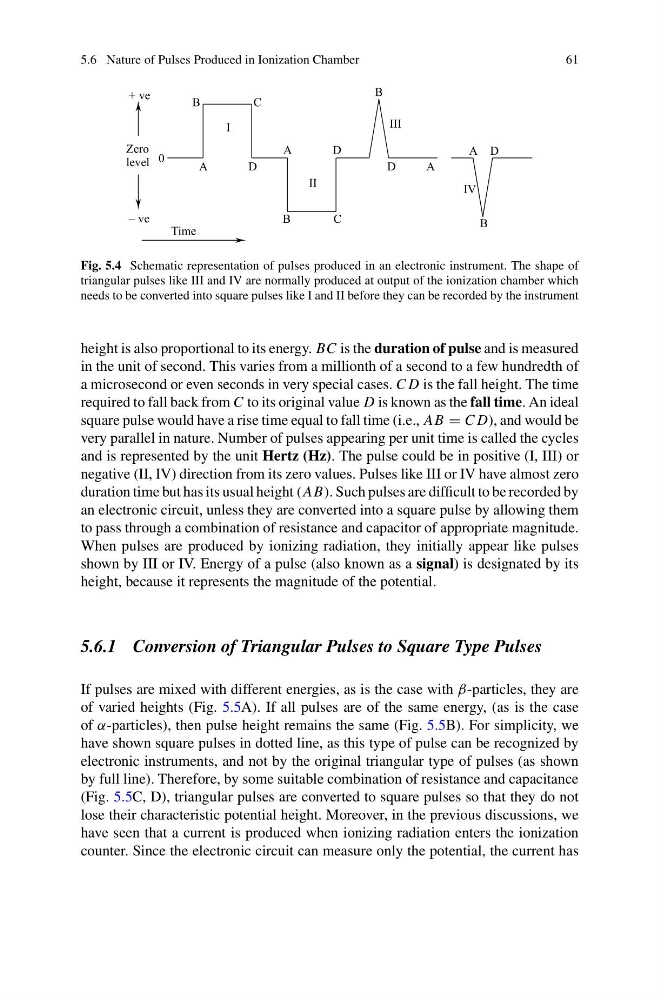
Fig. 5.4 Schematic representation of pulses produced in an electronic instrument. The shape of
triangular pulses like III and IV are normally produced at output of the ionization chamber which
needs to be converted into square pulses like I and II before they can be recorded by the instrument
height is also proportional to its energy. BC is the duration of pulse and is measured
in the unit of second. This varies from a millionth of a second to a few hundredth of
a microsecond or even seconds in very special cases. C D is the fall height. The time
required to fall back from C to its original value D is known as the fall time. An ideal
square pulse would have a rise time equal to fall time (i.e., AB = C D), and would be
very parallel in nature. Number of pulses appearing per unit time is called the cycles
and is represented by the unit Hertz (Hz). The pulse could be in positive (I, III) or
negative (II, IV) direction from its zero values. Pulses like III or IV have almost zero
duration time but has its usual height (AB). Such pulses are difficult to be recorded by
an electronic circuit, unless they are converted into a square pulse by allowing them
to pass through a combination of resistance and capacitor of appropriate magnitude.
When pulses are produced by ionizing radiation, they initially appear like pulses
shown by III or IV. Energy of a pulse (also known as a signal) is designated by its
height, because it represents the magnitude of the potential.
5.6.1 Conversion of Triangular Pulses to Square Type Pulses
If pulses are mixed with different energies, as is the case with β-particles, they are
of varied heights (Fig. 5.5A). If all pulses are of the same energy, (as is the case
of α-particles), then pulse height remains the same (Fig. 5.5B). For simplicity, we
have shown square pulses in dotted line, as this type of pulse can be recognized by
electronic instruments, and not by the original triangular type of pulses (as shown
by full line). Therefore, by some suitable combination of resistance and capacitance
(Fig. 5.5C, D), triangular pulses are converted to square pulses so that they do not
lose their characteristic potential height. Moreover, in the previous discussions, we
have seen that a current is produced when ionizing radiation enters the ionization
counter. Since the electronic circuit can measure only the potential, the current has
61
B
C
A
D
A
D
B
C
D
A
B
A D
I
II
III
IV
Time
– ve
+ ve
Zero
level 0
B
Fig. 5.4 Schematic representation of pulses produced in an electronic instrument. The shape of
triangular pulses like III and IV are normally produced at output of the ionization chamber which
needs to be converted into square pulses like I and II before they can be recorded by the instrument
height is also proportional to its energy. BC is the duration of pulse and is measured
in the unit of second. This varies from a millionth of a second to a few hundredth of
a microsecond or even seconds in very special cases. C D is the fall height. The time
required to fall back from C to its original value D is known as the fall time. An ideal
square pulse would have a rise time equal to fall time (i.e., AB = C D), and would be
very parallel in nature. Number of pulses appearing per unit time is called the cycles
and is represented by the unit Hertz (Hz). The pulse could be in positive (I, III) or
negative (II, IV) direction from its zero values. Pulses like III or IV have almost zero
duration time but has its usual height (AB). Such pulses are difficult to be recorded by
an electronic circuit, unless they are converted into a square pulse by allowing them
to pass through a combination of resistance and capacitor of appropriate magnitude.
When pulses are produced by ionizing radiation, they initially appear like pulses
shown by III or IV. Energy of a pulse (also known as a signal) is designated by its
height, because it represents the magnitude of the potential.
5.6.1 Conversion of Triangular Pulses to Square Type Pulses
If pulses are mixed with different energies, as is the case with β-particles, they are
of varied heights (Fig. 5.5A). If all pulses are of the same energy, (as is the case
of α-particles), then pulse height remains the same (Fig. 5.5B). For simplicity, we
have shown square pulses in dotted line, as this type of pulse can be recognized by
electronic instruments, and not by the original triangular type of pulses (as shown
by full line). Therefore, by some suitable combination of resistance and capacitance
(Fig. 5.5C, D), triangular pulses are converted to square pulses so that they do not
lose their characteristic potential height. Moreover, in the previous discussions, we
have seen that a current is produced when ionizing radiation enters the ionization
counter. Since the electronic circuit can measure only the potential, the current has