

62
5 Ionization Counters
output
output
input
or
II
I
input
input
output C
-particles
of mixed
energy
-particles
of same
energy
A
B
D
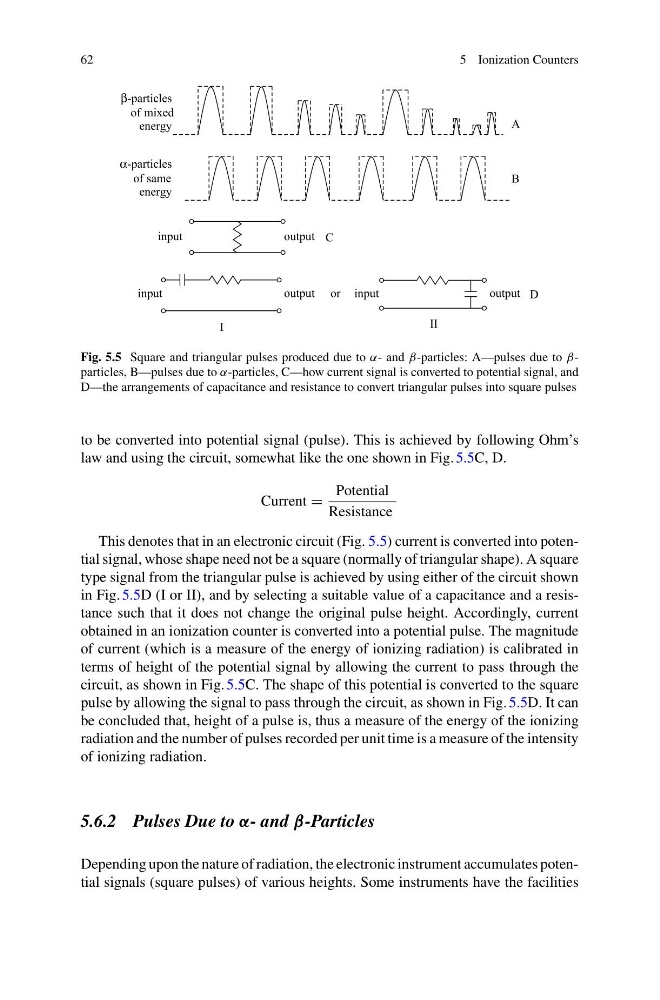
Fig. 5.5 Square and triangular pulses produced due to α- and β-particles: A—pulses due to βparticles, B—pulses due to α-particles, C—how current signal is converted to potential signal, and
D—the arrangements of capacitance and resistance to convert triangular pulses into square pulses
to be converted into potential signal (pulse). This is achieved by following Ohm’s
law and using the circuit, somewhat like the one shown in Fig. 5.5C, D.
Current =
Potential
Resistance
This denotes that in an electronic circuit (Fig. 5.5) current is converted into potential signal, whose shape need not be a square (normally of triangular shape). A square
type signal from the triangular pulse is achieved by using either of the circuit shown
in Fig. 5.5D (I or II), and by selecting a suitable value of a capacitance and a resistance such that it does not change the original pulse height. Accordingly, current
obtained in an ionization counter is converted into a potential pulse. The magnitude
of current (which is a measure of the energy of ionizing radiation) is calibrated in
terms of height of the potential signal by allowing the current to pass through the
circuit, as shown in Fig. 5.5C. The shape of this potential is converted to the square
pulse by allowing the signal to pass through the circuit, as shown in Fig. 5.5D. It can
be concluded that, height of a pulse is, thus a measure of the energy of the ionizing
radiation and the number of pulses recorded per unit time is a measure of the intensity
of ionizing radiation.
5.6.2 Pulses Due to α- and β-Particles
Depending upon the nature of radiation, the electronic instrument accumulates potential signals (square pulses) of various heights. Some instruments have the facilities
5 Ionization Counters
output
output
input
or
II
I
input
input
output C
-particles
of mixed
energy
-particles
of same
energy
A
B
D
Fig. 5.5 Square and triangular pulses produced due to α- and β-particles: A—pulses due to βparticles, B—pulses due to α-particles, C—how current signal is converted to potential signal, and
D—the arrangements of capacitance and resistance to convert triangular pulses into square pulses
to be converted into potential signal (pulse). This is achieved by following Ohm’s
law and using the circuit, somewhat like the one shown in Fig. 5.5C, D.
Current =
Potential
Resistance
This denotes that in an electronic circuit (Fig. 5.5) current is converted into potential signal, whose shape need not be a square (normally of triangular shape). A square
type signal from the triangular pulse is achieved by using either of the circuit shown
in Fig. 5.5D (I or II), and by selecting a suitable value of a capacitance and a resistance such that it does not change the original pulse height. Accordingly, current
obtained in an ionization counter is converted into a potential pulse. The magnitude
of current (which is a measure of the energy of ionizing radiation) is calibrated in
terms of height of the potential signal by allowing the current to pass through the
circuit, as shown in Fig. 5.5C. The shape of this potential is converted to the square
pulse by allowing the signal to pass through the circuit, as shown in Fig. 5.5D. It can
be concluded that, height of a pulse is, thus a measure of the energy of the ionizing
radiation and the number of pulses recorded per unit time is a measure of the intensity
of ionizing radiation.
5.6.2 Pulses Due to α- and β-Particles
Depending upon the nature of radiation, the electronic instrument accumulates potential signals (square pulses) of various heights. Some instruments have the facilities