

60
5 Ionization Counters
Energy (MeV)
Number of particles
Number time
(A)
- particles
Energy (MeV)
(B)
K
L
E
E
x
Energy (MeV)
(C)
B
A
E max
- particles
E max
Energy (MeV)
Current
Current unit time
(D)
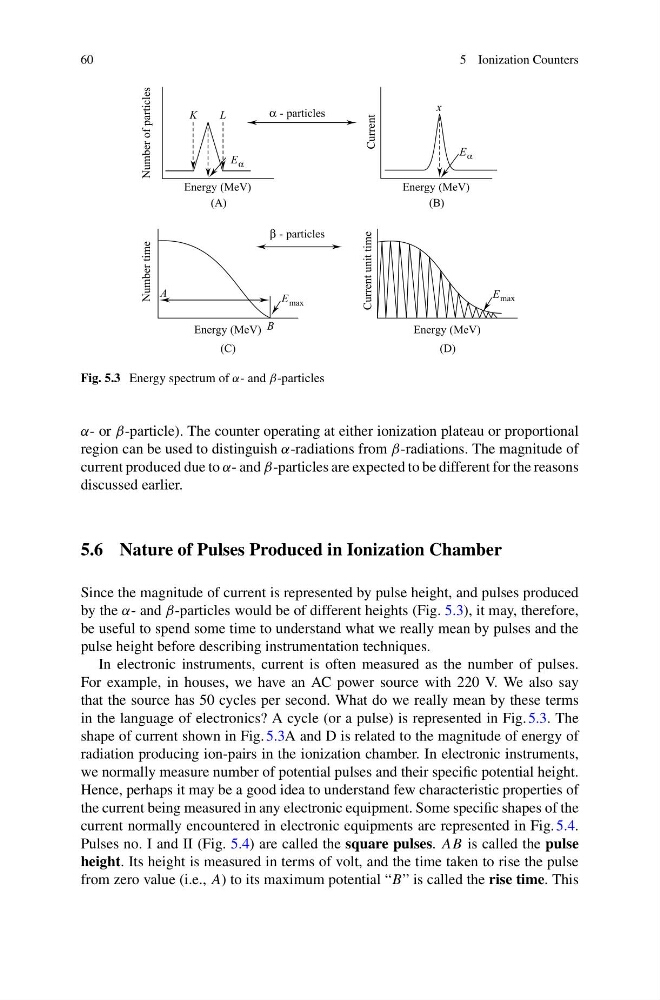
Fig. 5.3 Energy spectrum of α- and β-particles
α- or β-particle). The counter operating at either ionization plateau or proportional
region can be used to distinguish α-radiations from β-radiations. The magnitude of
current produced due to α- and β-particles are expected to be different for the reasons
discussed earlier.
5.6 Nature of Pulses Produced in Ionization Chamber
Since the magnitude of current is represented by pulse height, and pulses produced
by the α- and β-particles would be of different heights (Fig. 5.3), it may, therefore,
be useful to spend some time to understand what we really mean by pulses and the
pulse height before describing instrumentation techniques.
In electronic instruments, current is often measured as the number of pulses.
For example, in houses, we have an AC power source with 220 V. We also say
that the source has 50 cycles per second. What do we really mean by these terms
in the language of electronics? A cycle (or a pulse) is represented in Fig. 5.3. The
shape of current shown in Fig. 5.3A and D is related to the magnitude of energy of
radiation producing ion-pairs in the ionization chamber. In electronic instruments,
we normally measure number of potential pulses and their specific potential height.
Hence, perhaps it may be a good idea to understand few characteristic properties of
the current being measured in any electronic equipment. Some specific shapes of the
current normally encountered in electronic equipments are represented in Fig. 5.4.
Pulses no. I and II (Fig. 5.4) are called the square pulses. AB is called the pulse
height. Its height is measured in terms of volt, and the time taken to rise the pulse
from zero value (i.e., A) to its maximum potential “B” is called the rise time. This
5 Ionization Counters
Energy (MeV)
Number of particles
Number time
(A)
- particles
Energy (MeV)
(B)
K
L
E
E
x
Energy (MeV)
(C)
B
A
E max
- particles
E max
Energy (MeV)
Current
Current unit time
(D)
Fig. 5.3 Energy spectrum of α- and β-particles
α- or β-particle). The counter operating at either ionization plateau or proportional
region can be used to distinguish α-radiations from β-radiations. The magnitude of
current produced due to α- and β-particles are expected to be different for the reasons
discussed earlier.
5.6 Nature of Pulses Produced in Ionization Chamber
Since the magnitude of current is represented by pulse height, and pulses produced
by the α- and β-particles would be of different heights (Fig. 5.3), it may, therefore,
be useful to spend some time to understand what we really mean by pulses and the
pulse height before describing instrumentation techniques.
In electronic instruments, current is often measured as the number of pulses.
For example, in houses, we have an AC power source with 220 V. We also say
that the source has 50 cycles per second. What do we really mean by these terms
in the language of electronics? A cycle (or a pulse) is represented in Fig. 5.3. The
shape of current shown in Fig. 5.3A and D is related to the magnitude of energy of
radiation producing ion-pairs in the ionization chamber. In electronic instruments,
we normally measure number of potential pulses and their specific potential height.
Hence, perhaps it may be a good idea to understand few characteristic properties of
the current being measured in any electronic equipment. Some specific shapes of the
current normally encountered in electronic equipments are represented in Fig. 5.4.
Pulses no. I and II (Fig. 5.4) are called the square pulses. AB is called the pulse
height. Its height is measured in terms of volt, and the time taken to rise the pulse
from zero value (i.e., A) to its maximum potential “B” is called the rise time. This