

14.3 Application of Szilard-Chalmers Reactions
221
14.3 Application of Szilard-Chalmers Reactions
• One of the most important applications of this reaction is the production of labelled
inorganic or organic compounds at a high specific activity, as has been previously
mentioned.
• Another application is to estimate an internal conversion coefficient (i.e., the ratio
of the number of nuclides decaying by internal conversion to the total number
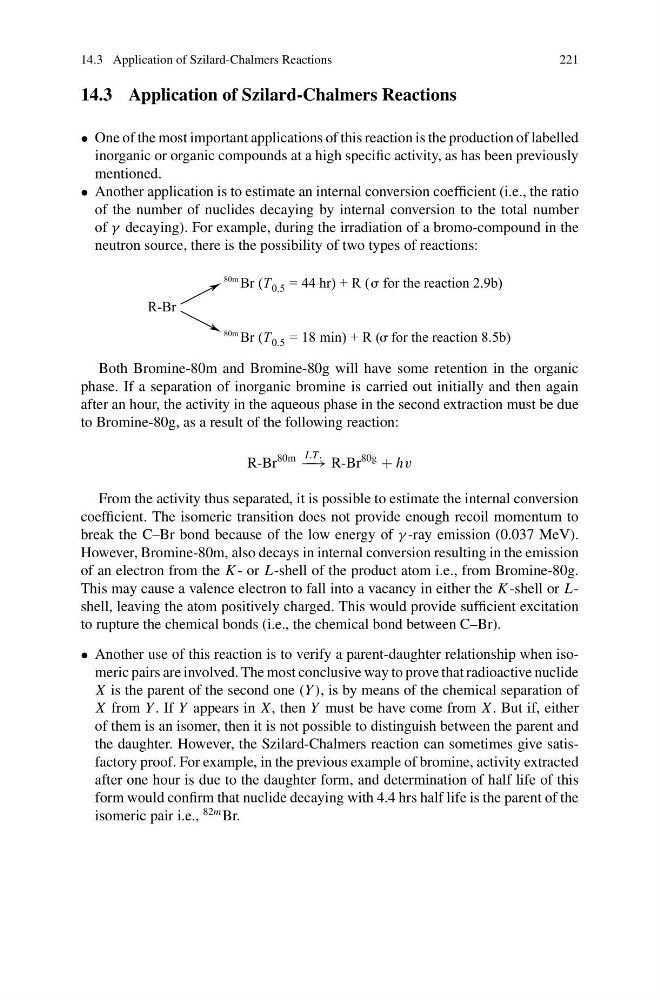
of γ decaying). For example, during the irradiation of a bromo-compound in the
neutron source, there is the possibility of two types of reactions:
Both Bromine-80m and Bromine-80g will have some retention in the organic
phase. If a separation of inorganic bromine is carried out initially and then again
after an hour, the activity in the aqueous phase in the second extraction must be due
to Bromine-80g, as a result of the following reaction:
R-Br
80m I.T.
− − → R-Br
80g
+ hv
From the activity thus separated, it is possible to estimate the internal conversion
coefficient. The isomeric transition does not provide enough recoil momentum to
break the C–Br bond because of the low energy of γ -ray emission (0.037 MeV).
However, Bromine-80m, also decays in internal conversion resulting in the emission
of an electron from the K - or L-shell of the product atom i.e., from Bromine-80g.
This may cause a valence electron to fall into a vacancy in either the K -shell or Lshell, leaving the atom positively charged. This would provide sufficient excitation
to rupture the chemical bonds (i.e., the chemical bond between C–Br).
• Another use of this reaction is to verify a parent-daughter relationship when isomeric pairs are involved. The most conclusive way to prove that radioactive nuclide
X is the parent of the second one (Y ), is by means of the chemical separation of
X from Y . If Y appears in X , then Y must be have come from X . But if, either
of them is an isomer, then it is not possible to distinguish between the parent and
the daughter. However, the Szilard-Chalmers reaction can sometimes give satisfactory proof. For example, in the previous example of bromine, activity extracted
after one hour is due to the daughter form, and determination of half life of this
form would confirm that nuclide decaying with 4.4 hrs half life is the parent of the
isomeric pair i.e.,
82m Br.
221
14.3 Application of Szilard-Chalmers Reactions
• One of the most important applications of this reaction is the production of labelled
inorganic or organic compounds at a high specific activity, as has been previously
mentioned.
• Another application is to estimate an internal conversion coefficient (i.e., the ratio
of the number of nuclides decaying by internal conversion to the total number
of γ decaying). For example, during the irradiation of a bromo-compound in the
neutron source, there is the possibility of two types of reactions:
Both Bromine-80m and Bromine-80g will have some retention in the organic
phase. If a separation of inorganic bromine is carried out initially and then again
after an hour, the activity in the aqueous phase in the second extraction must be due
to Bromine-80g, as a result of the following reaction:
R-Br
80m I.T.
− − → R-Br
80g
+ hv
From the activity thus separated, it is possible to estimate the internal conversion
coefficient. The isomeric transition does not provide enough recoil momentum to
break the C–Br bond because of the low energy of γ -ray emission (0.037 MeV).
However, Bromine-80m, also decays in internal conversion resulting in the emission
of an electron from the K - or L-shell of the product atom i.e., from Bromine-80g.
This may cause a valence electron to fall into a vacancy in either the K -shell or Lshell, leaving the atom positively charged. This would provide sufficient excitation
to rupture the chemical bonds (i.e., the chemical bond between C–Br).
• Another use of this reaction is to verify a parent-daughter relationship when isomeric pairs are involved. The most conclusive way to prove that radioactive nuclide
X is the parent of the second one (Y ), is by means of the chemical separation of
X from Y . If Y appears in X , then Y must be have come from X . But if, either
of them is an isomer, then it is not possible to distinguish between the parent and
the daughter. However, the Szilard-Chalmers reaction can sometimes give satisfactory proof. For example, in the previous example of bromine, activity extracted
after one hour is due to the daughter form, and determination of half life of this
form would confirm that nuclide decaying with 4.4 hrs half life is the parent of the
isomeric pair i.e.,
82m Br.