

220
14 Hot Atom-Nuclear Reaction
activity has been recovered in the form of chlorobenzene by irradiating a mixture
of carbon tetrachloride and benzene. It is also possible to obtain a different labelled
compound by irradiating a single species. For example, labelled dichlorobenzene can
be extracted from irradiated chlorobenzene. In such separations, compound carriers
are usually used to isolate the products or even to find out the various products
formed.
The production of such labelled compounds by an (n, λ) reaction can satisfactorily
be explained by considering the Libby theory of retention. In the previous discussion,
it was assumed that the breakage of a chemical bond takes place only between the
halogen atom and the immediately adjoining carbon atom. But this is not the only
possibility; the strength of the bond between, C–C or C–H is also of the order of
5–8 eV, and these bonds have a probability of being ruptured. If breakage of a C–C
bond takes place, the production of a new chemical species containing radioactive
halogen and fewer carbon atoms will result.
14.2.2 Szilard-Chalmers Reaction with
Inorganic Substances
Though the Szilard-Chalmers reaction with inorganic substances have been studied in detail, the interpretation of the results have been mainly speculative. This
is because, the chemical separation of the constituents from the solid substances
requires dissolution of the material after nuclear reaction. During the process of dissolution, many side reactions are initiated resulting in different species. Moreover, it
has not been established with certainty about all possible reactions occurring during
the dissolution. As a result of this uncertainty, the results with most of the inorganic
solid materials have always been difficult to reproduce. Nevertheless, work has been
done with phosphate, permanganate materials etc. For example, when a phosphate
solution is irradiated in a neutron flux, labelled phosphite is produced. The retention
of activity is about 50% irrespective of the nature of the target materials (i.e., whether
solid or either acidic or alkaline solution is irradiated). Because it is believed that the
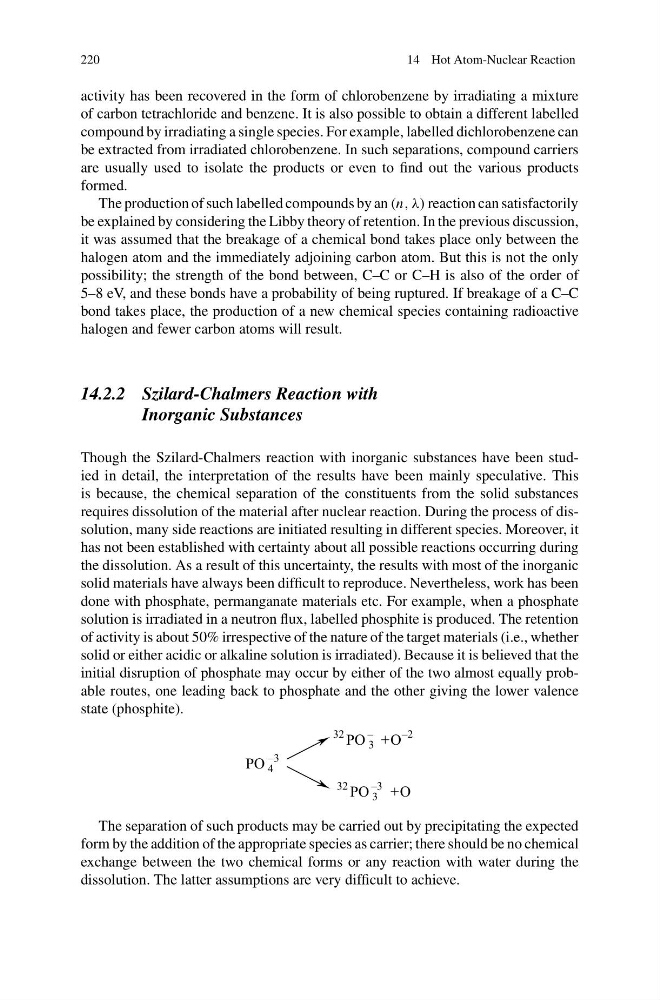
initial disruption of phosphate may occur by either of the two almost equally probable routes, one leading back to phosphate and the other giving the lower valence
state (phosphite).
PO 4
–3
32
–
PO
O
3 +
–2
32
–3
PO
O
3 +
The separation of such products may be carried out by precipitating the expected
form by the addition of the appropriate species as carrier; there should be no chemical
exchange between the two chemical forms or any reaction with water during the
dissolution. The latter assumptions are very difficult to achieve.
14 Hot Atom-Nuclear Reaction
activity has been recovered in the form of chlorobenzene by irradiating a mixture
of carbon tetrachloride and benzene. It is also possible to obtain a different labelled
compound by irradiating a single species. For example, labelled dichlorobenzene can
be extracted from irradiated chlorobenzene. In such separations, compound carriers
are usually used to isolate the products or even to find out the various products
formed.
The production of such labelled compounds by an (n, λ) reaction can satisfactorily
be explained by considering the Libby theory of retention. In the previous discussion,
it was assumed that the breakage of a chemical bond takes place only between the
halogen atom and the immediately adjoining carbon atom. But this is not the only
possibility; the strength of the bond between, C–C or C–H is also of the order of
5–8 eV, and these bonds have a probability of being ruptured. If breakage of a C–C
bond takes place, the production of a new chemical species containing radioactive
halogen and fewer carbon atoms will result.
14.2.2 Szilard-Chalmers Reaction with
Inorganic Substances
Though the Szilard-Chalmers reaction with inorganic substances have been studied in detail, the interpretation of the results have been mainly speculative. This
is because, the chemical separation of the constituents from the solid substances
requires dissolution of the material after nuclear reaction. During the process of dissolution, many side reactions are initiated resulting in different species. Moreover, it
has not been established with certainty about all possible reactions occurring during
the dissolution. As a result of this uncertainty, the results with most of the inorganic
solid materials have always been difficult to reproduce. Nevertheless, work has been
done with phosphate, permanganate materials etc. For example, when a phosphate
solution is irradiated in a neutron flux, labelled phosphite is produced. The retention
of activity is about 50% irrespective of the nature of the target materials (i.e., whether
solid or either acidic or alkaline solution is irradiated). Because it is believed that the
initial disruption of phosphate may occur by either of the two almost equally probable routes, one leading back to phosphate and the other giving the lower valence
state (phosphite).
PO 4
–3
32
–
PO
O
3 +
–2
32
–3
PO
O
3 +
The separation of such products may be carried out by precipitating the expected
form by the addition of the appropriate species as carrier; there should be no chemical
exchange between the two chemical forms or any reaction with water during the
dissolution. The latter assumptions are very difficult to achieve.