

154
9 Factors Affecting the Counting Efficiency
be used for counting energetic γ -rays. Therefore, if we have to measure the activity
of Cobalt-60 isotope, we should prefer to count its γ -rays rather than β-particles.
Its decay scheme also reveals that although Cobalt-60 decays by strong β-particles
(1.48 MeV), its abundance is only 0.1%. This indicates that out of 100 atoms of
Cobalt-60, only 1 atom is likely to decay giving β-particle of 1.48 MeV. In other
words, most atoms of Cobalt-60 will prefer to decay by β-particles of energy 0.31
MeV followed by the decay of γ -rays of energy 1.17 MeV. Decay scheme also indicates that this isotope decays by β-particles (0.31 MeV) and γ -rays (1.17 MeV) with
a similar percentage. Since it is easier to count γ -rays, this isotope can be counted
either in liquid or solid form by a G.M. counter. Thus, we see that a knowledge of the
decay scheme helps in selecting a counter for counting its activity. It can also help in
deciding the form in which the isotope should be counted in order to get maximum
counting efficiency. It can also give information regarding possible interference of
radiations, emitted by the radioactive materials on the actual count rate. To clarify
these points further, few decay schemes are discussed here.
9.3.1 Tritium
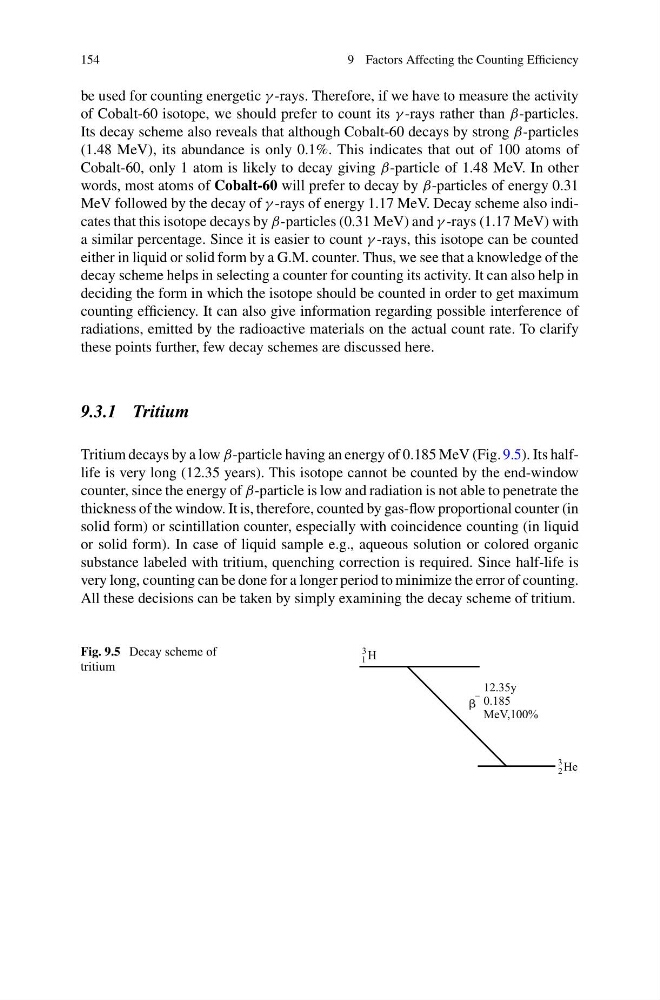
Tritium decays by a low β-particle having an energy of 0.185 MeV (Fig. 9.5). Its halflife is very long (12.35 years). This isotope cannot be counted by the end-window
counter, since the energy of β-particle is low and radiation is not able to penetrate the
thickness of the window. It is, therefore, counted by gas-flow proportional counter (in
solid form) or scintillation counter, especially with coincidence counting (in liquid
or solid form). In case of liquid sample e.g., aqueous solution or colored organic
substance labeled with tritium, quenching correction is required. Since half-life is
very long, counting can be done for a longer period to minimize the error of counting.
All these decisions can be taken by simply examining the decay scheme of tritium.
Fig. 9.5 Decay scheme of
tritium
9 Factors Affecting the Counting Efficiency
be used for counting energetic γ -rays. Therefore, if we have to measure the activity
of Cobalt-60 isotope, we should prefer to count its γ -rays rather than β-particles.
Its decay scheme also reveals that although Cobalt-60 decays by strong β-particles
(1.48 MeV), its abundance is only 0.1%. This indicates that out of 100 atoms of
Cobalt-60, only 1 atom is likely to decay giving β-particle of 1.48 MeV. In other
words, most atoms of Cobalt-60 will prefer to decay by β-particles of energy 0.31
MeV followed by the decay of γ -rays of energy 1.17 MeV. Decay scheme also indicates that this isotope decays by β-particles (0.31 MeV) and γ -rays (1.17 MeV) with
a similar percentage. Since it is easier to count γ -rays, this isotope can be counted
either in liquid or solid form by a G.M. counter. Thus, we see that a knowledge of the
decay scheme helps in selecting a counter for counting its activity. It can also help in
deciding the form in which the isotope should be counted in order to get maximum
counting efficiency. It can also give information regarding possible interference of
radiations, emitted by the radioactive materials on the actual count rate. To clarify
these points further, few decay schemes are discussed here.
9.3.1 Tritium
Tritium decays by a low β-particle having an energy of 0.185 MeV (Fig. 9.5). Its halflife is very long (12.35 years). This isotope cannot be counted by the end-window
counter, since the energy of β-particle is low and radiation is not able to penetrate the
thickness of the window. It is, therefore, counted by gas-flow proportional counter (in
solid form) or scintillation counter, especially with coincidence counting (in liquid
or solid form). In case of liquid sample e.g., aqueous solution or colored organic
substance labeled with tritium, quenching correction is required. Since half-life is
very long, counting can be done for a longer period to minimize the error of counting.
All these decisions can be taken by simply examining the decay scheme of tritium.
Fig. 9.5 Decay scheme of
tritium