

9.2 Geometrical Efficiency
153
Nevertheless, these effects are not important in case of gas-flow proportional counter
as it does not have a window nor air gap between source and counter.
9.2.4 Background Activity
Results of source counting are always associated with the natural background. Background count is subtracted from observed count rate, to obtain the count rate due to
the source only. In G.M. counter, the background count rate is usually a constant value
and is not very high (between 10–20 cpm), whereas, with a scintillation counter, the
background count rate depends much on the operating conditions and is usually high
(with exception of α-counting). In the proportional counter, background count also
depends on the type of particulate radiation being counted. For example, background
with α-particle counting is low, as the discriminator may be set to reject pulses produced by cosmic radiation and not the large α-pulses. However, when β-radiation is
counted, usually the background count is high.
9.3 Decay Scheme
In measuring the activity of a radioactive isotope, information regarding the nature of
radiation and its energy is very useful in selecting a counter. In addition, if we examine
various radioactive isotopes, it will be observed that almost all of them emit more
than one type of radiation with a different mode of emission. Information regarding
the type of radiation being emitted, its percentage abundance, energy of radiation
emitted, half-life etc., are shown in a decay scheme of each isotope (Figs. 9.4–9.8).
The percentage of decay mode by a particular path is helpful in selecting a counter
and the nature of source (i.e., whether in liquid or solid form) for counting an isotope.
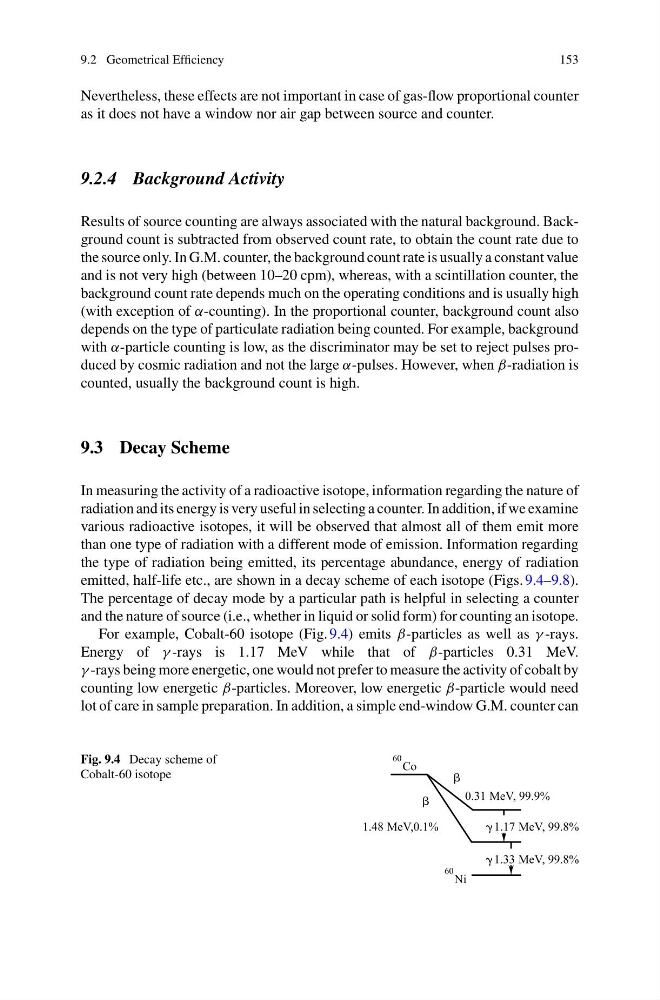
For example, Cobalt-60 isotope (Fig. 9.4) emits β-particles as well as γ -rays.
Energy of γ -rays is 1.17 MeV while that of β-particles 0.31 MeV.
γ -rays being more energetic, one would not prefer to measure the activity of cobalt by
counting low energetic β-particles. Moreover, low energetic β-particle would need
lot of care in sample preparation. In addition, a simple end-window G.M. counter can
Fig. 9.4 Decay scheme of
Cobalt-60 isotope
153
Nevertheless, these effects are not important in case of gas-flow proportional counter
as it does not have a window nor air gap between source and counter.
9.2.4 Background Activity
Results of source counting are always associated with the natural background. Background count is subtracted from observed count rate, to obtain the count rate due to
the source only. In G.M. counter, the background count rate is usually a constant value
and is not very high (between 10–20 cpm), whereas, with a scintillation counter, the
background count rate depends much on the operating conditions and is usually high
(with exception of α-counting). In the proportional counter, background count also
depends on the type of particulate radiation being counted. For example, background
with α-particle counting is low, as the discriminator may be set to reject pulses produced by cosmic radiation and not the large α-pulses. However, when β-radiation is
counted, usually the background count is high.
9.3 Decay Scheme
In measuring the activity of a radioactive isotope, information regarding the nature of
radiation and its energy is very useful in selecting a counter. In addition, if we examine
various radioactive isotopes, it will be observed that almost all of them emit more
than one type of radiation with a different mode of emission. Information regarding
the type of radiation being emitted, its percentage abundance, energy of radiation
emitted, half-life etc., are shown in a decay scheme of each isotope (Figs. 9.4–9.8).
The percentage of decay mode by a particular path is helpful in selecting a counter
and the nature of source (i.e., whether in liquid or solid form) for counting an isotope.
For example, Cobalt-60 isotope (Fig. 9.4) emits β-particles as well as γ -rays.
Energy of γ -rays is 1.17 MeV while that of β-particles 0.31 MeV.
γ -rays being more energetic, one would not prefer to measure the activity of cobalt by
counting low energetic β-particles. Moreover, low energetic β-particle would need
lot of care in sample preparation. In addition, a simple end-window G.M. counter can
Fig. 9.4 Decay scheme of
Cobalt-60 isotope