

152
9 Factors Affecting the Counting Efficiency
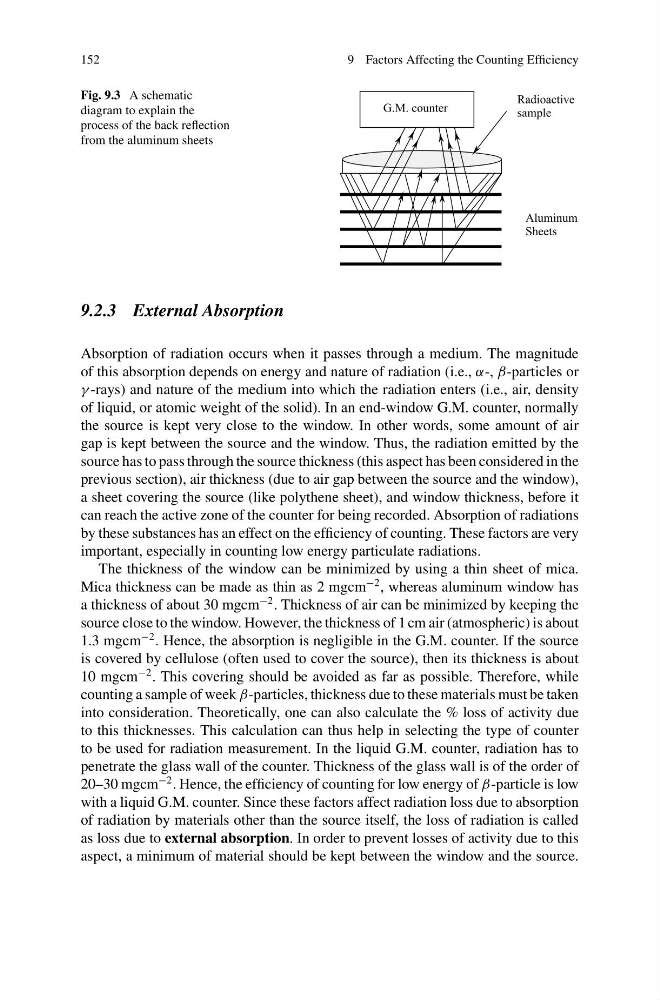
Fig. 9.3 A schematic
diagram to explain the
process of the back reflection
from the aluminum sheets
9.2.3 External Absorption
Absorption of radiation occurs when it passes through a medium. The magnitude
of this absorption depends on energy and nature of radiation (i.e., α-, β-particles or
γ -rays) and nature of the medium into which the radiation enters (i.e., air, density
of liquid, or atomic weight of the solid). In an end-window G.M. counter, normally
the source is kept very close to the window. In other words, some amount of air
gap is kept between the source and the window. Thus, the radiation emitted by the
source has to pass through the source thickness (this aspect has been considered in the
previous section), air thickness (due to air gap between the source and the window),
a sheet covering the source (like polythene sheet), and window thickness, before it
can reach the active zone of the counter for being recorded. Absorption of radiations
by these substances has an effect on the efficiency of counting. These factors are very
important, especially in counting low energy particulate radiations.
The thickness of the window can be minimized by using a thin sheet of mica.
Mica thickness can be made as thin as 2 mgcm
−2 , whereas aluminum window has
a thickness of about 30 mgcm
−2 . Thickness of air can be minimized by keeping the
source close to the window. However, the thickness of 1 cm air (atmospheric) is about
1.3 mgcm
−2 . Hence, the absorption is negligible in the G.M. counter. If the source
is covered by cellulose (often used to cover the source), then its thickness is about
10 mgcm
−2 . This covering should be avoided as far as possible. Therefore, while
counting a sample of week β-particles, thickness due to these materials must be taken
into consideration. Theoretically, one can also calculate the % loss of activity due
to this thicknesses. This calculation can thus help in selecting the type of counter
to be used for radiation measurement. In the liquid G.M. counter, radiation has to
penetrate the glass wall of the counter. Thickness of the glass wall is of the order of
20–30 mgcm
−2 . Hence, the efficiency of counting for low energy of β-particle is low
with a liquid G.M. counter. Since these factors affect radiation loss due to absorption
of radiation by materials other than the source itself, the loss of radiation is called
as loss due to external absorption. In order to prevent losses of activity due to this
aspect, a minimum of material should be kept between the window and the source.
9 Factors Affecting the Counting Efficiency
Fig. 9.3 A schematic
diagram to explain the
process of the back reflection
from the aluminum sheets
9.2.3 External Absorption
Absorption of radiation occurs when it passes through a medium. The magnitude
of this absorption depends on energy and nature of radiation (i.e., α-, β-particles or
γ -rays) and nature of the medium into which the radiation enters (i.e., air, density
of liquid, or atomic weight of the solid). In an end-window G.M. counter, normally
the source is kept very close to the window. In other words, some amount of air
gap is kept between the source and the window. Thus, the radiation emitted by the
source has to pass through the source thickness (this aspect has been considered in the
previous section), air thickness (due to air gap between the source and the window),
a sheet covering the source (like polythene sheet), and window thickness, before it
can reach the active zone of the counter for being recorded. Absorption of radiations
by these substances has an effect on the efficiency of counting. These factors are very
important, especially in counting low energy particulate radiations.
The thickness of the window can be minimized by using a thin sheet of mica.
Mica thickness can be made as thin as 2 mgcm
−2 , whereas aluminum window has
a thickness of about 30 mgcm
−2 . Thickness of air can be minimized by keeping the
source close to the window. However, the thickness of 1 cm air (atmospheric) is about
1.3 mgcm
−2 . Hence, the absorption is negligible in the G.M. counter. If the source
is covered by cellulose (often used to cover the source), then its thickness is about
10 mgcm
−2 . This covering should be avoided as far as possible. Therefore, while
counting a sample of week β-particles, thickness due to these materials must be taken
into consideration. Theoretically, one can also calculate the % loss of activity due
to this thicknesses. This calculation can thus help in selecting the type of counter
to be used for radiation measurement. In the liquid G.M. counter, radiation has to
penetrate the glass wall of the counter. Thickness of the glass wall is of the order of
20–30 mgcm
−2 . Hence, the efficiency of counting for low energy of β-particle is low
with a liquid G.M. counter. Since these factors affect radiation loss due to absorption
of radiation by materials other than the source itself, the loss of radiation is called
as loss due to external absorption. In order to prevent losses of activity due to this
aspect, a minimum of material should be kept between the window and the source.