

9.3 Decay Scheme
155
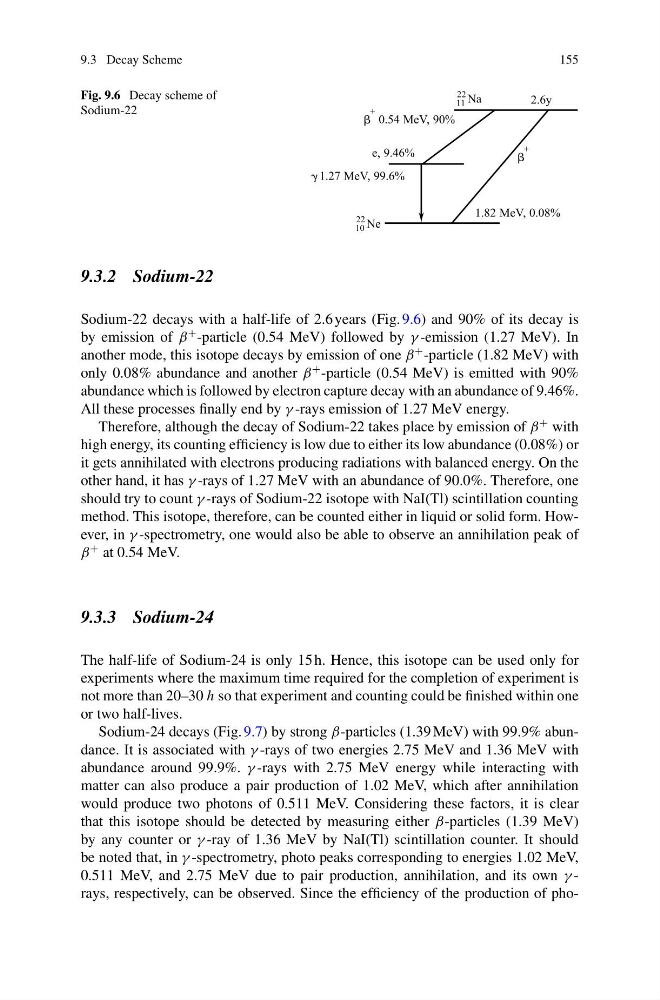
Fig. 9.6 Decay scheme of
Sodium-22
9.3.2 Sodium-22
Sodium-22 decays with a half-life of 2.6 years (Fig. 9.6) and 90% of its decay is
by emission of β
+ -particle (0.54 MeV) followed by γ -emission (1.27 MeV). In
another mode, this isotope decays by emission of one β
+ -particle (1.82 MeV) with
only 0.08% abundance and another β
+ -particle (0.54 MeV) is emitted with 90%
abundance which is followed by electron capture decay with an abundance of 9.46%.
All these processes finally end by γ -rays emission of 1.27 MeV energy.
Therefore, although the decay of Sodium-22 takes place by emission of β
+ with
high energy, its counting efficiency is low due to either its low abundance (0.08%) or
it gets annihilated with electrons producing radiations with balanced energy. On the
other hand, it has γ -rays of 1.27 MeV with an abundance of 90.0%. Therefore, one
should try to count γ -rays of Sodium-22 isotope with NaI(Tl) scintillation counting
method. This isotope, therefore, can be counted either in liquid or solid form. However, in γ -spectrometry, one would also be able to observe an annihilation peak of
β
+ at 0.54 MeV.
9.3.3 Sodium-24
The half-life of Sodium-24 is only 15 h. Hence, this isotope can be used only for
experiments where the maximum time required for the completion of experiment is
not more than 20–30 h so that experiment and counting could be finished within one
or two half-lives.
Sodium-24 decays (Fig. 9.7) by strong β-particles (1.39 MeV) with 99.9% abundance. It is associated with γ -rays of two energies 2.75 MeV and 1.36 MeV with
abundance around 99.9%. γ -rays with 2.75 MeV energy while interacting with
matter can also produce a pair production of 1.02 MeV, which after annihilation
would produce two photons of 0.511 MeV. Considering these factors, it is clear
that this isotope should be detected by measuring either β-particles (1.39 MeV)
by any counter or γ -ray of 1.36 MeV by NaI(Tl) scintillation counter. It should
be noted that, in γ -spectrometry, photo peaks corresponding to energies 1.02 MeV,
0.511 MeV, and 2.75 MeV due to pair production, annihilation, and its own γ -
rays, respectively, can be observed. Since the efficiency of the production of pho-
155
Fig. 9.6 Decay scheme of
Sodium-22
9.3.2 Sodium-22
Sodium-22 decays with a half-life of 2.6 years (Fig. 9.6) and 90% of its decay is
by emission of β
+ -particle (0.54 MeV) followed by γ -emission (1.27 MeV). In
another mode, this isotope decays by emission of one β
+ -particle (1.82 MeV) with
only 0.08% abundance and another β
+ -particle (0.54 MeV) is emitted with 90%
abundance which is followed by electron capture decay with an abundance of 9.46%.
All these processes finally end by γ -rays emission of 1.27 MeV energy.
Therefore, although the decay of Sodium-22 takes place by emission of β
+ with
high energy, its counting efficiency is low due to either its low abundance (0.08%) or
it gets annihilated with electrons producing radiations with balanced energy. On the
other hand, it has γ -rays of 1.27 MeV with an abundance of 90.0%. Therefore, one
should try to count γ -rays of Sodium-22 isotope with NaI(Tl) scintillation counting
method. This isotope, therefore, can be counted either in liquid or solid form. However, in γ -spectrometry, one would also be able to observe an annihilation peak of
β
+ at 0.54 MeV.
9.3.3 Sodium-24
The half-life of Sodium-24 is only 15 h. Hence, this isotope can be used only for
experiments where the maximum time required for the completion of experiment is
not more than 20–30 h so that experiment and counting could be finished within one
or two half-lives.
Sodium-24 decays (Fig. 9.7) by strong β-particles (1.39 MeV) with 99.9% abundance. It is associated with γ -rays of two energies 2.75 MeV and 1.36 MeV with
abundance around 99.9%. γ -rays with 2.75 MeV energy while interacting with
matter can also produce a pair production of 1.02 MeV, which after annihilation
would produce two photons of 0.511 MeV. Considering these factors, it is clear
that this isotope should be detected by measuring either β-particles (1.39 MeV)
by any counter or γ -ray of 1.36 MeV by NaI(Tl) scintillation counter. It should
be noted that, in γ -spectrometry, photo peaks corresponding to energies 1.02 MeV,
0.511 MeV, and 2.75 MeV due to pair production, annihilation, and its own γ -
rays, respectively, can be observed. Since the efficiency of the production of pho-