

144
6 Micromechanical Models of PVA-Based Bionanocomposite Films
the radius of particle cavities r at an arbitrary point. Accordingly, e v (r ) can be given
by
e v (r ) = (1 − η)exp
−πρ
er + dr
3
+ gr
3
(6.15)
e =
4R
2
1 − η
(6.16)
d =
4R
1 − η
+
8πρR
2
2
(1 − η)
2
(6.17)
g =
4
3(1 − η)
+
16πρRR
2
3(1 − η)
2
+
64mπ
2
ρ
2
R
2
3
27(1 − η)
3
(6.18)
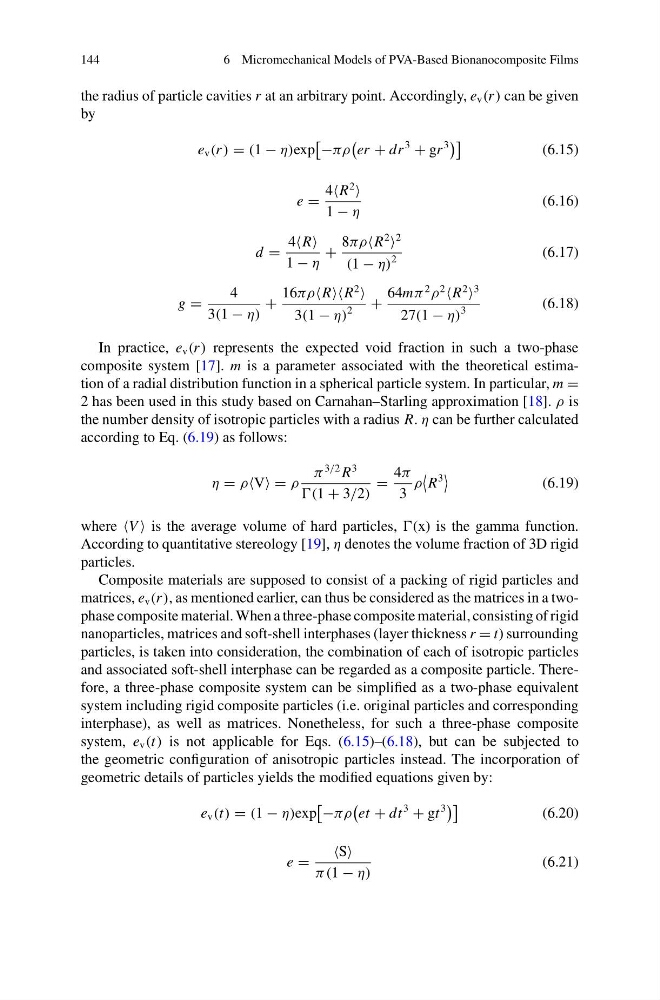
In practice, e v (r ) represents the expected void fraction in such a two-phase
composite system [17]. m is a parameter associated with the theoretical estimation of a radial distribution function in a spherical particle system. In particular, m =
2 has been used in this study based on Carnahan–Starling approximation [18]. ρ is
the number density of isotropic particles with a radius R. η can be further calculated
according to Eq. (6.19) as follows:
η = ρV = ρ
π
3/2 R
3
(1 + 3/2)
=
4π
3
ρ
R
3
(6.19)
where V is the average volume of hard particles, (x) is the gamma function.
According to quantitative stereology [19], η denotes the volume fraction of 3D rigid
particles.
Composite materials are supposed to consist of a packing of rigid particles and
matrices, e v (r ), as mentioned earlier, can thus be considered as the matrices in a twophase composite material. When a three-phase composite material, consisting of rigid
nanoparticles, matrices and soft-shell interphases (layer thickness r = t) surrounding
particles, is taken into consideration, the combination of each of isotropic particles
and associated soft-shell interphase can be regarded as a composite particle. Therefore, a three-phase composite system can be simplified as a two-phase equivalent
system including rigid composite particles (i.e. original particles and corresponding
interphase), as well as matrices. Nonetheless, for such a three-phase composite
system, e v (t) is not applicable for Eqs. (6.15)–(6.18), but can be subjected to
the geometric configuration of anisotropic particles instead. The incorporation of
geometric details of particles yields the modified equations given by:
e v (t) = (1 − η)exp
−πρ
et + dt
3
+ gt
3
(6.20)
e =
S
π (1 − η)
(6.21)
6 Micromechanical Models of PVA-Based Bionanocomposite Films
the radius of particle cavities r at an arbitrary point. Accordingly, e v (r ) can be given
by
e v (r ) = (1 − η)exp
−πρ
er + dr
3
+ gr
3
(6.15)
e =
4R
2
1 − η
(6.16)
d =
4R
1 − η
+
8πρR
2
2
(1 − η)
2
(6.17)
g =
4
3(1 − η)
+
16πρRR
2
3(1 − η)
2
+
64mπ
2
ρ
2
R
2
3
27(1 − η)
3
(6.18)
In practice, e v (r ) represents the expected void fraction in such a two-phase
composite system [17]. m is a parameter associated with the theoretical estimation of a radial distribution function in a spherical particle system. In particular, m =
2 has been used in this study based on Carnahan–Starling approximation [18]. ρ is
the number density of isotropic particles with a radius R. η can be further calculated
according to Eq. (6.19) as follows:
η = ρV = ρ
π
3/2 R
3
(1 + 3/2)
=
4π
3
ρ
R
3
(6.19)
where V is the average volume of hard particles, (x) is the gamma function.
According to quantitative stereology [19], η denotes the volume fraction of 3D rigid
particles.
Composite materials are supposed to consist of a packing of rigid particles and
matrices, e v (r ), as mentioned earlier, can thus be considered as the matrices in a twophase composite material. When a three-phase composite material, consisting of rigid
nanoparticles, matrices and soft-shell interphases (layer thickness r = t) surrounding
particles, is taken into consideration, the combination of each of isotropic particles
and associated soft-shell interphase can be regarded as a composite particle. Therefore, a three-phase composite system can be simplified as a two-phase equivalent
system including rigid composite particles (i.e. original particles and corresponding
interphase), as well as matrices. Nonetheless, for such a three-phase composite
system, e v (t) is not applicable for Eqs. (6.15)–(6.18), but can be subjected to
the geometric configuration of anisotropic particles instead. The incorporation of
geometric details of particles yields the modified equations given by:
e v (t) = (1 − η)exp
−πρ
et + dt
3
+ gt
3
(6.20)
e =
S
π (1 − η)
(6.21)